 |
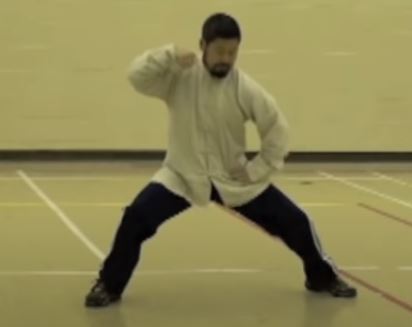
There is a long-standing wisdom that “To give a man a fish is not as good as teaching a man to fish” (授人以魚,不如授人以漁; Shòu rén yǐ yú, bùrú shòu rén yǐ yú). In the internal martial arts, we follow this same logic: “To teach a man to punch is not as good as teaching a man the Principles” (授人以拳,不如授人以理。; Shòu rén yǐ quán, bùrú shòu rén yǐ lǐ). This dual focus on theory and application reveals that Master Chen Zhonghua’s theory of Indirect Power is not merely a collection of techniques, but a sophisticated mechanical system of action transmitted through a specialized structure. At the heart of this principle is the Anchor—a stable, consistent point of contact that functions as either a handle for pushing or a hook for pulling. |
| Unlike instinctive direct power, which reacts to an opponent’s force by tensing at the point of contact, Indirect Power requires the practitioner to keep the contact point stationary and “tight,” similar to a secure screw in a well-engineered machine.By maintaining this structural integrity, the practitioner can bypass resistance and generate power from distant sources creating an Indirect Energy Path that processes external force through the body as a singular, integrated unit. The depth of a practitioner’s skill is measured by their ability to coordinate the body’s nine major levels, where the first level is the direct contact point and the remaining eight represent escalating classes of indirect power. This hierarchy allows for the sequential neutralization of force; if an opponent pulls, the practitioner does not resist at the hand but instead moves the waist or elbow to follow and redirect that energy. Master Chen emphasizes that this discipline requires overcoming biological programming to move past direct conflict. Ultimately, by utilizing the body’s internal geometry and maintaining a secure frame, the Taiji practitioner ensures that every contact point becomes a pivot for control, effectively dampening shocks and redirecting momentum without relying on brute strength. | |
| (This is is an articles is based on the Theory and demonstration of “Indirect Power” filmed in Ottawa, Canada Dec 3, 2014.) |
|
 |
Part 1. Don’t Eat with Your Hands
Part 3. Learning How to Fish
Part 4. Yang Actions
Part 5. Yin Actions
Part 7. Not using force is a magic trick
|
Part 3. Learning How to Fish
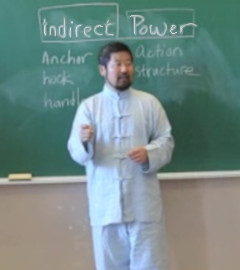
The Principle of Indirect Power in Taiji
|
“When we discuss power, this is the number one, and truly the only principle, for all Taiji movements. We’ll use the term ‘power,’ but we can also roughly equate this to action, because actions are what create power.”
“The key rule is that power must be indirect. You could also say that your structure must always be indirect. This concept of indirectness is critically important, and we’ll dive into it today.”
“So, what exactly is indirect power? To put it simply, it means it’s not direct.”
|
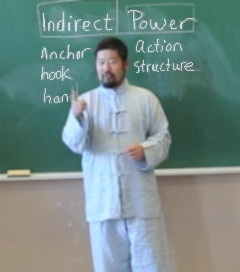 |
The Fishing Analogy: Understanding Indirect Power
 |
Master Chen conveys the concept of an “anchor” through a fishing analogy, explaining: “Think about when we go fishing. There is a hook that latches onto the fish’s mouth; that hook is our anchor. Once that connection happens, you pull. Whether you are pulling the line in by hand or with a reel, you do not reach out and grab the fish’s mouth directly. Grabbing the fish or the hook with your hand would be an example of Direct Power. Instead, you use the line and reel. This separation—this method of pulling from a distance—is what we call indirect power. In Taiji movements, this concept is absolutely essential.” |
The Two Fundamental Actions (Push and Pull)
Within this framework, all physical movement is distilled into two fundamental actions: the Push and the Push. The Push embodies Yang energy—an expansive, outward force directed away from the center. Conversely, the Pull represents Yin energy—a receptive, inward force that draws objects toward the center.
In Taijiquan, these forces exist in a constant state of reciprocity: if an opponent pushes, you neutralize it with a pull; if they pull, you respond with a push. This interplay is the essence of ‘Yin-Yang separation‘—a principle where the mutual interaction of these forces ensures that power is transmitted continuously rather than being blocked.
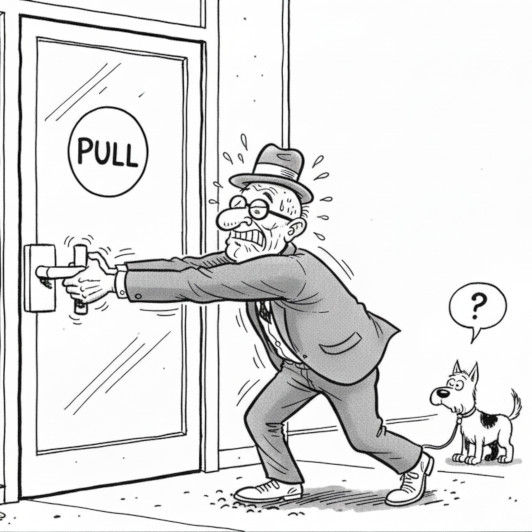 |
To facilitate this transmission, there must be a point where these opposing energies meet and stabilize, known as the Anchor. This point of contact serves as the essential bridge between your intent and the object you are manipulating.Consider the physical analogy of a person interacting with a heavy door. If one pushes with all their weight against a door designed to be pulled, they create a state of static resistance. No work is accomplished; the individual is simply colliding with an immovable object. The same imbalance occurs in reverse: pulling against a door designed to be pushed results in a similar deadlock. | 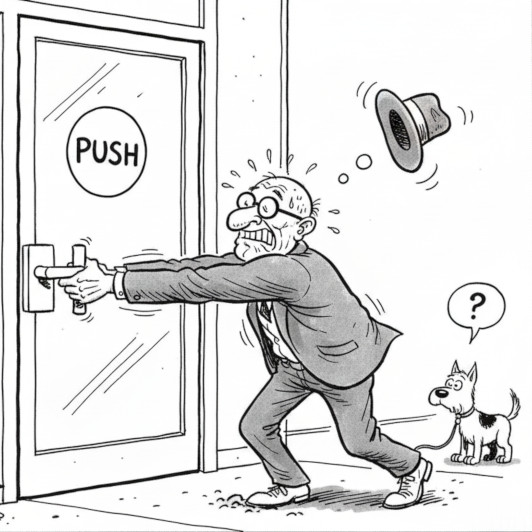 |
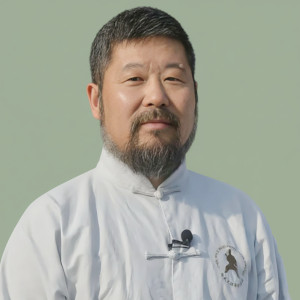
In this interaction, the door handle acts as the physical Anchor. This anchor is further differentiated by its function: it acts as a handle when receiving a push and as a hook when facilitating a pull. By maintaining this precise point of contact and balancing the internal pull against the external push, the practitioner ensures that power is never wasted in a collision. Instead, it is transmitted through a stable, controlled pivot.” As Master Chen explains:
|
 |
Use a Handle to Push
Master Chen illustrates this distinction through a simple demonstration of stopping an opponent’s momentum. He continued. “Let me demonstrate this difference between grabbing and pushing.”
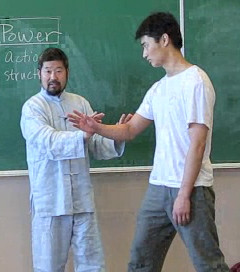 |
As a student raises his right forearm toward Master Chen’s chest, the Master stops the forward progress of that arm with both hands. “This push—the way it is done in Taiji—means when your opponent is right here, moving toward you, you only stop their progress with an equal, opposing force,” Master Chen explains. “The result is simply making contact.” This specific positioning, as shown in Figure 1, creates the stability required for the Anchor to function.Master Chen continues, “Because when their power is here [on the forearm], my power is also here [matching it on the forearm]. This contact area immediately becomes a handle. This is crucial: I am not pushing him in the conventional sense.” |
“I am using this stable, matched contact to create a handle on him. If I use too much power, change the direction of the push, or fluctuate the power, there is no handle. Therefore, I touch his forearm not for pushing it away, but for getting hold of him. That’s why I don’t use any more power than necessary. I only do just enough to create that stable handle right here.”
Use a Hook to Pull
| Master Chen clarifies that the Taiji “Pull” is just as specialized as the Push. “The Taiji technique of Pull is also different from the normal understanding of pulling,” he explains. “When I initially touch his forearm, I can stop his forward progress, but I generally cannot pull him because I am on the outside.” This initial contact, where the hands act as a stabilizing push, is shown in Figure 2-1.In Figure 2-2, the red arrows illustrate a common mechanical failure: because the hands remain on the surface without a specialized connection, they are prone to slipping, making a pull impossible from this position. |
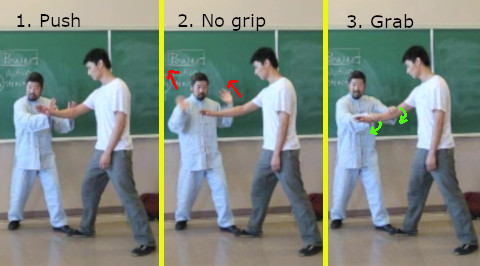 |
To draw the opponent inward, the practitioner must transition from a “handle” to a “grab.” Master Chen notes, “To bring him in towards me, I need to switch to the technique of a ‘grab.’ When I grab, it means my power is on his inside, allowing me to pull him toward me effectively. My fingers become the hook that pulls my opponent toward me.”
This functional shift is illustrated in Figure 2-3. The green arrow highlights how the fingers wrap to the opposite side of the initial push. By moving to the “inside” of the limb, the fingers transform the Anchor into a Hook, facilitating a controlled pull and ensuring that the opponent’s momentum is captured rather than lost.
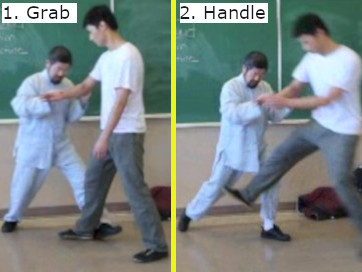 |
“In Taiji practice, I’m not just pushing; I’m holding onto him at the contact point so the forward action is still generated by his own body. Similarly, I am not simply pulling him, but I have created a hook that I can use to pull him.” These actions are visualized in Figure 3-1 as a grab which pulls the opponent and in Figure 3-2 as a handle which pushes the opponent away.Master Chen concludes: “Therefore, these two things—to push and to grab, to push and to pull—are not actions in the common sense. They are ways of touching and connecting with your opponent.” |
“Because of that, you can create indirect power, making every contact point an opportunity to control and redirect energy without relying on direct force.”
Creating a Secure Grip
Master Chen began, “That’s why in yesterday’s training session, when we practiced securing your partner, I initially used this type of hold.”
| To demonstrate, he reached out and gripped the student’s right hand with his own right hand in a position similar to a handshake (Figure 4-1). He immediately pointed out the inherent weakness of this position. “Using this single-hand grip, if I need to pull strongly, my hand can easily slip, and the grip breaks.” As he spoke, he demonstrated how the hand can slide off the grip, a vulnerability illustrated by the wavy red lines in Figure 4-2. |
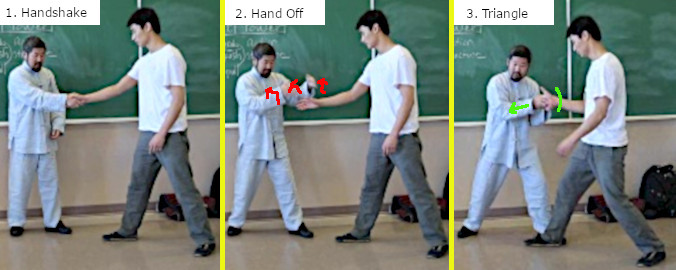 |
Seeking to show the solution, Master Chen then demonstrated an improved, secure grip. Starting again with the initial handshake, he brought his free left hand over to secure the student’s right wrist. He carefully circled the base of the student’s wrist with his left thumb and two fingers.
“Now I add my second hand here,” he explained, “gripping the base of his wrist. These two grips form a secure, triangular anchor on my opponent’s wrist.”
This triangulated two-handed grip—depicted in Figure 4-3 by a solid green line across the wrist and a green arrow showing the pull direction—changed the physics of the encounter. “With this two-handed grip, I can pull on his hand to control him,” Chen continued. “Even if he releases his hand, I can immediately push into his hand, and he is forced backwards. This ensures the ‘hook’ or ‘handle’ remains in place.”
Master Chen concluded, “That secure hold is crucial. Overall, this technique is about establishing a solid hold and maintaining contact.”
The Geometry of Indirect Power
“Now consider what is happening with your body in places away from the anchor or hold,” Master Chen continued. In the theory of Indirect Power, these distant points represent the power sources for the point of contact.
While basic Tai Chi theory identifies only nine levels, more advanced theories often cite 18, 36, or more. These numbers are sometimes attributed to cosmological concepts like the Five Elements or the hexagrams of the Yi Jing (易經 I Ching). However, in the Practical Method, these additional levels represent something more functional: the ability to maintain the same hold while fundamentally changing its properties.
“For example,” Master Chen explained, “when you change the grip, you can push from one side or pull from another. Each variation can be counted as a different level. Therefore, these additional levels are simply the added usages of the initial contact point.”
The Nine Joints and the Hierarchy of “Directness“
“When you set aside these variations and look at the body from a single perspective, there are only nine levels, corresponding to the nine major joints of the body. In this system, the levels are defined by their relationship to the point of contact:
|
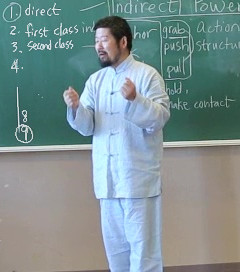 |
As Master Chen noted, the numbering of the level is always one higher than the Class of Indirect Power. “You lose one because the first level is defined as being direct,” he explained. This structure allows a practitioner to track power as it moves from the point of contact (Direct) all the way through the body’s furthest anchors (Indirect).
The Discipline of “Duo” (多)
Master Chen then reminded the students to apply the first stage of Master Hong’s Learning System of Duo (多). Since Indirect Power is a new concept, the student’s sole job is to listen and refrain from outside analysis.
“And so far, just remember some of these things,” Chen suggested. “Do not debate, do not argue. Do not think you know something. When you learn this, you must assume every single human being only does this [use direct power].”
He emphasized that this total focus is necessary to overcome our biological programming. “If you don’t believe in that initial premise, you don’t need to learn anymore. But the reality is, nobody knows Taiji. Why? Because everybody’s instinctive actions are always direct actions.”
Demonstration of Indirect Power
Master Chen demonstrates the fundamental difference between standard conflict and the principles of Taiji. To begin, he illustrates Direct Action using a typical Push Hands competition scenario.
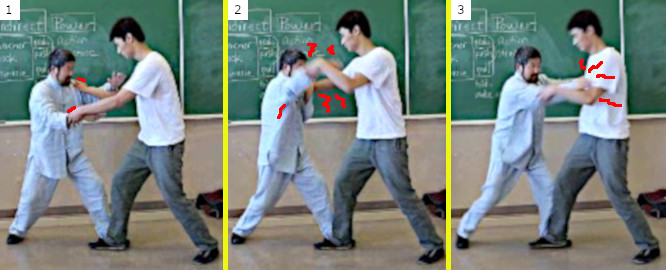 |
In this demonstration, Master Chen adopts a ready stance with his left side forward while his student stands with the right leg forward, gripping Master Chen’s left shoulder and right forearm. As shown in Figure 5-1, where a red line indicates this initial contact, Master Chen encourages the student to “fight me.” |
As the student pushes forward aggressively, Master Chen counters by using his hands to engage the student’s grip directly. Once the grip is broken, Master Chen advances to push the student backward. He describes these actions by stating that “everything is direct.” This exchange is further detailed in Figures 5-2 and 5-3, where red lines highlight arm movements that emphasize Direct Conflict—a straightforward struggle between two participants.
Shifting to Taiji: The First Level of Indirect Power
| Master Chen then contrasts these ordinary conflicts with Taiji actions. He explains that “when you don’t move anymore, first of all, you don’t move the point of contact.” In Figure 6-1, the student grabs Master Chen’s left shoulder and right bicep; this contact point is represented by a green dot. Master Chen counters by gripping the student’s left bicep but emphasizes that he does not fight against the student’s hold. “Here [his grip on my right bicep], whatever you do, you see [I do not fight against this grip]. Whatever you do, can you see here [the contact is maintained]?” |
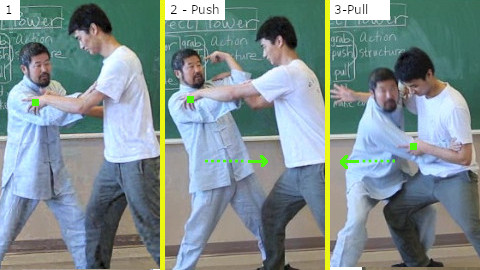 |
Even as the student attempts quick pushes and pulls, Master Chen maintains the contact point at the bicep without resistance. “Whatever he does, I’m not moving [this contact point] anymore. I stay on him. So you can push. I’m still on him.” As shown in Figure 6-2, when the student pushes forward, Master Chen bends backward at his waist to dissolve the forward power while keeping the contact point stationary. A dotted green line in the figure illustrates this waist movement. When the student switches to a quick pull, as seen in Figure 6-3, Master Chen bends forward at the waist to neutralize the tug. Master Chen notes that “whatever attack he does, I reacted with my waist [rather than at where he is grabbing me].” This use of a single joint—the waist—to handle force is what Master Chen classifies as “First Class [Indirect Power].”
Multi-Joint Coordination and the Indirect Energy Path
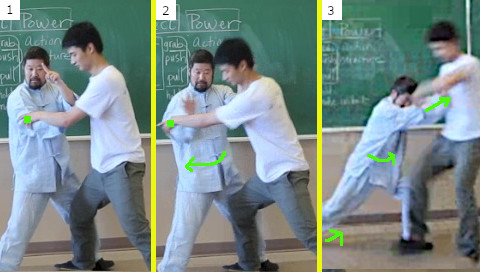 |
The demonstration moves into more complex scenarios involving multiple sources of Indirect Power. When the student rushes in to pin Master Chen’s elbows to his side (Figure 7-1), Master Chen maintains contact on the student’s forearm while rotating his waist to the right. This rotation, indicated by a green arrow in Figure 7-2, allows him to combine two sources of Indirect Power. The result, shown in Figure 7-3, is the student being launched backward. |
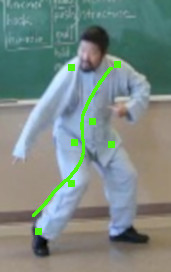
| Master Chen explains that the energy does not stop at the hands: “When I touched him, I went all the way here [the rear foot].” He traces an Indirect Energy Path that begins at the contact point and travels through the shoulders, past the waist and the kua (inguinal crease), down to the rear foot. In Figure 8, green dots highlight the joints used to create this power, while a curved green line represents the energy path itself. |
 |
Sequential Application of Indirect Power
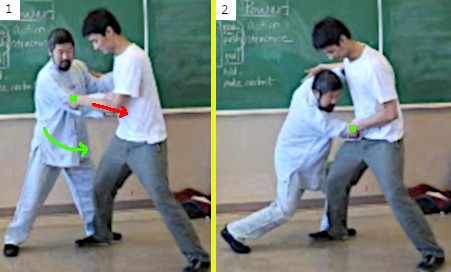 |
To further refine the concept, Master Chen instructs the student to pull his elbows (Figure 9-1). Instead of resisting, Master Chen rotates his waist to the left, which moves his right elbow forward into the student’s pull. “When he pulled, I give him my elbow,” Master Chen explains, meaning the gripped joint does not fight but follows the direction of the force (Figure 9-2). |
| If giving up the elbow is insufficient to break the student’s hold, as seen in the intermediate position of Figure 10-2, Master Chen adds another layer. “I would give him my waist. Can you feel the sequence?” By rotating his waist toward the student (indicated by the green arrow in Figure 10-2), Master Chen moves his centerline past the student’s, causing the student to stumble and lose his grip (Figure 10-3). |
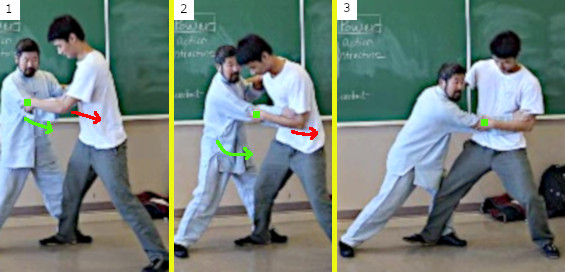 |
Master Chen concludes by explaining that the depth of one’s Taiji technique is measured by how many levels of indirectness can be coordinated. “By the time you do eight [levels of Indirect Power], it [your Taiji technique] is finished.” He notes that there is no “Level Nine” because the body only has nine primary parts or joints available for use; since the first part is always the point of Direct Power (the contact), only eight part remain to create Indirect Power. “So now do you understand the theory? It’s very simple.”
Exercise to Understand Indirect Power 1
Start with a Controlled Pull
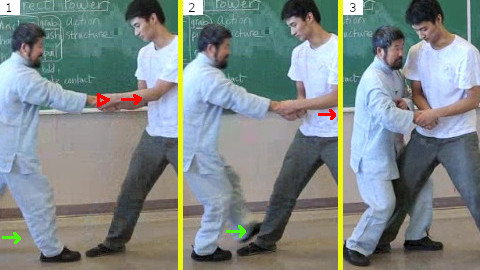 |
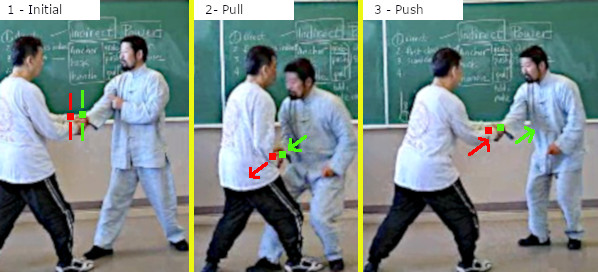
Master Chen begins by demonstrating the first exercise for developing an understanding of Indirect Power. He extends his right hand and encourages his student to engage him with both hands, telling him to “Grab. [Use a] Two hand hold. [Use the triangulated hold on my hand] Just like [the hold we practice] yesterday, okay?” As seen in Figure 11-1, the student uses his left hand to hold Master Chen’s right wrist and his right hand to hold Master Chen’s right hand, forming the triangulated hold indicated by the red triangle. |
To test the connection, Master Chen asks his student, “Now, can you feel how much power I have on you [at the point of contact]?” The student confirms a sense of constant power at the grip. Master Chen then instructs the student to “Pull me,” prompting the student to pull Master Chen’s right hand into his chest. Master Chen reacts by stepping in, as shown in Figure 11-2 and Figure 11-3, all the while maintaining constant pressure at the grip. In these figures, the red arrow shows the direction and magnitude of the student’s pull. The green arrows shows the corresponding movement of Master Chen that matches the direction and magnitude of the pull. He explains, “I match that [pull] with the rest of my body. Never change anything here [at the grip].”
Continued with a Controlled Push
| Master Chen begins by demonstrating the first exercise for developing an understanding of Indirect Power. He extends his right hand and encourages his student to engage him with both hands, telling him to “Grab. [Use a] Two hand hold. [Use the triangulated hold on my hand] Just like [the hold we practice] yesterday, okay?” As seen in Figure 11-1, the student uses his left hand to hold Master Chen’s right wrist and his right hand to hold Master Chen’s right hand, forming the triangulated hold indicated by the red triangle. |
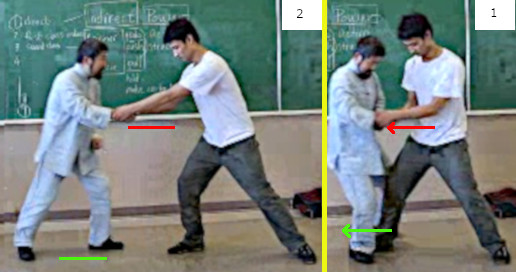 |
Figure 12-2 illustrates the final position, showing how Master Chen reacts to the push by stepping back while maintaining the identical triangulated hold. In this state, the red and green lines demonstrate that the final position is equal and opposite in magnitude and direction to the initial push, signifying a perfect match of the student’s energy.
Contrasting Direct and Indirect Power
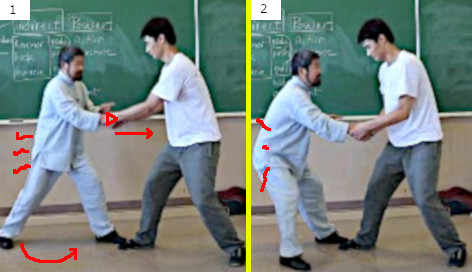 |
Master Chen contrasts his controlled movements with the typical instinctive reactions to a pull. Figure 13-1 illustrates the starting position where, as the student pulls hard as shown by a red arrow, Master Chen attempts to counter by dragging his right hand back. The curve red arrow in this figure indicates the involuntary forward movement of the rear leg in response to the student’s pull. He describes this instinctive failure by saying, “I fought back,” emphasizing that resisting at the point of contact inadvertently allows the student to pull his entire body. |
This loss of structure is further shown in Figure 13-2, where Master Chen’s right leg is pulled forward as a result of the tension.
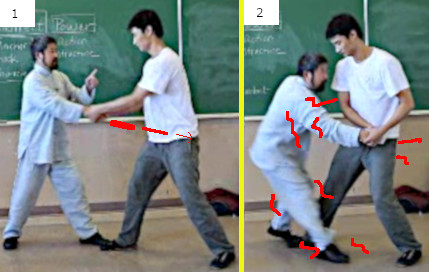
| In another example of a common reactive error, shown in Figure 14-1, the student provides a quick yank (indicated by a dashed red arrow). This sudden pull catches Master Chen off guard, forcing him to stumble forward with his right leg to prevent a fall, as seen in Figure 14-2. The red curvy lines in Figure 14-2 represent the looseness and instability caused by this reaction.Master Chen describes this failure by saying, “I let go,” explaining that these examples represent the pitfalls of engaging with direct power. |
 |
To clarify the lesson, he asks the student to describe the interaction to the class: “Tell people what I did. Because I did what I did, he felt it. You guys, from what you see, it looks like to you [as I perform those normal reactions] that I lost—but what did I do?”
The student describes his impression of the direct power contact, noting that “it [the contact point] was inconsistent there was a tightening or loosening of the grip itself and something I could change with…”
Dynamic Push-Pull Cycles
Progressing to the third stage, he instructs the student to alternate his actions between a series of pushes and pulls. Master Chen explains his internal process during this flux: “I maintain this contact never changed power level. Never change the squeeze, what ever he did, I use here, here, here [different parts of the body such as the elbow, shoulder, and waist, that is away from the grip] to compensate.”
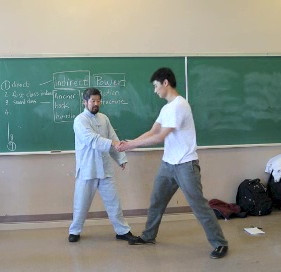 |
Master Chen contrasts the normal reaction with the Taiji action. As the student initiates the two-handed pull again, Master Chen remarks, “So when I do it right. Now go again.” The student carries out a series of pulls and pushes, shown in Figure 15, while Master Chen adjusts his position according to Taiji principles. Afterward, Master Chen asks, “All right. So what’s that?” The student, comparing this to the previous direct power actions, replies, “It’s something that’s no longer in my control. I’m not controlling the pacing anymore.” |
The Engineering of Structure
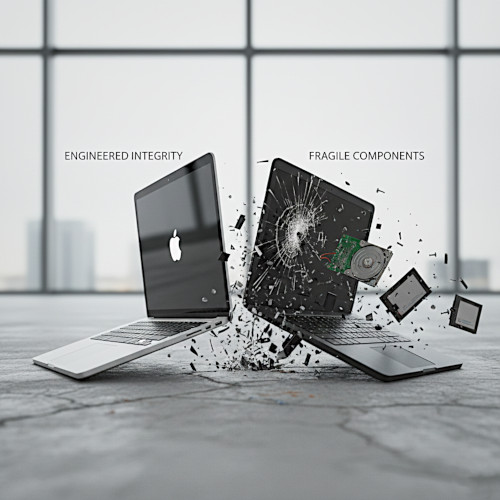 |
Master Chen explains the theory behind this exercise using a mechanical analogy. He notes that “a very very well made computer… it’s an Apple computer,” and explains that the internal screws anchoring the hard drive to the aluminum structure are so secure that “it’s so tight it never moves.” He describes the hallmark of a well-engineered computer as having exceptional internal integrity, where the tolerance is so tight that the components are absolutely immovable. |
He continues this thought by explaining that “when you drop the computer that screw does not loosen with the dropping of the computer so everything is housed together so your computer can withstand some kind of shock.” This superior design ensures that even if you drop the computer, the anchoring screw will not loosen, allowing it to withstand significant shock. Master Chen observes that “everything that is more advanced has that quality in it.”
The Car and the Frame
| Extending this to other complex systems, Master Chen relates his experience with vehicles: “so that in your car when your car goes through a bump like Rochelle’s car you withstand a little more shock… if when the car goes through a bump and the inside starts to fall apart… we would not be able to have that conversation anymore.” This principle of integrated, shock-resistant design means that everything is secured onto the frame of that car. The car has a singular move as a unit, but “it does not have individual moves inside,” which Master Chen identifies as the essence of indirect power. |
 |
He concludes by warning that a car provides security because the passenger “only feels an indirect impact by the shock absorber by the tire softness.” Without this internal security, a person would not survive the impact: “just to sit on the chair when you go over something the person will die and that’s how severe it is when you have direct power if you don’t secure yourself you will die.” This indirect power, or shock dampening, ensures that external forces are processed by the entire system rather than breaking the individual parts.
The Principle of the Secured Hold
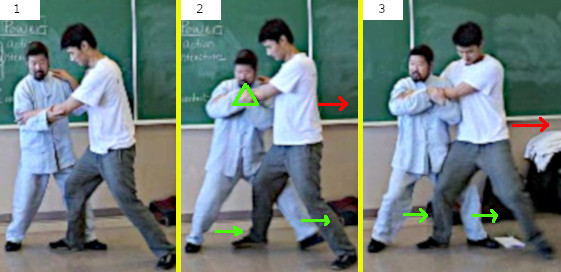 |
Master Chen demonstrates the importance of a secured hold through a Taiji application, beginning the moment a student grabs his right bicep with the left hand and holds his left shoulder with the right. Acknowledging this initial contact, Master Chen notes, “See, I touched him.” He counters by holding the student’s left elbow with his right hand, establishing the position seen in Figure 16-1. |
Master Chen then illustrates the futility of direct action. He asks, “If I do this [fight against his left hand grip on my arm] can you see in here?” as he attempts to struggle specifically at the gripped position. He explains that “[this struggle represents direct action]” and warns that “[this grip] is life and death [as explained in the car analogy].”
Shifting to the Taiji approach, he tells the student, “but watch me here [at the grip].” Master Chen uses his free hand to cover his right hand, effectively using both hands to lock onto the student’s elbow. This creates a triangular hold, indicated by the green triangle in Figure 16-2.
Master Chen continues to describe the student’s disadvantage: “Can you see whatever I do, there’s not anything [he can do to counter my actions.] You see [from his perspective] nothing happens [his grip is still intact, but] I screwed myself onto here [his elbow.]” To demonstrate the resulting power, Master Chen shovels his feet sideways, forcing the student backward, and kicks the student’s leg from under him, as shown in Figure 16-3. He concludes, “That’s indirect power first class. So do the exercise again.”
Guided Practice of Indirect Power
| In providing guided instructions for the Indirect Power exercise, Master Chen tells the student to “[use the secure triangular hold with] two hands. [You] push and pull [me but use] only two moves.” This specific series is shown in Figure 17.Master Chen asks the student, “Can you feel that?” emphasizing that the student must feel the pressure changes in the grip. |
 |
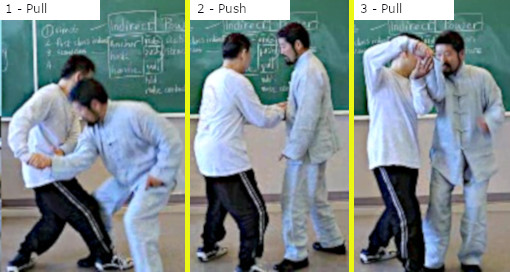 |
If the partner reacts according to Taiji principles, there should be no feedback from the hold. Introducing a higher level of complexity, Master Chen instructs, “Change the direction [of the pull and the push] now.” As the student pushes and pulls in various random directions, Master Chen moves according to Taiji principles, as seen in Figure 18. He explains, “That’s the correct way [of responding to a pull or push. You should not feel any power fluctuation in your grip].” |
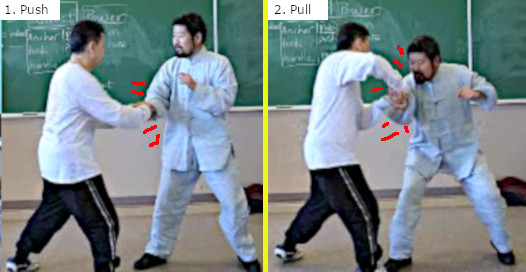
| To contrast this with direct power, Master Chen says, “Go do it again.” As the student pulls, Master Chen responds by snapping his hand forward. He describes this flawed reaction: “That’s direct [power.] I reacted only with my hand by tightening it and loosen it.” This normal reaction is illustrated in Figure 19. The red wavy line highlights the local struggles at the grip. |
 |
Summary of Training Principles
Master Chen concludes with a definitive rule for the practitioner: “The first part of the training is this: once you’ve been grabbed, lock it [at the point where you are being held]. You have to be consistent [at this point]; there should be no more changes there.” He explains that when a partner applies an external force, the practitioner must adapt by “changing the rest of your body.”
He clarifies this full-body adaptation by stating, “How do you change the rest of your body? It doesn’t matter—even if you have to fall, then fall—but that [contact point] is not going to change. The amount of pressure and the squeeze at that point of contact should feel exactly the same throughout.” The partner’s role is to act as a living gauge, providing a controlled external force to ensure the practitioner maintains consistent pressure at the point of the grip.