 |
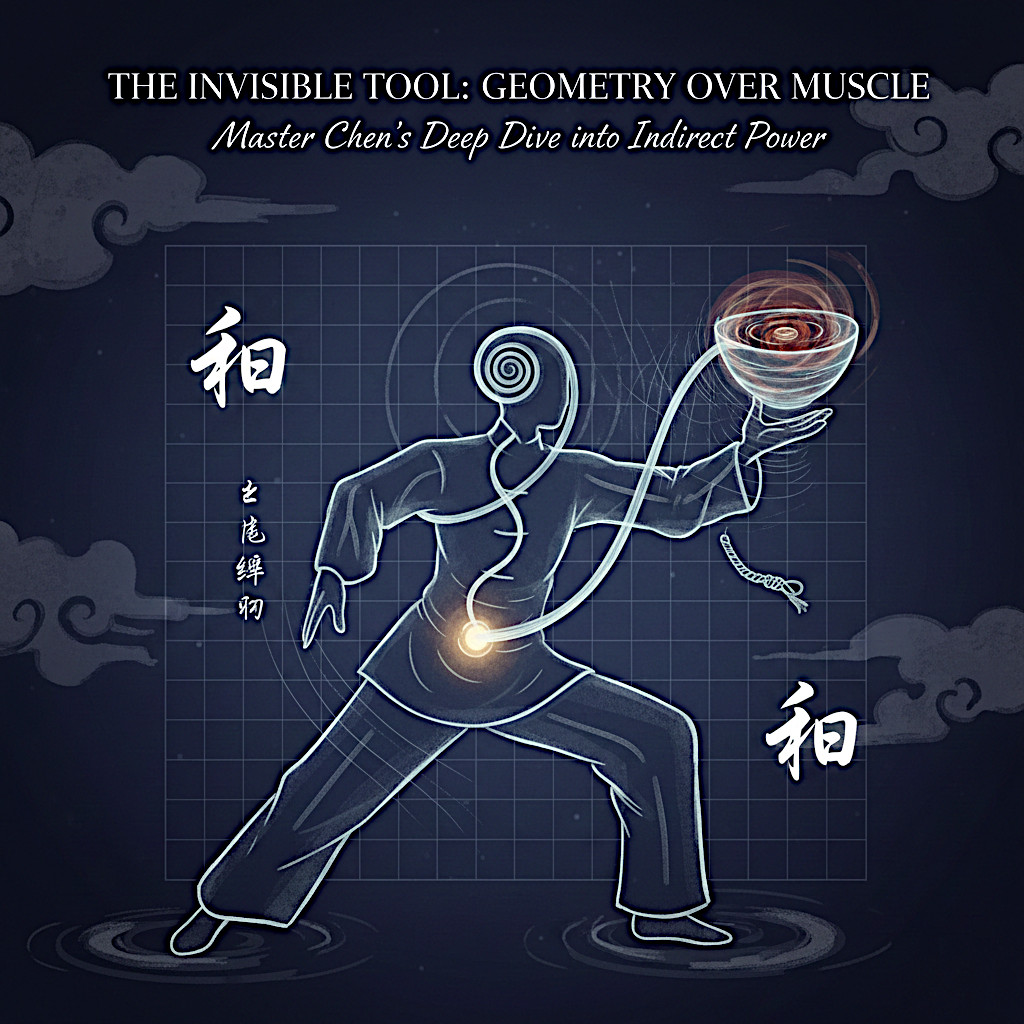
In the high-level application of Taijiquan, direct force is a flaw. Master Chen teaches us that true mastery lies in the Indirect. When we meet an opponent, we do not collide; we harmonize through structural containment.
Think of a rope tying a knot. The strength isn’t in the fibers’ “effort,” but in the geometry of the wrap. By separating our power source—the Dantian or the rooting foot—from the point of contact, we achieve Hé. We become the vessel, and the opponent’s force is simply the liquid we contain. |
| To project power, we look to the principle of “length.” The further the source is from the strike, the greater the leverage. While a long lever is usually fragile, Taiji solves this through Silk Reeling. This spiral path acts as a structural reinforcement, ensuring that our alignment never bends or breaks.The result? An internal alignment that looks like stillness but feels like an incoming tide—overwhelming, piercing, and impossible to find. | |
| (Part I: Adapted from the video transcripts of Wang Jinyi (王金宜) for the “Indirect Force” Video Highlights “ (间接力”视频花絮) filmed in Daqingshan (大青山), China 2012.) |
|
 |
Part 1. Don’t Eat with Your Hands
Part 3. Learning How to Fish
Part 4. Yang Actions
Part 5. Yin Actions
Part 6. The Invisible Tool: Geometry Over Muscle
Part 7. Not using force is a magic trick
|
Part 6. The Invisible Tool: Geometry Over Muscle
The Principles of Indirect Force and Engagement in Taijiquan
 |
The primary focus of this discussion is the method of applying force indirectly. Master Chen Zhonghua emphasizes that power in Taijiquan must never be a blunt collision: “The force used in Taijiquan must never be direct; it must be indirect” (太极拳里面的用力啊,绝对不能直接,是要间接; Tàijíquán lǐmiàn de yònglì a, jué bùnéng zhíjiē, shì yào jiànjiē). |
This indirect nature is rooted in the mechanics of displacement. Master Chen explains:”The place where you exert force must be away from the point of application. Your force should be issued from one place to act upon another” (用力的地方一定要离开作用力的那个地方,就是你的力是要发在一个地方或者说被发在一个地方; Yònglì de dìfāng yīdìng yào líkāi zuòyònglì de nàgè dìfāng, jiùshì nǐ de lì shì yào fā zài yīgè dìfāng huòzhě shuō bèi fā zài yīgè dìfāng*).
Essentially, force is generated at a “power source” (often the dantian or the rear foot) within the body, but its effect is realized at a distant point of contact.
Avoiding the Clash: From Dǐng (顶) to Hé (合)
When an opponent initiates a push, the specific spot where these two opposing forces meet is known as the Point of Contact or the Place of Engagement. At this intersection, Master Chen warns against the common mistake of Dǐng (顶), or clashing. He insists that “you cannot resist it with brute strength” (不能用力; bùnéng yònglì), because if you do, the two practitioners “just end up pushing against each other, clashing and resulting in a stalemate” (两个人就这么顶了; liǎng gèrén jiù zhème dǐngle).
To avoid this pitting of strength against strength, one must adopt the fundamental principle of Hé (合)—the act of uniting with the incoming energy. Master Chen emphasizes:
|
 |
The Mechanics of “Joining” (Hé Shàng 合上)
This mindset of Hé requires a shift from resistance to cooperation. As Master Chen explains:”So he pushed, and I couldn’t resist or simply yield; he was the one who made things difficult, so I had to work with him” (所以他推,我这么顶不行,化也不行,就是他搞这个地方,我和他合上; Suǒyǐ tā tuī, wǒ zhème dǐng bùxíng, huà yě bùxíng, jiùshì tā gǎo zhège dìfāng, wǒ hé tā hé shàng).
To illustrate what it means to “join” or “work with” an opponent (合上, hé shàng), Master Chen utilizes two distinct analogies:
| 1. The Rope Analogy (绳子, shéngzi): This illustrates using structural “loops” and knots to securely lock and tie the opponent’s force. Master Chen notes: “It means to tie it up with a rope; that’s the first principle of ‘closing‘” (用绳子捆上,这是第一个合的原则; Yòng shéngzi kǔn shàng, zhè shì dì yī gè hé de yuánzé). Much like a straight rope wrapping into a knot, this is a matter of geometry and structural “wrapping” rather than muscular tension. |
 |
|
| 2. The Cup Analogy(杯子, bēizi): This demonstrates passive containment by “using a cup to hold water” (第二个原则是用杯子盛水; Dì èr gè yuánzé shì yòng bēizi chéng shuǐ). Because a cup has a concave (凹, āo) shape, the water is held by the vessel’s structure rather than an active grasp. |
 |
Together, these analogies transform the point of contact from a site of conflict into a unified structure: “It’s about using structure and shape to contain that force, not about forcefully grabbing it” (是用结构和形状来合住那个力,不是用力抓住它; Shì yòng jiégòu hé xíngzhuàng lái hé zhù nàgè lì, bùshì yònglì zhuāzhù tā).
By focusing on Hé, the goal is simply to “lock him up and keep him still, not to use force” (那个东西,就是把他关住,让他别动,并不是使的劲儿; Nàgè dōngxi, jiùshì bǎ tā guān zhù, ràng tā bié dòng, bìng bùshì shǐ de jìn’ér).
The Transition to Indirect Power (间接发力 Jiànjiē Fālì)
The initial phase of any Taiji engagement involves merging with and containing an opponent’s incoming energy. After this engagement, any subsequent counter-force must be indirect.
Master Chen explains that power is not generated at the point of impact but originates from a distant source. This process begins with two strict rules of stillness:
|
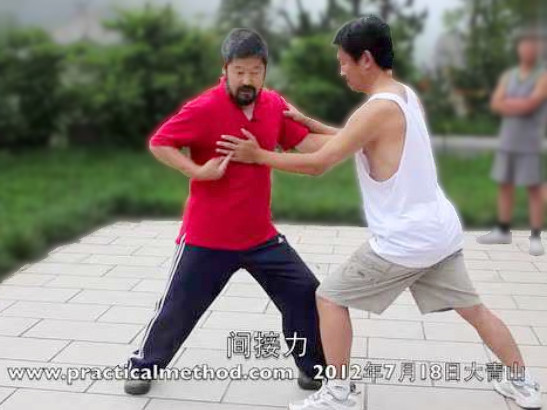 |
Once these requirements for absolute balance and stillness are met, the practitioner reaches the stage of unity:”We need to take another step, which is to achieve something—to unite with the other party” (我们再加上一步,就是要做到一个什么,和对方合住; Wǒmen zài jiā shàng yībù, jiùshì yào zuò dào yīgè shénme, hé duìfāng hé zhù).
It is only within this state of unity that the specific mechanics of Taiji power can be applied:
“After engaging, we can start to exert force indirectly” (合住之后呢,再开始间接发力; Hé zhù zhīhòu ne, zài kāishǐ jiànjiē fā lì).
The Two Indirect Forces: Peng and Ji
Master Chen clarifies that at this stage, “there are only two forces” (只有两种力; Zhǐyǒu liǎng zhǒng lì), which are defined by the distance between the power source and the point of contact.
|
 |
Despite their different directions, Master Chen explains that “these two forces come from one action, namely, pushing and pulling” (这两种力呢是从一个动作出来了,就是一推一拉; Zhè liǎng zhǒng lì ne shì cóng yīgè dòngzuò chūláile, jiùshì yī tuī yī lā). This duality highlights the counter-intuitive nature of Taijiquan: while conventional martial arts often seek separation and external motion, the Practical Method demands stillness and unity at the point of interaction.
The Architecture of Taiji
Master Chen adopts an introspective tone, invoking the classic proverb: “A tower of ten thousand stories rises from level ground” (万丈高楼平地起; wàn zhàng gāo lóu píng dì qǐ). He emphasizes that mastery begins with a minute understanding of basic principles.
The Unified Principle
In Taiji, every detail must align with a singular, overarching logic: “In Taiji, every detail must align with one overarching principle” (我们这个太极的要求,就是慢慢的慢慢的让他呢符合一个大的原则; Wǒmen zhège tàijí de yāoqiú, jiùshì màn man de màn man de ràng tā ne fúhé yīgè dà de yuánzé).
He elaborates that while individual movements may seem distinct, they are all governed by the same source:
|
 |
The Pyramid vs. The Spider Web
 |
Master Chen uses the visual of a pyramid to describe a successful foundation that narrows to a point of clarity: “It looks like a pyramid” (就是金字塔的这种样子; Jiùshì jīnzìtǎ de zhè zhǒng yàngzǐ).Conversely, he cautions against a “web-like” approach to learning, where the practitioner becomes lost in a maze of information: “He can’t follow every principle [at once]; it’s not good to be like a spider web… you can’t discern where the key point is” (他不能每个原则每个原则,像蛛网一样是不行的… 你看不出来他是什么地方是一个关键; Tā bùnéng měi gè yuánzé měi gè yuánzé, xiàng zhūwǎng yīyàng shì bùxíng de… Nǐ kàn bù chūlái tā shì shénme dìfāng shì yīgè guānjiàn). |
To truly understand Taiji, one must view it as a structured entity that grows from the ground up: “We are like a structure, like a house, like a pyramid. There is a principle at the top, and it is divided and generated from the bottom” (我们像一个结构,像一个房子,像个金字塔,他是有一个原则的在上面,底下分,分,分生出来的; Wǒmen xiàng yīgè jiégòu, xiàng yīgè fángzǐ, xiàng gè jīnzìtǎ, tā shì yǒu yīgè yuánzé de zài shàngmiàn, dǐxia fēn, fēn, fēn shēng chūlái de).
Application of Indirect Power
Opponent’s Push – The Concept of Converged Power
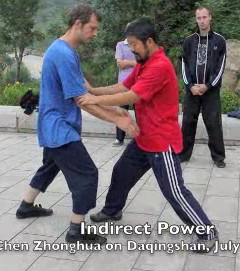 |
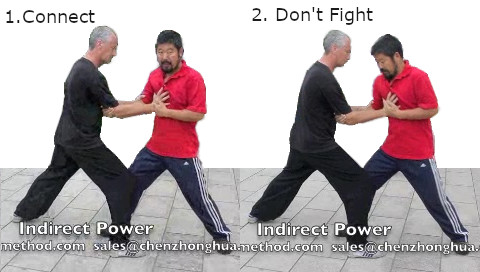
Master Chen explains the practical application of Indirect Power (间接力). When an opponent pushes, Master Chen observes the common imbalance of the attacker: “He is pushing here. Although he is using both hands, he tends to apply pressure unevenly—one hand is light while the other is heavy” (他推的是这儿,虽然是两个手,但他总是有一个轻一个重; Tā tuī de shì zhè’er, suīrán shì liǎng gè shǒu, dàn tā zǒng shì yǒu yīgè qīng yīgè zhòng).Master Chen remarks that for a push to be truly effective, the practitioner must apply pressure with total uniformity: “You need both [hands] to be completely [even]” (你要两个都是完全…; Nǐ yào liǎng gè dōu shì wánquán…). |
He notes, “If they [the pressure from both hands] are exactly the same, then your skill level is extremely high” (都一样的话,那你这个功夫就非常的高; Dōu yīyàng dehuà, nà nǐ zhège gōngfū jiù fēicháng de gāo).
This balance leads to what is known as Converged Power: “This is what we call ‘converged power'” (这就叫什么,聚力; Zhè jiù jiào shénme, jù lì). “When your power is gathered together, I cannot separate it; I cannot distinguish between Yin and Yang” (你的力聚在一起我分不开了,我分不出阴阳来了; Nǐ de lì jù zài yīqǐ wǒ fēn bù kāile, wǒ fēn bù chū yīnyáng láile).
The result of achieving this alignment is structural stability: “It is now aligned correctly, and once aligned, the center is locked in place” (就是正了,正了以后把中间给锁住了; Jiùshì zhèngle, zhèngle yǐhòu bǎ zhōngjiān gěi suǒ zhùle).
Pointing to the spot where the push first contacts the Taiji practitioner, Master Chen states: “This is called the ‘point of intersection.’ Because the forces intersect here, you cannot push through it” (这就叫相交点,力在这儿相交了,推他不行; Zhè jiù jiào xiàngjiāo diǎn, lì zài zhè’er xiàngjiāole, tuī tā bùxíng).
Referring to the incoming force from the opponent and the counter-force of the practitioner, Master Chen stresses that a perfect balance must be maintained:
|
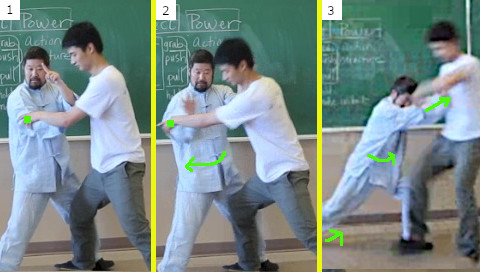 |
Listening Skill and Indirect Force
 |
Master Chen proceeds to explain the interaction from the perspective of the practitioner receiving the push: “Once I understood this [the point of intersection] and tested him, I realized how exceptional his listening skill was” (等这个明白乐,并且把他一试,他这个听劲儿…; Děng zhège míngbáile, bìngqiě bǎ tā yī shì, tā zhège tīng jìn er…). |
Master Chen provides a technical correction regarding the term “Listening Skill” (听劲 Tīng jìn). While often defined as “heightened tactile sensitivity,” Master Chen finds that definition too vague: “I don’t like using that word [listening skill]; I prefer to say he has a superior command of the applied force” (我不愿意用这个词,就说对他的力的掌握比较好; Wǒ bù yuànyì yòng zhège cí, jiù shuō duì tā de lì de zhǎngwò bǐjiào hǎo).
This mastery allows the practitioner to perceive the opponent’s intent instantly: “I grasped his intentions the moment he made a move. I understood it, and once I understood…” (他一出手我掌握了,知道了,知道了之后…; Tā yī chūshǒu wǒ zhǎngwòle, zhīdàole, zhī dào liǎo zhīhòu…).
Demonstrating the application of Indirect Force (间接力), Master Chen shows how a tiny adjustment can displace an opponent:
|
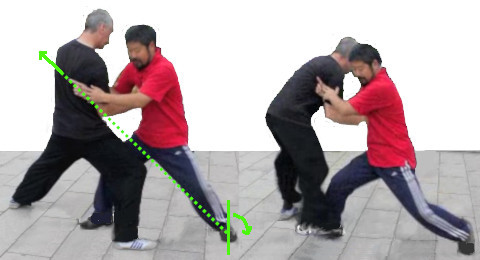 |
If the opponent does not understand this concept, they remain vulnerable: “If you cannot grasp this, then that [being moved easily] is simply how you will react” (要掌握不住的话,基本就是他就是这个; Yào zhǎngwò bù zhù dehuà, jīběn jiùshì tā jiùshì zhège).
Master Chen concludes: “You can try pushing yourself—you all tried it last night. This is what happens when the force is not separated and is not resolved according to our principles” (你来推你试,昨天晚上你们都推了,就是这个。这就是力没分开,没按着我们的原则化解掉是什么意思?; Nǐ lái tuī nǐ shì, zuótiān wǎnshàng nǐmen dōu tuīle, jiùshì zhège. Zhè jiùshì lì méi fēnkāi, méi ànzhe wǒmen de yuánzé huàjiě diào shì shénme yìsi?).
The Length of Force and the Spiral Path
Skill level in Taijiquan is determined by the distance between the Point of Contact and the Source of Power.
Master Chen explains: “The more you practice, the higher your skill level becomes. This is because skill is acquired as that point moves further away from the intersection [the point of contact]” (越练水平高呢就是,另外那个地方离相交点越远越有功夫; Yuè liàn shuǐpíng gāo ne jiùshì, lìngwài nàgè dìfāng lí xiàngjiāo diǎn yuè yuǎn yuè yǒu gōngfū).
He continues: “So this force—the so-called expansion—means it must be applied rapidly from the point of intersection” (所以这个力呢,所谓的展开就是从相交的一点把他一定要快速的; Suǒyǐ zhège lì ne, suǒwèi de zhǎnkāi jiùshì cóng xiàngjiāo de yīdiǎn bǎ tā yīdìng yào kuàisù de). “It must be transmitted to a very distant location” (传递到一个很远的地方; Chuándì dào yīgè hěn yuǎn dì dìfāng).
Master Chen then asks, “What is the logic behind this?” (它是个什么道理呢?; Tā shìgè shénme dàolǐ ne?)
The Analogy of the Stick
To convey the concept of indirect force, Master Chen asks the audience to imagine holding a stick: “Imagine you take a stick” (就是你拿一个棍儿; Jiùshì nǐ ná yīgè gùn er).
|
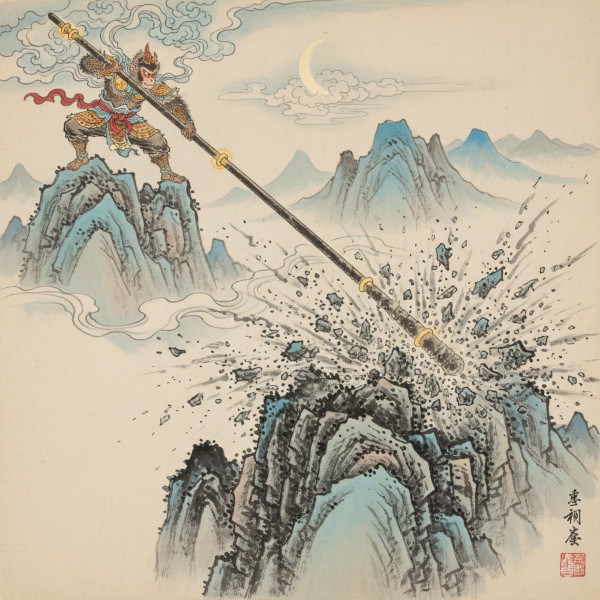 holding the Rúyì Jīngū Bàng (如意金箍棒) |
To emphasize the importance of length, Master Chen provides an extreme example:
|
The Challenges of Long-Distance Force
Master Chen explains the difficulties of applying this long-distance force: “One problem is that when there is a great distance, if you try to poke the opponent and they move aside, you cannot ‘catch’ or contain them” (有一个问题,远了之后你这个力啊,一捅的时候,他在边上跑了,你合不住他; Yǒu yīgè wèntí, yuǎn liǎo zhīhòu nǐ zhège lì a, yī tǒng de shíhòu, tā zài biān shàng pǎole, nǐ hé bu zhù tā).
This failure to contain is what he calls “being unable to handle [contain] him” (这就叫合不住他; Zhè jiù jiào hé bù zhù tā). He notes that “his counter-force, directed to the sides, will bend the stick. Therefore, we must resolve this contradiction” (他那个力,他往两边,那个棍儿他弯,所以我们要解决这个矛盾呢; Tā nàgè lì, tā wǎng liǎngbiān, nàgè gùn er tā wān, suǒyǐ wǒmen yào jiějué zhège máodùn ne).
He further explains:
|
 |
The Solution: Spiral Force (Silk Reeling)
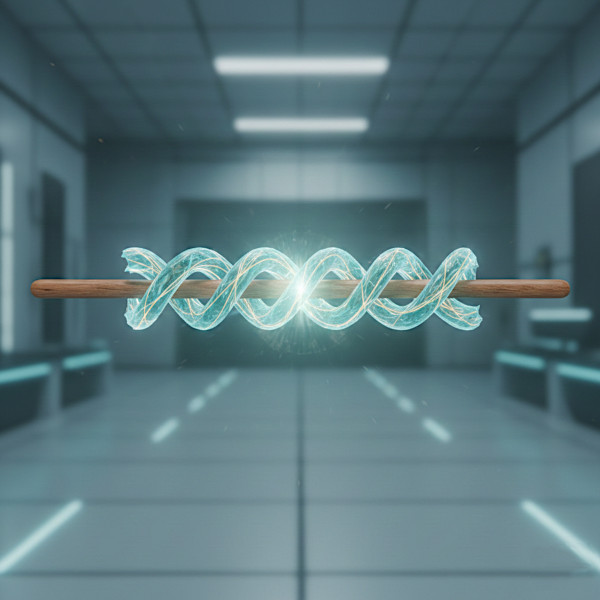
Master Chen poses the central problem: “In training, how can we ensure that the force remains long and penetrating?” (所以练呢,怎么样才能保证这个力要长; Suǒyǐ liàn ne, zěnme yàng cáinéng bǎozhèng zhège lì yào zhǎng).
The solution is to deliver force through a spiral rather than a straight line.
 |
|
|
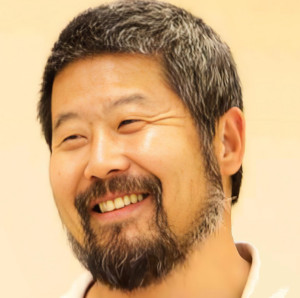 |
Summary of Principles
Master Chen concludes: “These are the internal principles of force” (这是力的里面的几个道理; Zhè shì lì de lǐmiàn de jǐ gè dàolǐ).
“The most fundamental principle is that whenever you engage an opponent, the force must originate from a different [distant] location” (简单的最根本的就是只要是交手的时候,力要从另外一个地方走; Jiǎndān de zuì gēnběn de jiùshì zhǐyào shi jiāoshǒu de shíhòu, lì yào cóng lìngwài yīgè dìfāng zǒu).
To summarize:
|
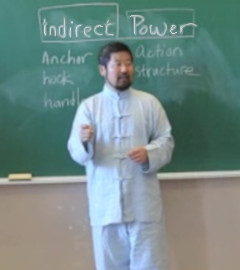 |
“Therefore, this energy line must be maintained. We have already discussed the issue of the ‘power path’ (Jin Lu) at great length” (所以,这条线不断呢,我们已经就说这个,劲路的问题讲了很多很多很多了; Suǒyǐ, zhè tiáo xiàn bùduàn ne, wǒmen yǐjīng jiù shuō zhège, jìn lù de wèntí jiǎngle hěnduō hěnduō hěnduōle).
Demonstration: The Energy Thread and Power Sources
1. Connecting the “Wire”
At first, the technique yields no reaction from the opponent. Master Chen diagnoses a lack of structural integrity:”The wire is broken, so the force didn’t go in” (这个线断了,所以那个劲儿没进去; Zhège xiàn duànle. Suǒyǐ nàge jìn er méi jìnqù).
After adjusting his hand’s direction and aim, the opponent shows a slight reaction:”I made an adjustment, and you see—the force went in, right?” (所以我一调整,这一调整你看,劲儿进去了吧?; Suǒyǐ wǒ yī tiáozhěng, zhè yī tiáozhěng nǐ kàn, jìn er jìnqùle ba?).
Master Chen notes that while this fine-tunes the aim, it is still localized: “But that was only using the hand” (但这是用手的; Dàn zhè shì yòng shǒu de).
2. Shifting the Source of Power
Master Chen then demonstrates indirect force by moving the source of power progressively further away from the contact point. He first shifts the source to his dantian, then to his rear kua (hip joint): “Now that I am using this [the dantian/kua], the strength has increased. Can you feel it?” (现在是用这儿了,劲儿长了,感觉到了吧?; Xiànzài shì yòng zhè’erle, jìn er zhǎngle, gǎnjué dàole ba?).
Finally, he draws force from his rear foot—the maximum distance from the contact point: “If it sinks, you will see it completely descends; he won’t be able to stop the force from spreading through his whole body” (那如果一沉你看,整个的下去了,他全身你就堵不住了; Nà rúguǒ yī chén nǐ kàn, zhěnggè de xiàqùle, tā quánshēn nǐ jiù dǔ bù zhùle).
The opponent reacts as if being pierced. Master Chen explains the sensation: “It feels like a needle is stabbing you” (觉得是一根来捅你; Juédé shì yī gēnlái tǒng nǐ).
3. The Role of the Contact Point
Master Chen concludes this exercise with a vital reminder about the Place of Engagement:”This place only plays the role of a connection (he). It cannot use [direct] force” (这个地方他就只起个合的作用。他不能使劲儿; Zhège dìfāng tā jiù zhǐ qǐ gè hé de zuòyòng. Tā bùnéng shǐjìn er).
Demonstration: Indirect Force via Internal Separation
Master Chen uses a second student to demonstrate how to handle a push. He explains that if the reaction is too local, the forces remain “entangled”: “This is local; it hasn’t been separated. So when I combine (he), the force stays right here” (这就是当地的,没分开,所以我一合,力量走这儿; Zhè jiùshì dāngdì de, méi fēnkāi, suǒyǐ wǒ yī hé, lìliàng zǒu zhè’er).
The Sequence of Application:
|
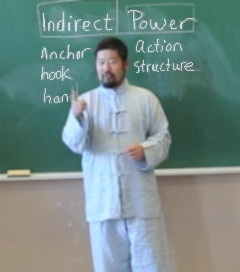 |
Master Chen describes the sensation of the force passing through: “I initiate from here [the source], but it passes right through this point [the contact point] like that” (我从这儿走,但是这个地方,这么样过去了; Wǒ cóng zhè’er zǒu, dànshì zhège dìfāng, zhème yàng guòqùle).
He emphasizes the stillness of the contact point: “This place [the point of contact] does not move at all” (这地方一动也不动; Zhè dìfāng yīdòng yě bù dòng).