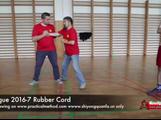
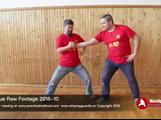
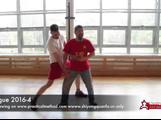
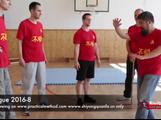
This year we were scheduled to receive master Chen at march, but due to a few issues beyond all of us it wasn’t possible.
The problem for us locally was that by then we had already confirmed with a lot of people, teachers of other taiji styles and other arts who were attending the workshop.
Faced with having to make a decision, me and my partner Flavio Prado decided simply to conduct the workshop ourselves, best we could, and introduce everyone to Practical Method, so when Master Chen comes at a later date, everyone would be more prepared to learn taiji from him.
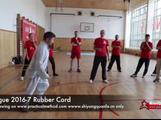
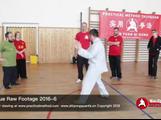
This is a little bit of how it went down:
We had a lot of fun and everyone was very hard working, interested and pleasant. We finally have an interested group being created which is a great step for us. Everyone in Brazil is dead serious about the martial aspect of the art, which I think benefits the practice.
Taiji is a very interesting art that has different challenges for everyone.
We covered topics ranging from basic foundations, yilu and push hands. Flavio also conducted some lessons on qigong and other general aspects of martial art. Everyone came out feeling they won something, and all of them are very excited with the prospect of being face to face with Master Chen in the future.
Hope you guys enjoy the video, all the best and keep training!
Name: Mark Hanley
Class: Richmond Hill
Practical Method Start Date: Oct. 15, 2016
Martial Art Experience: Karate Black Belt, and practiced Yang Taiji previously
Name: Bruce Robinson
Class: Richmond Hill
Practical Method Start Date: May 23, 2015
Martial Art Experience: Practiced Aikido and Yang Taiji previously.
The first European Practical Method meeting took place in Vienna in late winter 2017. On 17. – 19. February, people from Göttingen, Berlin and Vienna convened in this wonderful city to practice and exchange experiences.
On Saturday and Sunday, we dedicated a lot of time to practice the Yilu. Also, we worked on basic foundations and put special emphasis on progressions in partner work. Special thanks to Rick, who instructed us in these progressions in the most precise and knowledgeable way.
Altogether, it was a great meeting. I am sure that everyone had her or his very personal insights and “aha!”-moments. I myself, being relatively new to Taiji, surely learned a mountain of things. It has been really motivating to see other people with more experience practicing Taiji.
Many of us already knew each other, having met before on workshops or at Daqingshan, now having the chance to catch up on what happen since then. But many also could get to know each other for the first time. Being able to practice with many enthusiastic and committed people made the days in Vienna an invaluable experience.
Many thanks to Carlotta, Pawel, Fabian and Rick, who made the meeting possible. Thanks to your commitment, it has been a wonderful and enriching weekend. Hope to see all of you again and many more on the next meeting, which will probably be hosted in Berlin in 2018.
Speed is not a function of how fast you can move, but of how quickly you can close distance. As such, speed is not a matter of agility, but of directness.
For example, if I can close the distance between myself and the opponent directly in a linear fashion, I can technically reach the opponent before they reach me. This is because if you can close distance with your whole body, it works as a force multiplier. Not only are you closing distance with one body part (the way an arm would be in a punch), but with multiple body parts. Your lower half is closing distance, your waist is moving closer, AND your arm is reaching out. All these movements together allow for a speed that is quicker than any individual slow or fast twitch muscles on their own. Of course, having quick movements is also of benefit and can work well in conjunction with the rest of the body moving forward.
This open class is an event to pre-celebrate World Taiji Day, which will be on Apr 29, 2017. It welcomes anyone interested in learning tai chi. It will let participants experience a typical class, which includes foundations, form and push hands.
See you there!
Registration is recommended, please contact Kelvin Ho by emailing kelvin.ho@practicalmethod.ca or texting 647-738-8384.
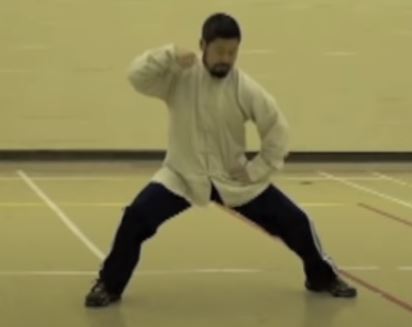
fetching water,
– you must be in front bow stance with weight on front
– back hand open on belly
– front arm down open hand to thigh
– move front KWA out as the only movement – when front arm moves bring elbow to body
Kelvin ho had us doing this foundation exercise today. Issues I had around the move that I experienced
1. Moving shoulders ( I needed to press down first, move the kwa and capture the internal movement to go across my belly rather than up to my back shoulder)
Kelvin indicated that once stretched I should hold it for a minute or two to help loosen the kwa.
2. Moving front hands and arms independently ( the kwa works like a lever attached to the rope and pail gathering well water; when the rope moves back and forth so does the pail) the hands and arm cannot move independently
3. stance too high , I needed to perform the above in a lower stance
Master Chen’s disciple Ping Wei will again teach Practical Method foundations,Yilu and Cannon Fist on June 4th (Sunday, 9:30am-1pm and 2-5pm) in Irvine, California. Registration for the workshop is required for all newcomers; the deadline is 5/26/2017. For location, details and all inquiries, please contact Al Yu at 949-331-2735, or via email: mralyu@yahoo.com.
In the beginning I used to observer my teacher’s external form. Where is his hands, the right or left moves first, what’s the next move, how high is his hands. Then I learned to observe beyond the physical form. Where is the weight, his focus, which parts of his body he is locking and releasing, path of movement and connection, parts that are strong and relaxed. How the weight is counterbalanced with hands out stretched, or leaning forward/backward.
Then Self-reflection and assessment is key. Understanding how the body works and moves. Physical appearance: grounding, stretching out, grounding more while expending to maintain balance.
Why we shift weight and settle into posture by dropping weight. – My observation of my teacher- dropping weight grounds the body and creates effectiveness. I.e. stepping into opponent’s space- weight forward – settling into pose, structure and weight drop to create effectiveness.
Bring right hand 45 degree palm up – Just above the left thigh
Bring left hand near right hand 45 degree palm up, elbows touching in a straight line Pull elbows to dantian at the same time bringing left foot (with toes) in beside the right foot. Rest the heel of the foot. All should be one action, like a bullet.
Things to check.
Keep hands straight and locked at all times
Keep back straight and lock the right side. Imagine there is a bar from back of right shoulder to right heel.
Review of negative circle
– elbow in hand on outside
– drop hand strait down
– hand out once at elbow torqueing forearm keeping elbow down
starting in front bow stance after bringing in my elbow hand on outside, I found that bringing the hand down helped keep my elbow aligned when the hand went out kelvin Ho reminded me to keep my elbow down. We also performed cross hands draping over the body. Kelvin showed me how the end position had stability by aligning the elbow with the back foot with the fist out like a punch. Kelvin’s hand wrapped my punch and pushed.
Review of Positive circle
-elbow in do not move hand or wrist
– twist waist without moving hips
– hand out do not move elbow
– do not move off the finger line to the exact spot on the opponent
starting in front bow stance after bringing in my elbow, I found that when I twisted my waist my weight moved off the front foot. Kelvin Ho corrected this by calling out when my weight incorrectly changed from my front foot. The twisting of the waist helps bring the elbow to the centerline. It requires a lot of focus to keep the fingers leading when going out torqueing the arm while not letting the elbow get away and keeping it down.
Kelvin Ho corrected me on proper formation & alignment of tile hand (palm) which I find has helped me considerably whilst performing both the negative and positive arm circles
In addition Kelvin re-iterated the concept of having a stick in the arms especially from the elbow to the finger tips and with the proper use of the aforementioned hand alignment while going out with the hand & in with the elbow, without deviation by bending at the wrist which I have been doing ,has helped a lot
To be clear I did not believe or at least I did not think I was bending at the wrist during this process, however, he pointed out that I was indeed doing so as as a means of compensating for my inflexibility in bringing the elbow in to touch the waist in the proper spot.
I was really pleased today that a new chap joined our class. Having just recently completed the choreography of the entire form Kelvin has at this juncture decided to return to the start of the form and systematically move sequentially forward. Now, in all probability he has explained the breakdown of the various movements using the same words he has used before (probably many times) ,however, at least in my case today, I actually understood them more clearly than ever before which I must confess made me both happy and more inspired to continue practicing
What I found when breaking down the 1st part of the first move “Budda’s Warrior Attendent Pounds Mortar” is that when required to bring the foot in before shovelling it back out on a 45 degree angle, is that the entire core muscle groups are used to “pull” the foot in. Previously I was rising to make it easier to bring the foot in & today I was told to go lower down and activate those front/back core muscles, tendons & ligaments etc….Big difference doing it this way (properly).. to be sure.
This is an expression Master Chen uses that I find particularly helpful in understanding the procedure for utilizing the method of fighting taught in the recent video ‘ Move into empty space ‘.
Engage the opponent
… this creates a ‘ front line ‘ like on a battlefield, causing the opponent to commit his troops to maintain that line. This is the same as the demarcation line. The key seems to be to cause the opponent to commit enough of his ‘ forces ‘ and attention to preoccupy him, while you move to step 2
Move into empty space ( Go behind enemy lines )
…. while maintaining the front line, you must use stealth to maneuver, another force to take up a position behind enemy lines, ( beyond the demarcation ( front line ) by moving into the empty space. The keys are, you must maintain the front line, the movement of the secondary forces must neither disturb the front line, nor should they be construed as a threat. In keeping with taiji threory, if the two ends are locked ( non moving ) this requires we move whats in the middle, ideally getting the kua in, (kua to kua)