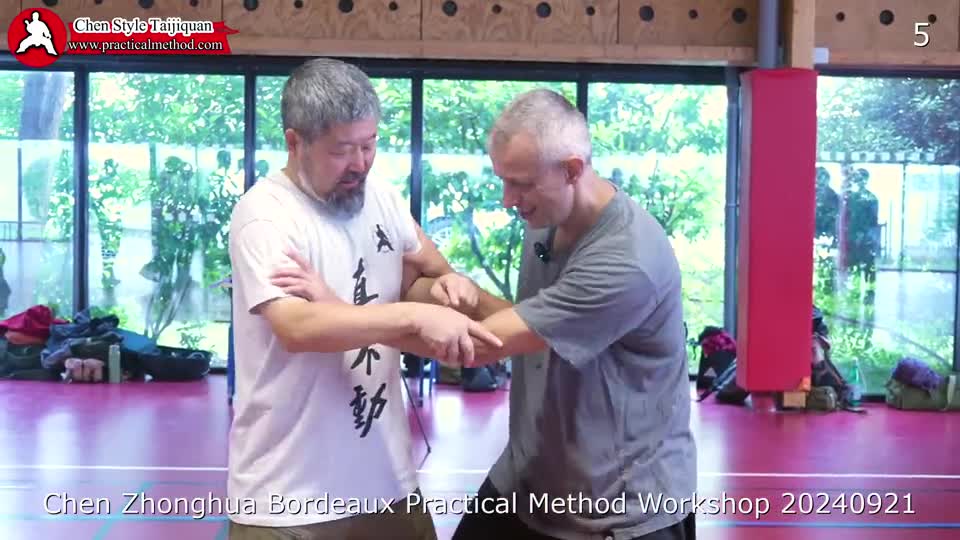
51st Daqingshan Chen Zhonghua Taiji Seminar 20260501 Video Package. The videos in this package has mixed English and Chinese languages. We will try to mark them in the titles.
Indirect power is an absolutely vital concept in our practice; in fact, it is the primary pillar of the Chen Style Tai Chi Chuan Practical Method. To grasp this, consider a simple, everyday analogy: Think about eating—if we simply grab the food with our bare hand, that is direct, as there is no medium between the hand and the food; indirect, on the other hand, is when we use a utensil like a spoon or chopsticks, where we use our hand to manipulate the utensil, and the utensil then touches the food, meaning the force is transmitted, not applied directly.
In our Tai Chi practice, we learn to gain direct access to an opponent while ensuring they only ever have indirect access to us, effectively taking advantage of the situation. While this strategy may seem ‘unfair‘, it is the fundamental approach of our training. Through dedicated drills and understanding, we strive to reach a level where our contact exerts direct force on the opponent, yet their contact with us only results in a roundabout, indirect connection. Once this is accomplished, we establish control over the engagement, and the opponent does not have control over us. This strategic mindset aligns with a key principle drawn from Chinese classics such as The Art of War. Within Tai Chi, this ideal strategic blueprint is explained by Wang Zongyue in the Taijiquan Jing (太极拳经): “I know the other, but the other does not know me.” (人不知我,我獨知人。 – Rén bù zhī wǒ, wǒ dú zhī rén.). This principle describes the mastery of understanding their intent and connection while successfully obscuring our own methods, granting us the indispensable advantage.