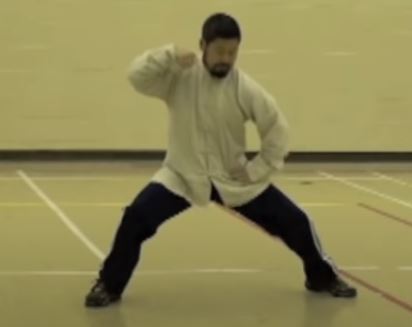
This year’s Hunyuan World Seminars event was relatively smaller than previous years. The highlight of the 4-day event is the special lectures on Qigong and Yiquan by Master Kenneth Cohen.
Participants to this event were quite diversified. They are seasoned Hunyuan World veterans like Charles Paoletti and David Hilburn, who have both attended all the Hunyuan World events thus far. We also have a number of new people attending for the first time, such as Hallie Bruce and Kathy Massey.
It appeared short (4 days) for people to come all the way from as far as New York or Puerto Rico. But there was something for everybody.
Tian Qiu Xin used to recite the following verses: Since the beginning movement the spiral rises, and the force comes from the feet.
One after the other it passes through all joints, therefore all the body being a unity. The belly is like the sea, and the form like the tide. When changing the movement, folding comes from the waist.
Although forwards and backwards the level changes, you must keep stability. Upwards and downwards go through each other, and then the force reaches the extremes.
Thanks to John Vanko for submitting this quotation.
At the 2008 Hunyuan World Seminiars in GA, USA, I spent several hours one night after the evening class to work with several disciples on taiji fighting.
I will not go into details of what we did, as there is no way to explain it with simple words. We didn’t make any videos of the session either. What I want to discuss here is some of the comments from students. These comments or questions are as a result of the fact that what we did did not APPEAR to be taiji.
It’s almost the same as praying mantis.
It’s the same as karate.
Is taiji this fast?
Master Chen, you kick is so fast we cannot even respond to it.
As a matter of fact, real taiji IS a martial art. It does not resemble that taiji that we see practiced and taught today. What we normally see is the training set or method of taijiquan. Here is a video clip of a simple teaching session with some applications.
Here is another youtube video that has some elementary fighting techniques.
Here is a brief summary of the notes I made in Hunyuan World. I hope I was able to have some understanding from Master Chen´s teachings in the seminar. I am open to any corrections on these notes. Read more
Chen Cake is a variation on the children’s game of Patty Cake. Here is how we play it.
The participants will stand facing each other with their arms outstretched in front of them. The wrists will be bent and the fingers pointed at the ceiling. They will adjust the distance between them until the backs of their hands are in line. From this position they will proceed to slap their palms together trying to upset the balance of their opponent.
They are not allowed to move their feet except to avoid falling over.
This exercise will result in a better sense of timing, balance, recognition of the opponent’s structure, and a good flow of blood to the hands.
This is a detailed list of the classification of moves of the Chen Style Taijiquan Practical Method forms of Yilu and Cannon Fist. Hong Junsheng’s Taijiquan Practical Method Movement Classifications: Read more
“Elbow Sticks to the Ribs” is a principle that is shared by all martial arts, not only Taijiquan. It’s a pity that most martial artists only pay lip service to this age-old aphorism. This is indeed a secret training method to higher levels of martial attainment.
Chen Style Taijiquan Practical Method regards this aphorism as a major principle to follow.
Wuwei is “none doing”. It is a concept that sometimes in life the action required is “not to do anything”. This is very different from don’t do anything in a normal sense. This concept is stressed very heavily in the Daoist philosophy because the Daoists perceive a reality that has both action and non action together. This is not a Chinese concept alone. For example, in English we say “No news is good news”. We also say that if the opponent does not say no, that can be construed as acquiescence. Daoists believe that Wuwei should be at least half of our actions. This is a very difficult task to achieve.
So the objective is to “lengthen”, to expand (not collapse) from our central balance point. We create a line, which intersects our center, from two longer points. For example, a line might be drawn from a shoulder point near the neck, to connect with a point on the bicep above the elbow. This opens the shoulder, while letting it rotate into the center of our structure, instead of “popping” up or out (which would collapse the point).
Taiji Push Hands is always about the state of mind, body, structure, angle, space, timing, etc. It is not an emphasis on responding to the opponent. It is always about adjusting my structure, to sustain my center and stability of the structure. It involves rotating joints, to reorganize my inner body relationships, creating appropriate angles, to occupy the optimal space for my center balance to be sustained, while my opponent’s space and center is taken away.
The famed Zheng Banqiao (one of the Seven Poets of the Bamboo Forest) wrote:
It’s difficult to have a clear mind
It’s not easy to be confused
It’s even harder to transform from clarity to the state of confusion.
He wrote this at an era of no hope for the people. Indeed in his time, the learned would be able to live in peace if only they could voluntarily go into a state of drunkenness or confusion. The relevancy of this point in terms of our pursuit of Taijiquan is that there is a time for clarity and there is a time for confusion.
This reminds me of what Hong told me and many of his students:
Those who are smart cannot learn this art
Because they think they can understand it
Those who are mentally retarded cannot learn it
Because they CANNOT understand it
Only those who have the mental capacity to understand
But fail to see the point
Will one day get it
Through persistant
One of the terms we hear often in the Chen Style Taijiquan Practical Method system is “Rotation”. This term relates to silk reeling, spiral, circles, turning, etc. It is an inseparable part of the Chen Style Taijiquan Practical Method system.
In dealing with this concept, one must keep in mind the following:
There are no complete rotations with any part of the body.
Every part of the body should have partial rotational movements.
According to the number of parts of the body, the rotation is composed of mini rotational movement of each part. The total of all involved parts must add up to 360 degrees, a full circle.
Hong’s form of taiji has no ‘rehearsal movements’ or pre-movements, its just the useful stuff. Don’t load your taiji with rehearsal movements and unimportant movements.
“Don’t Move Your Hands!”
Contrary to what most believe, the hand in most cases move too much. Everybody wants to learn how to move the hand. In fact, they should learn how NOT to move it! Read more
Chen (2) Jian (1) Zhui (4) Zhou (2) 沉肩坠肘
Sink the shoulder and pull down the elbow.
The shoulder can only sink downwards towards the direction of the kua. It cannot move sideways. It cannot move upwards either.
The elbow must point downwards towards the direction of the Dantian. It cannot raise upwards.
Are you learning anything? I often mention at my workshops that I notice many old disciples of the Grandmaster who spent dozens of years with the Grandmaster without learning a thing.
Why do I say something so harsh? Look at the physical evidence. They continue to look like they are doing wushu, or whatever they used to do. They continue to use force in their push hands. They continue to use tricks in their applications. Their abilities are all external.
Are you one of the above?
One observation that I have consistently made is that most people follow the rules for about 4 months. They gain considerable ability and understanding during these four months. After that they mentally graduate. They won’t “hear” anything any more. The first four months were filled with real learning because they were totally new to the system. After the first four months, they continue to believe that they are learning but in reality, they don’t learn any more. If you tell them, they will have 1 million explanations. They confuse what they do with what learning is. They experiment and are on their own while in their mind they are trying out what they learned.
In real life, a person gets into this frame of mind at the age of about 11 to 13. That’s when you notice that they start believing in themselves. In learning Taiji, this is reduced to about 4 months. Once a person gets into that frame of mind, there is almost no return.
Another scenario is almost the opposite but has the same bad effect. People come to the system but will not learn. There could be a myriad of reasons but they are not learning. If these people can persist, one day they will learn. When that happens, their learning will be in leaps and bounds. That is because by this time, they will have a very good foundation for learning. Their understanding will be based on facts they know.