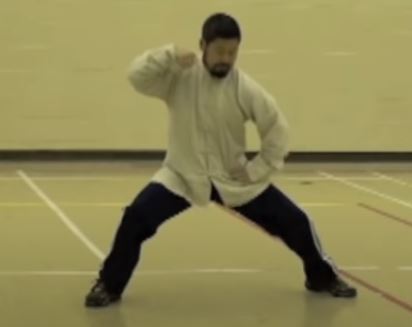
On May 31, 2026 in my Toronto class, I taught to use bie to lock the opponent, and then issue with a different body part not involved in the lock. I recorded the following video at the end of the class:
I later had an interesting discussion with John Upshaw on this video, and it went as follows:
Kelvin: The isolated movement is how to send energy from my dantian to opponent’s dantian through my hand. It also requires me to make the opponent like a board in order to bounce him.
John: So they have to stiffen up before you exectue your move?
Kelvin: I had to make him that way. He was not threatened when I put my hand there, then something else had to hit him at the right place. It is like shooting something out from a gun as my body did not move forward.
John: The second move you had him stiffen up before executing your move.
Kelvin: It is basically the same thing on the reverse direction. For the 2nd one, I also showed a wrong way of doing it.
John: I assume you aim your datien at his when doing both moves? I’ve done the 1st one…it’s like having a stick between your dantians, and you push as if the stick is real…with dantian locked…
Kelvin: The aim is to his dantian so that it pulls the rest of his body backwards when hit. If he holds a stick vertically with two hands at the two ends of the stick, I have to hit the middle. That is the idea, but the difficulty is that I only have one hand on him.
John: Like a hammer? The dantien is the head of the hammer?
Kelvin: So I only make contact with the top end of the stick and yet it needs to be the same as hitting the middle without tilting the stick. I was imitating Shifu’s demostration in https://channels.weixin.qq.com/finder-preview/pages/sph?id=Apvo9ZLX0r.
John: You do a good job replicating both moves.
Kelvin: My students are recently saying that on the touch, they just freeze up, they don’t know why.
It is the Bie that I do, in combination with the wall behind me.
John: I am going to try that out!
Kelvin: When something starts to work, it really requires a number of different aspects.
John: So you do a bie, add the wall? The bie in any combination?
Kelvin: The most amazing part is being able to send the opponent both feet off the ground without a low to high motion. The Bie is to lock the opponent. The Bie is a concept or a type of action. The wall is me not moving. You can see that I did not move towards the opponent. There is nothing new itself. It is made of everything you have heard of before. The most important part is indeed about not moving. Long time ago, shifu told me at some point, we need to separate the physical action and the energy. That is also an expression of yin yang separation. It is like pulling the trigger on the gun. The bullet is separated from the gun. The gun powder energy is transferred to the bullet. The bouncing of opponent is like making the basketball bouncing up from the ground when it is just sitting on the ground. There is compression on the opponent.
John: Much like a trampoline? But tighter and less movement.
Kelvin: Not quite the same analogy as the ground is hard but the trampoline is not. If you put a basketball on the trampoline, and press on the basketball, it will jump because of the trampoline. I want to compress the basketball onto the ground to make it jump.
John: Gotcha.
Kelvin: So it is a bit different. I can just use a paddle to hit a pickleball off the ground. It is the same in this analogy.
John: The wall you produce is like the ground in your analogy.
Kelvin: Yes from the horizontal dimension to send the opponent backwards. To make him bounce off the ground, I press him against the ground. We need to produce more than one vector. These are things that shifu talks about, but I realize that it is very difficult to teach exactly how to do it.
John: So you pull them into the wall (the bie) to create the compression?
Kelvin: No, the Bie part is different. The Bie part is the general idea that he just feels stuck. I will give a counter example. Imagine that you are just pushing on his chest with a lot of force. His upper body may just tilt backwards and fall backwards. Normally, it would require bending your arm to issue. If he is agile and flexible, he may just bend backwards and not fall though. In this case, your force only affects his upper body, but his entire body is not locked. In our actions, we must first lock their body and then add one, right?
John: Yes.
Kelvin: The Bie is used to lock their body, and then you add one to hit the centre for example. This is what we learned. If the entire body is locked, he will fall backwards. To make him bounce upwards, you need to hit him evenly, without him able to really distinguish how you hit him.
John: That is very clear.
Kelvin: At all times, he is locked during the bounce.
John: So he is locked until the release?
Kelvin: If you can make him bounce, it means you can control how to hit him, and he won’t get hurt. For someone to bounce, his structure must remain in tack in the air. For 1st demo, his body structure did not change shape. For the 2nd one, the opponent looked very stiff, I pulled him in a way that kept his body structure. The pull was very sharp, and I had no extra motion in my body. Nothing deviates.
John: So by locking the opponent up, the compression is contained.
Kelvin: The locking (Bie) part is difficult. In our drills, we often ask the opponent to lock for us so we can do the drill.
John: Yes.
Kelvin: In my analogy, I need to create and keep the wall. My students when they do the drills by themselves, they don’t have the expected effect. They feel that something is off or not right, but they often can’t figure what the difference is by themselves.
John: I have difficulties with lose opponents…for that reason.
Kelvin: I talked about Bie again in the last class, I think that they are starting to get it. One student mentioned about remembering the lesson in this video that I did two years ago:
John: That is an excellent demonstration and explanation!