Sat.
Rick Kare, Todd Turik, Jody Hall, Randy Hay (one day), Blake Caldwell (one day), Bill Vanderhall, Kay Terai, Helen Kita, Gary Kong, Wilkin Ng, Jay Smith, Dina Kerr, Bob Fell. Read more
Chen Style Taijiquan and Hunyuan Taiji email: practicalmethod@qq.com
Sat.
Rick Kare, Todd Turik, Jody Hall, Randy Hay (one day), Blake Caldwell (one day), Bill Vanderhall, Kay Terai, Helen Kita, Gary Kong, Wilkin Ng, Jay Smith, Dina Kerr, Bob Fell. Read more
Hong Junsheng was born on February 17, 1907 (Chinese Lunar Calendar) in Yuxian County, Henan Province and passed away on January 23, 1996 in Jinan, Shandong Province, China. Read more
The flight to Toronto today was plagued with problems. First there was the delay in departure. Then my video entertainment system did not work. Read more
“Withdraw is to issue” is an important concept in Chen Style Taijiquan Practical Method. It is also a measurement of level of skill in this style. Here Master Chen explains a technical aspect of this skill. Read more
This seminar was attended by three visitors/new students. Nicholas Fung, an old student of mine, is visiting from Hong Kong. Wilkin Ng is from Vancouver and he has joined us. Gino Nasato is from Victoria. He has been an active participant in my Victoria workshops and in local classes there. He is visiting this weekend also.
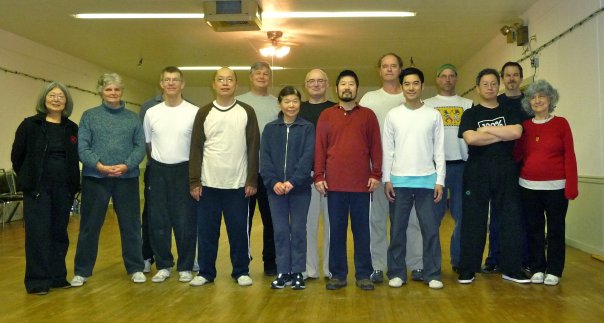
The main subject this weekend is on how to keep three different lines while pushing hands. This is a very difficult act to perform. I explained and experimented for students the example of how to aim at something or some place. In our push hands or applications, we often don’t push towards where we ACTUALLY intend to push!. This is a question of the mind intent not harmonized with the energy alignment. This question touches upon our basic natural disposition. It is very important for you NOT to believe that you don’t have this problem!
I have been giving this group of people seminars here for the seventh year. We started in Vancouver and moved to Fort Langley and finally settled in Maple Ridge. Currently we have three students from Seattle, one from Denver, CO who joins us occasionally, several from Victoria, and one from Nanaimo. Some have to drive more than three hours to get here; others have to take the ferry for over 5 hours. I fly here from Edmonton early in the morning. All this for Chen Style Taijiquan Practical Method!
I attended a morning session of the conference at the Yinjian Hotel. The only thing I can remember from the lecture is that we are not born with cancer, we get it.
Went shopping for clothes after the session. Beijing is too cold and I had to buy some clothes. Supper with Sun Zhonghua. He took me to a Shanxi restaurant. He is from Shanxi. Had 4 dishes that I cannot remember the names of. It cost 44 yuan. Very cheap indeed!
Back to the hotel after dinner and burned 14 DVDs for him.
回家的路上。今天要花在路上了。五点离开去机场。。。
一路上在想这个问题:这几年来,我穿梭世界诸大城市推广陈式太极拳实用拳法,已有一点成效,值得吗?当然第一个问题是洪师的拳法值得这么推广吗?第二个问题是我有资格推广这个拳法吗?
洪师的拳很有特点。这点我学拳的时候就知道的,但是,这么多年来,发现这一点比我想像的深刻的很多。真是其小无内。越练越深,好像是一个无底洞。 昨天晚上给学生讲洪师格言“收肘不收手,出手不出肘”时,拉飞亚尔威勒说他没有想到手肘之间是这样的一个感觉,我是指的给他试手后。他的拳已经练的颇得三味,但一搭手,他就有感觉了。“洪师爷是怎么练出来得?难道他比常人聪明?”他不禁问道。
其实,世人都是一样的。有聪明的地方也有愚钝的地方, 有聪明的时候也有愚钝的时候。真正的差别是个顺序问题。也就是说,该聪明的时候就好好动动脑子,不该的时候就要多做该做的事。做到这一点要有起点。我的很多朋友们就是没有找到这个起点。有人说就是那薄薄的一层窗户纸没通破。
但 是就是这么薄薄的一张纸世人却无法捅破。这不是今天我们独有的问题,自古以来这个问题就存在。为什么呢?就是因为人生中的所有事情都是有鉴别的标准的,然 而人却自信没有这样的标准或者错误地规定了这个标准。缺少这个准则,就无法迈出第一步。举例说,很多人就认为只要练上去舒服就是对的。然而还有的认为只要 能赢得对方就是对的。真正的太极拳的标准,是死的,不变的。不以人的好恶而改变。
我学拳的时候,老师说最怕的是“懂”, 不懂才是学习的正道。我到第四个月的时候以为自己已经会划圈了,老师给出了划圈的要求后才名白根本就不会,到今天已经划了30年了还是没划明白。这么多年 的真正收获是明白的一个道理,划圈和人生是一个道理,不可能明白,只不过是一个过程。你在这个过程中有所体会罢了。
那 层纸就在这个圈里。这个圈的标准就是内动外不动。这样你做不到,但要坚持,到了时候就自然开拳了。开了拳,才如了门,才能开始明白为什么练拳,练得什么 拳,怎么练拳。最近有本书介绍一个概念,说世界上所有成功的职业人都是在苦练一万小事后才成功的。钢琴如此、拳击如此、网球也是如此。我个人喜欢的书法也 是这样的。
其实中国古代的智者早就告诫我们了。不是”拳打百遍,身法自然“吗!洪师说坚持3年一小成,7年就能有一个大成。按每天5遍拳,3年就是5475遍,可不是一小成吗?如此算来,7年就是12775遍一路。陈发科当年每天练20趟一路,自然成为大师了。
纽约勒瓜地亚机场飞机晚点一个半小时,到多伦多时误了机,要明早才能回家了。
其实捅破那曾窗户纸也不难。先明白它。窗户纸是贴在窗棱子上的。这就是我说的内动外不动。按照这个准则去练,也用不了多长时间。
1:12 早上。还在飞机上。
Jan Juan, Puerto Rico 2009
上午给拉呜标致私课。他学习很有步骤,每次都给他一点,他会慢慢体会一年,融入他的拳法中去的。这次也不例外。给他讲了怎样把力点在自己身上走动。
午饭后哈维尔圣地亚哥来了,他上午有课,已经读到了医学的第三年,明年就实习了。很快就成大夫了。我们3人一起去了古城堡。又详细讲解、练习了一路头13式。
晚上有学生来,到1点。很热,拉呜冲凉两次,我少出汗,但还是觉得够热。12月的天,开着空调睡觉。
这里是“冬 天”,一年最冷的季节。到达的那天晚上,零上29度,由于湿度高,觉得像零上38,还更难受。离开埃德蒙顿的时候,家里仅仅是零下的温度,来波德里哥寻找 温暖,像是在说笑话。昨天给家里电话,被告知家里零下36度!我是来对了,可残了老婆孩子!他们要把自己从雪里挖出来!圣胡安阳光明媚,早上和晚上竟然有 点凉风!白天是无人能受得了的烈日!
这此已经是3年内的第四次来波德里哥了。别的先不说,就只凭家里今天零下46度也足以说明这次南下值得了。刚来那天心里还觉得很不得意这里的太热,整天都是汗滋滋的,身上湿呼呼的,一听说家里加风速零下58度,才知是身在福中不知福。
下午在海边给两个徒弟改了一遍一路,完时已经五点多了。我们直接去了晚上练拳的公园。到的时候天已经有点黑暗了。无法拍照。很失望。昨晚的照片也没有拍好。学生们在拉呜标致的带领下先练习基本功,我突然有兴趣在周遍转转。
这 是一个不大的公园,在一个小湖的东边。西边就是圣胡安市。我们经常去吃饭的中餐馆利口福就在湖对岸。从这里看不见饭店,但吃饭的时候从窗户就一定能看见这 个公园。南边友一群人在做健身操。他们在一个漂亮的水泥棚下。依尔哒说那个建筑师一定没有来过这个公园,因为他是唯一的不知道这个棚子不挡雨的人。往西一 点,有三个人在练一种特别的瑜伽,他们都是怀孕的妇女。
午饭我和拉呜标致、哈维尔圣地亚哥一起在满诺林 (Manolin)吃。 外面这么热的天,里面竟然冷的皮肤起鸡皮疙瘩。我坐在空调对面,让冷风吹的直咳唆。这家古城的餐馆很火红,我们等了半天才有位置呢!

拉斐尔威勒和黑苏斯 (Rafeille Veilie and Jesus) 晚饭后来到我下榻的拉呜标致的家。当然东道主在了,还有徒弟哈维尔圣地亚哥,一共四个人。虽然教了一天拳,但看见他们倦意全无了。拉斐尔威勒是吴波拖帕马 来的徒弟,也就是我的徒孙了。身为一家银行分行行长的拉斐尔威勒酷爱陈式太极拳实用拳法。在我们没有见面前就通过DVD 自己先学了一路,打的规规距距,一板一眼,很有本门的气派。无论他有多忙,我每次来波德里哥他总是会设法来学上一招半式。这次正在处理美国金融危机带来的 他所属7个国家的业务,还是晚上来了。
我们一直到了12:35。要不是东道主的提醒,恐怕要通宵达旦了。


Chen Zhonghua in New York 2009
今年第二次来纽约。第一次是在2月。这次从多伦多机场进入美国,一帆风顺。美国和加拿大的海关是很特别的。美国的海关设在加拿大境内的边界或机场。这样,进入候机厅,也就算是进入美国了,所以,从加拿大去美国,下飞机时和普通美国人是一样的。海关在加拿大境内已经过了。
徒弟克兰德拉和杜林已经在行李处等候。克兰德拉是纽约警察,现在给资深民主党国会议员楚马做保镖,空手道黑带7段。杜林早半个小时从米尔瓦基飞来。接着我和夫人,我们驱车前往预定的花园区宾馆。我们和杜林同住一个宾馆。
徒弟克兰德拉和杜林已经在行李处等候。克兰德拉是纽约警察,现在给资深民主党国会议员楚马做保镖,空手道黑带7段。杜林早半个小时从米尔瓦基飞来。接着我和夫人,我们驱车前往预定的花园区宾馆。我们和杜林同住一个宾馆。
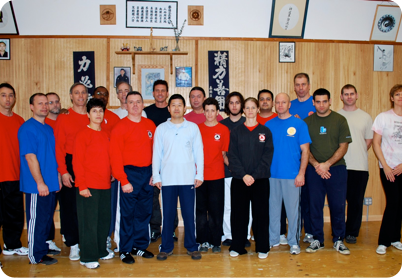
Chen Zhonghua New York 2009 Workshop Group Photo
I was born with a weak constitution and relied on martial art training for my health recovery. Later on I met Grandmaster Hong Junsheng who transmitted Practical Method to me. Over dozens of years I repeatedly practiced it and benefited from it. I did not dare to take it as my own and vowed to pass it on. Another dozen years made me realize that I did not know enough to be a master. I therefore went to study from Grandmaster Feng Zhiqiang by devoting another dozen years to learning. Again, I gained a bit more knowledge and ability in taijiquan.
When I was young I believed that I was smart. Approaching the half mark in my life I realized that I was not. Taijiquan is not made for the average. It is not for smart people; slow people; light-hearted people; nor stubborn people. It is designed for those who are persistent, and focused. One must let go and be enlightened.
Daqingshan Mountain is pretty, picturesque, tranquil, and deep. It is a clear piece of land in crowded China. One can practice and meditate in between land and clouds. I chose this bit of special soil to start my teaching, to make friends with the like minded and to entertain myself. When the art is not perfect, one can continue to learn. When one is not enlightened he can seek.
The rock of Daqingshan, might be jade.
传承是练拳习武的首要问题,然而给这个问题一点思考的人极少。无论国内国外,崇拜师父是最突出的表现。 Read more
洪式太极拳家王宗宪先生简介 Read more
At a higher level, stretching moves are changed to arching moves. Arching is really a way of extension without stopping the energy flow.Arching is more stable than stretching. However, arching creates less distance than stretching.
Some examples:
Another way Master Chen teaches the students how to stick to your opponent. Master Chen believes that one of the most common errors in modern Taijiquan training is the use of other energies before “Squeezing” (press) energy is developed. The sequence of the primary four energies are:
Peng as a initial energy
Lu as a change of direction based on Peng
Ji as a step in (further energy) in addition to Lu, and
An as a result of the three previous energies.
Most people perform the four energies in an unrelated manner. They will not have progression in this way.
In the video clip below, Master Chen Zhonghua shows how two people are tied up with rubber cords to experience “snot” (sticking) energy. The aim is to make the lower body move and power up, while making the upper body to adapt and to adhere.
The knees are hinge joints, unlike ball joints. They only allow the thigh to move up and down. They cannot move horizontally.
When I asked Master Wang Haizhou of the Zhaobao Village what Bei Si Kou is, he said, You throw a silk (like a spider’s web) net on him. He will struggle until he cannot move any more. Then it is your time to do something.
These two types of movements form the proper physical structure for our taiji practice.
Taiji uses a type of energy generated through spiral movements. This energy is constantly powered. Momentum is a great energy source that is abundant in everyday life. Many other martial art forms use this energy. Taiji does not.
Present at the class: Clinton Jurke, Allan Belsheim, Trevor Juuti, Alex Nay, Scott Hess, Camille Lipford and Blake Norman.
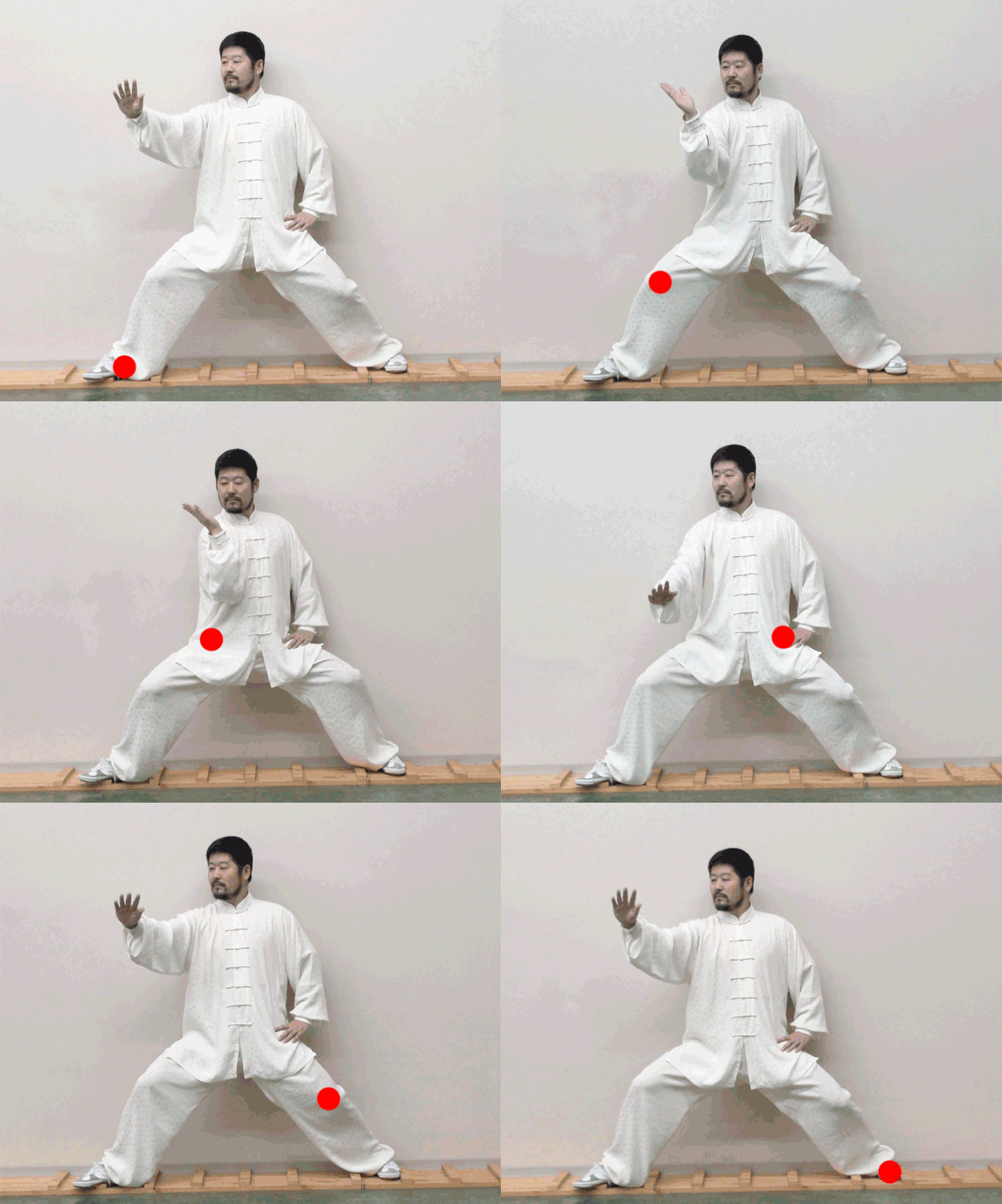
In this animation model, I tried to show how the energy moves in a line of energy from front hand to the rear foot. 在这个幻影里,我演示前手到后脚的劲路方向
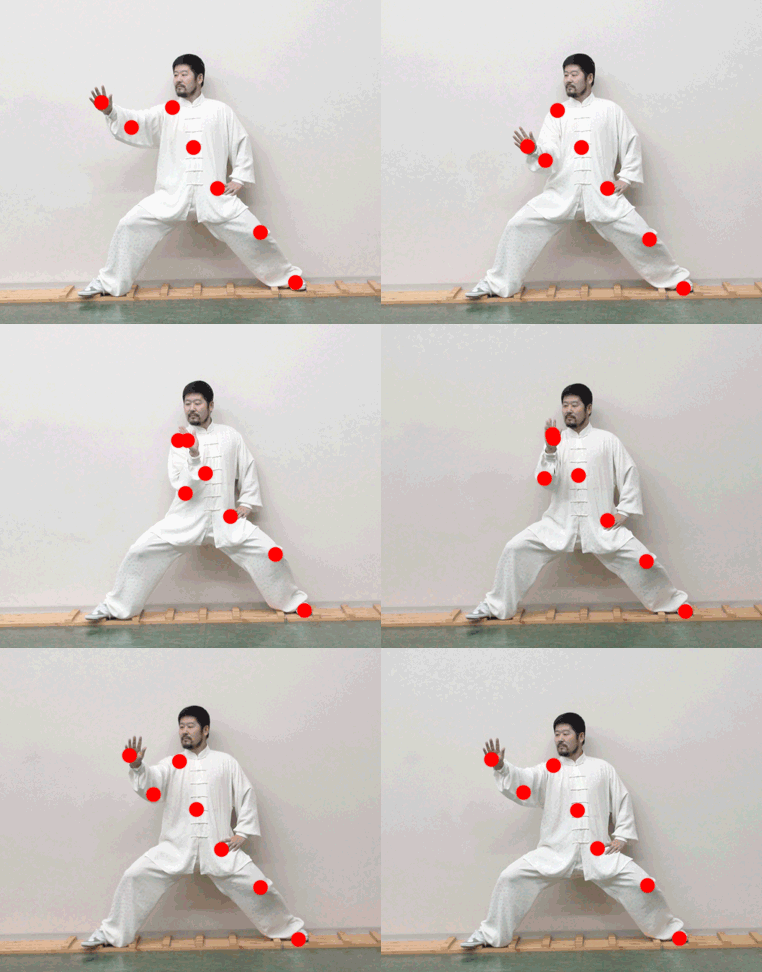
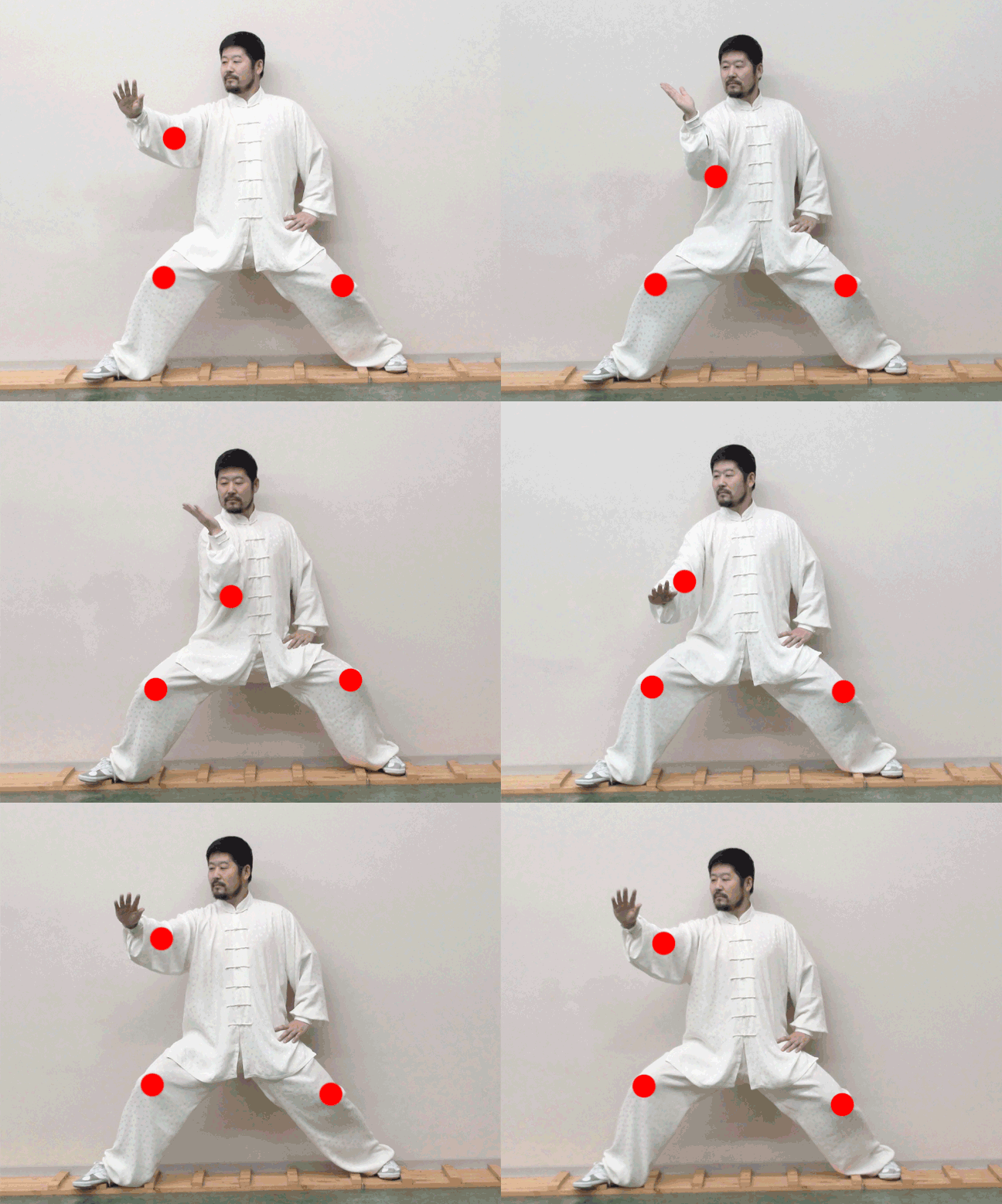
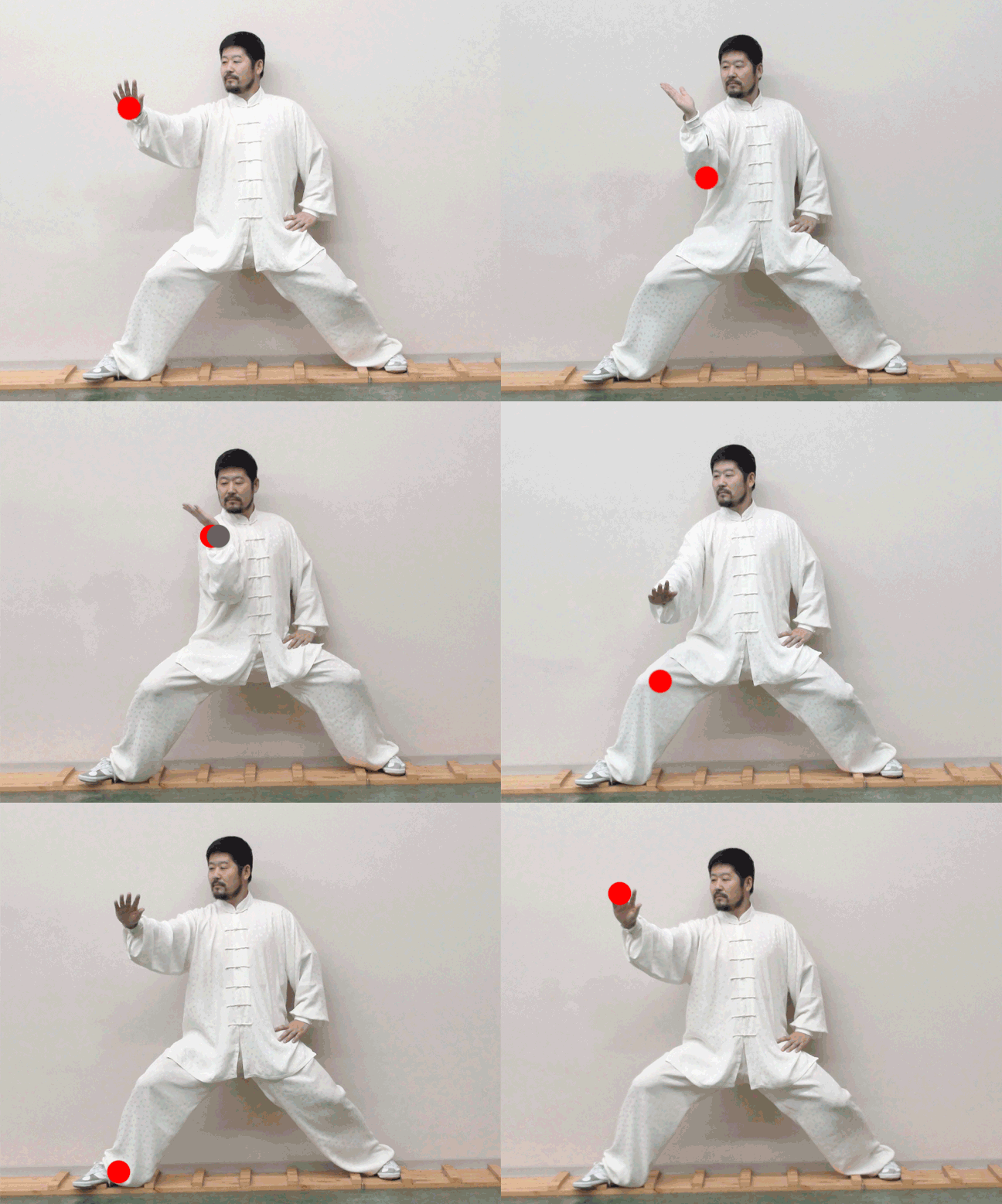
What are the Three Pans of Taiji?
Lian : 炼
2007-10-01
Smith, Jay
Yilu – The knees are more locked in properly now. His stance is much more stable.
Good deeds leave no traces behind; Good advice contains no blame;and Righteous calculations come without thought. Read more
Xian (1) Ru (4) Wei (2) Zhu (3) 先入为主
Xian: first, early, before
Ru: enter
Wei: become, be
Zhu: host, master
“One who enters first is the host”. The second part of this idiom is “He who enters later is the guest.” This is a special type of idiom in Chinese. It is called “Xie Hou Yu”. In using it, the speaker leaves out the conclusion. The listener has to fill the gap. This is a clever play of language, however, it also causes confusion or problems when the listener does not have the necessary knowledge to complete the whole idea.
When Richard Nixon went to Beijing to pay an official visit to Chairman Mao in 1972, Mao started the conversation by saying that he was an old monk holding a broken umbrela. The unspoken conclusion of the idiom is “No hair, no sky.” The meaning of the unspoken part is, “For me, I am above all laws, even God.” Nixon’s interpreter did not know this particular idiom. He made a mistake by interpreting the Chairman’s idiom into “I am humbled to meet you.” This small error in interpretation made history.
Other examples of Xie Hou Yu.
Let’s go to the second part of this lesson: the relevancy of this idiom to Taiji.
In learning, whatever is introduced to you first becomes the standard for your subsequent learning. This is a nasty and stubborn problem for everyone. The proper learning process should/must involve learning new things and eliminating previous mistakes. This is the ideal situation but in reality, it does not work like that. Xie Ru Wei Zhu is the dominant method of learning. It is the default learning mode. This mode actually overrides the ideal scenario of learning and the elimination of mistakes. Fist of all, when the wrong thing is set as the standard, you won’t learn anything correctly. Secondly, you won’t have the ability to find out the mistakes to eliminate them.
Now you realize that whether you are right or wrong is largely a toss up.
What do we do from here? How can we get rid of this pesty Xian Ru Wei Zhu?
Grandmaster Hong Junsheng offered a few advice:
Transmission has to be directly from one person to another. Simple and straight forward. It cannot be that there are one million justifications but no transmission. What should we look for in a transmission? 1. Did the two people in question meet? How long were they together? Were there others present? Is the choreography identical? Are there others in the class who also have identical choreography?
Taijiquan is a physical science. It is not a belief system. Do not trust yourself. Use physical measurements and objective standards. Do not trust your instinct. Do not go with the flow.
Use simple tests. Do not devise complicated tests that involve too many parameters. Many of the parameters are falsely established. Many of the “Taiji Principles” in classics are simply erroneous. For example, the story of Chen Fake’s learning grew from 10 yilus a day to 20 a day, then 40 a day and eventually 100 times a day. Some even claimed that he did Yilu and Cannon Fist a hundred times a day! People quoted these unfounded claims exactly the same way gossip is spread in tabloid papers! I asked Todd Elihu, John Dahms, Dave Dahms and others to complete 100 yilus in a day. They started at 4:30 in the morning and went till past 9:30 at night. They had prepared food ahead of time to save time and did not take lengthy breaks. They were able to do 100, 104 and 110 respectively.
Just imagine that. It is certain that Chen Fake did not practice from 4:30 in the morning till 9:30 at night each day for many years!
LET GO of the precepts, principles, habits, ideals, beliefs and techiques you hold to be dear! Embrace the simple practical method. You will see yourself improve quantumly.
Open: shun Close: ni Shun: the arms move towards own body. Ni: the arms move away from own body.
“When you follow the rules to the extreme, every unintentional action becomes part of the form!”
—Hong Junsheng Read more
Thursday, 15 November 2007
The shoulder cannot move sideways on its own.
It can move downwards and rotate on its seat. It must always staying right on top of the kua.
Feng Zhiqiang is the ultimate example of Taiji. He is a paradox and a harmonized contradiction. He is the most common retired old man and yet the most feared legendary master. He is our only link (as of 2001) to the time of fists and swords, of legends and heroes, and of dedication and bitter struggle to survive. Read more
In this video Gordon Muir and I demonstrated how to match your opponent’s power with your angle changes and other subtle adjustments. Read more