Dynamic Pairs in Action 3

by Ming on 2026/10/11

Universal Logic of Relationship
The Universal Logic of Relationship

Most people view martial arts as a collection of techniques: strikes, stances, and sequences to repeat. But Taijiquan, practiced at its deepest level, is a living grammar written in bone, breath, and timing.

This essay explores the moment philosophy stops being abstract and begins to animate the body. Drawing on the teachings of Masters Hong Junsheng and Chen Zhonghua, it traces how the relational logic of the Daodejing takes its most literal form in the coordination of a turning waist and a sinking elbow.

Through a close analysis of three classical movements, a startling claim emerges: every Taiji movement is a sentence with its own syntax. When the structure is flawed, the meaning collapses, and the failure is mechanical rather than aesthetic. In this system, power isn’t generated. It is earned through correct relationship. This is for anyone who suspects the body knows things the mind hasn’t yet mastered.
(This article is based on the lecture notes Dynamic Pairs in Motion
Toronto, 2010.
)

Thinking about Taiji grammar
This series moves through three interlocking scales. In Part 1, we reframe Taijiquan as a grammar rooted in Daoist dialectics. The shift is from static “nouns” to relational “verbs,” and it shows how the Daodejing and Zhuangzi function not as philosophy but as a technical manual for the body, where power resides in the logic of interaction rather than in any isolated part. Part 2 grounds this theory in the uncompromising mechanics of the Chen Style Practical Method. It traces how the kua and peng physically enact this grammar through a kinetic chain of mutual successions, where one thing does only one thing, and structural integrity is the result.

Part 3 brings this grammar to life through the form itself, analyzing three classical movements as complete sentences of action. Each one tests whether the body can sustain correct relationship under real conditions. Here, the principles stop being understood and begin to be inhabited.
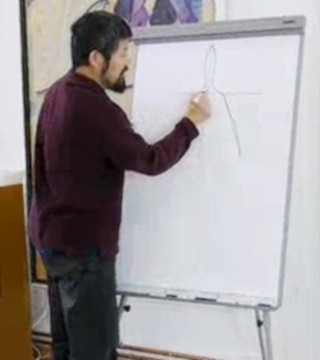

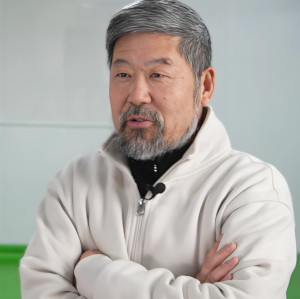
Master Chen lecturing
Part Three: Forms as Language

Part Three: Forms as Language

With the mechanical basis established, the question shifts from how movement functions to how it is organized and expressed over time. Taijiquan operates through relational differentiation: each part of the body assumes a distinct function, and coherence arises from how these roles work together rather than from any isolated component. At this stage, movement can no longer be adequately described in terms of fixed shapes or postural positions. What appears externally as “form” is instead a structured sequence of actions, each defined by its role within an evolving whole. When the waist turns, the elbow sinks in answer, and neither action means anything without the other. This “sentence” structure of Taiji movement is a continuous unfolding of verbs of mutuality (相). No action stands alone. Each exists only through its connection to the others, generating, completing, and transforming according to the same grammar articulated in the Daodejing (道德經) and Zhuangzi (莊子).

Taiji Movements as Sentences of Action

Master Hong Junsheng’s statement that Chen-style Taijiquan is grounded in the interplay of Yin (陰) and Yang (陽) finds its concrete meaning here. This interplay is not a blending into uniformity, but a sustained differentiation within continuous connection. Through this differentiation, movement becomes intelligible, and power becomes mechanically available. The philosophical principles stated in the Daodejing and Zhuangzi are no longer abstract; they are enacted directly through the body.
A clarification is needed here. A “verb” refers to functional action, an operation performed by a part of the body, and not to language in the literal sense. A “relation” refers to the structured coordination between these actions across the system as a whole. The claim is that this model is structural, and it can be tested. If the model is right, errors in the roles should produce predictable failures. Merging two roles in one part produces the problem of double-weight. Reversing the order of two actions interrupts transmission. Dropping one action leaves a leak of power, as when the hands close and the elbows do not seal. Each failure can be felt by the practitioner and found by a partner.
As in a sentence, wrong word order or a missing word weakens the message. In the body, wrong order or a missing action weakens transmission. A word asked to carry two meanings muddies a sentence. A part asked to carry two roles muddies the movement. Structure is an objective standard defined by principles. Whether each role is distinct, correctly ordered, and properly timed can be checked by the practitioner and by a partner, independently of the result. When the structure conforms to Taiji theory, the result follows. When the result fails, the structure is the place to look. A well-formed sentence delivers its message, and its author does not blame the delivery. The author revises the sentence. In the same way, the practitioner may try different structures to suit the situation, but the principle is not in doubt. A purely figurative vocabulary would predict none of these failures. “Living grammar” and similar images illustrate the model. A correct sentence delivers the message. The structure carries the claim.
From this perspective, a Taiji movement is a sentence to be enacted, not a position to be held. Its meaning does not reside in any single posture, just as the meaning of a sentence does not reside in any single word. It emerges through the timing, ordering, and coordination of actions across the body. The movement does not conclude in a final shape. Like a sentence, it resolves only by giving rise to what follows.

The Form Analyses

This shift in perspective allows us to read the classical curriculum as the working expression of the Taijiquan Classics, the foundational texts of the art, a course in structural integrity rather than a series of aesthetic postures. By examining the mechanical requirements of specific movements, we can observe how these relational verbs appear in the physical body.

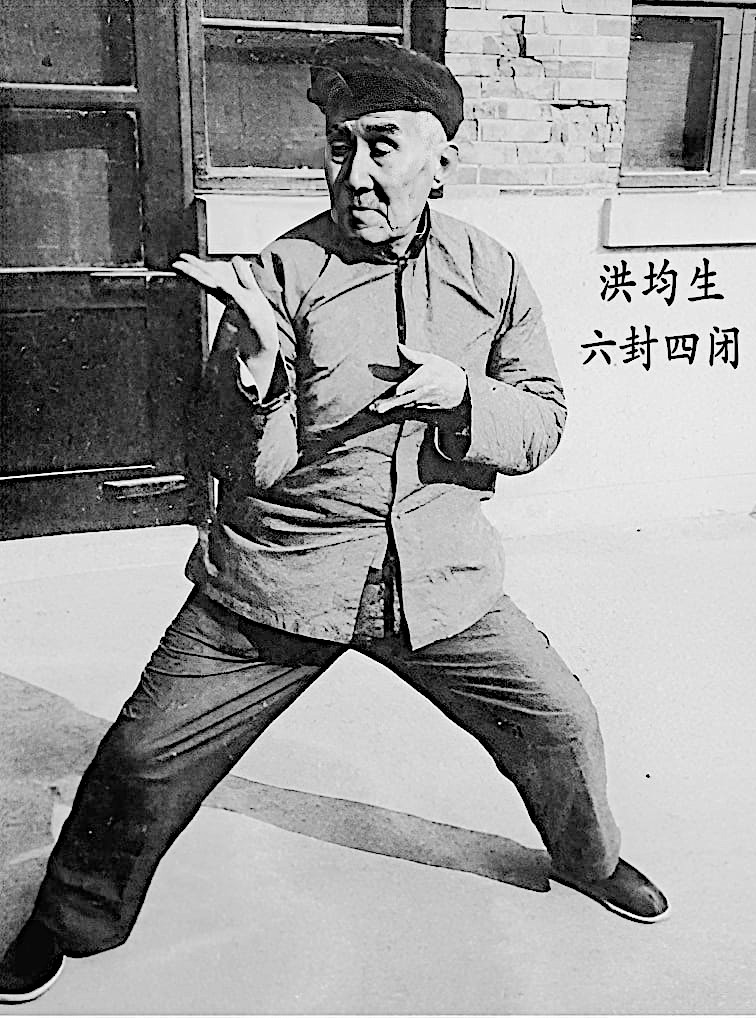
I. Six Sealing Four Closing — The Sentence of Containment and Release

Six Sealing Four Closing (六封四闭) provides a clear entry point into this mode of analysis because its structure unfolds through successive phases, each carrying all the roles at once. The name itself encodes its function: sealing (封, fēng) and closing (闭, bì) describe a set of coordinated actions directed inward rather than a visual posture. From the outset, the movement presents itself as a relational process, not a static configuration.
As it develops, the body organizes into a series of functional roles. The hands draw inward, the elbows sink and seal, the chest contains, the kua folds, and the legs establish a stable root. These actions do not occur independently, nor do they collapse into a single undifferentiated motion. Each part performs a specific function, and the movement holds together because these distinctions are maintained.
This may be expressed as a complete relational sequence:
“The hands close, the elbows seal, the chest contains, the kua folds, the legs root.”
Master Hong demonstrate Six Sealing Four Closing
The character of this phase is predominantly Yin: inward, compressive, and gathering. Yet this gathering must not be mistaken for collapse. It is a structured containment in which each component contributes to a unified condition of storage while retaining its own role. If, for example, the hands close without the elbows sealing, the structure leaks forward. Containment fails, and effort is not the issue. The relational condition has been broken.
From this gathered state, a transition follows. The stored structure gives rise to its complementary phase instead of remaining static. The kua opens, the waist turns, and the hands expand outward. What was previously inward becomes outward; what was compressive becomes expansive. The movement resolves into a paired structure composed of two distinct but inseparable phases: closing (Yin) and opening (Yang).
Its effectiveness depends on the clarity of the relationship between the two phases, not on either one in isolation. If the closing phase is incomplete, there is nothing to release. If the opening begins prematurely, the stored condition dissipates before it can be expressed. Power, within this framework, is not added to the movement. It is conditioned by the transition between these phases.

II. Single Whip — Simultaneous Differentiation
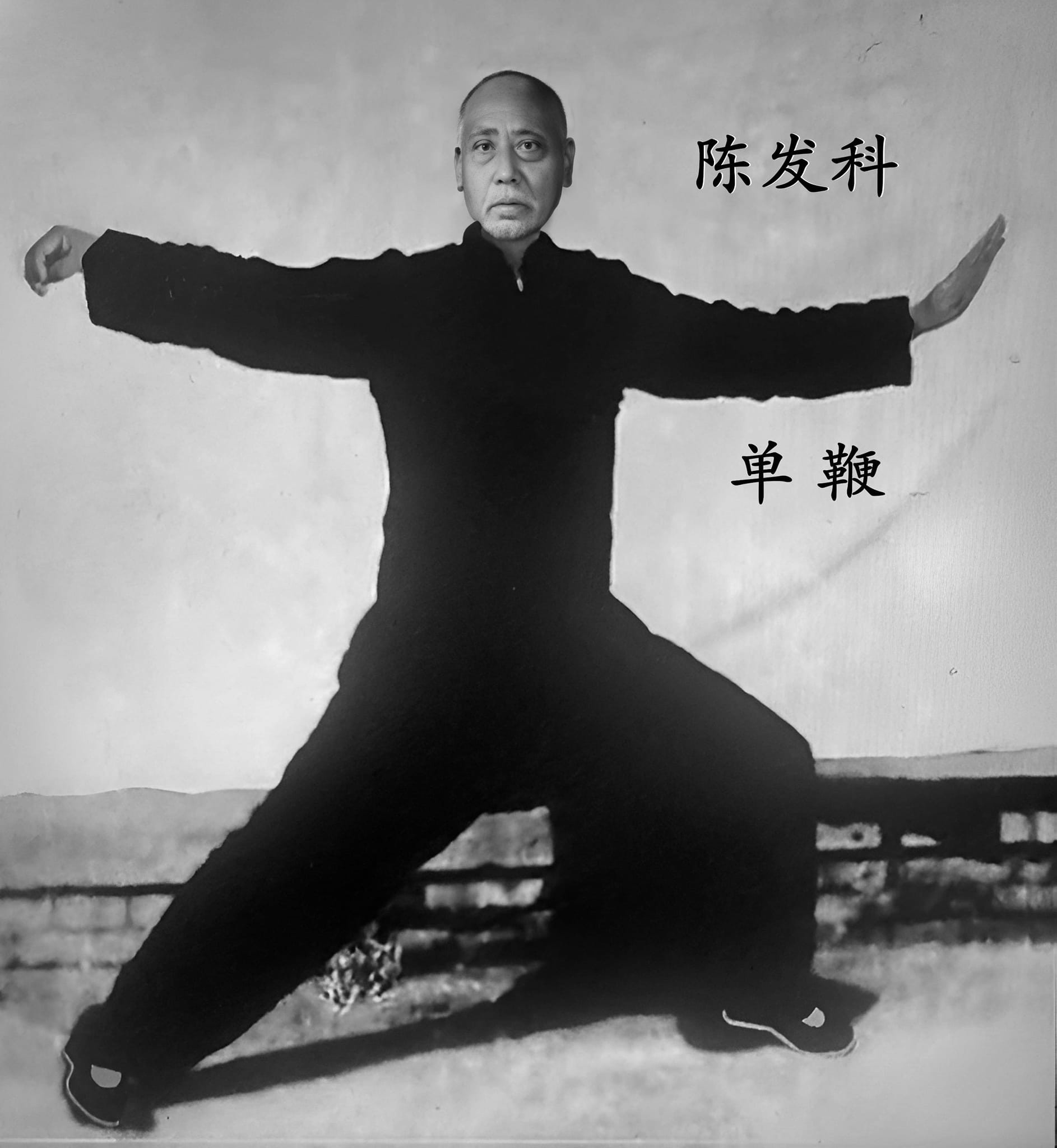
Six Sealing Four Closing moves between opposing phases, closing and then opening. Single Whip (單鞭) holds the opposing functions at the same time. The demand is greater because nothing is handed off: complementary roles must coexist in real time, each defined by the other. In this movement, the left hand gathers into a hook while the right hand extends outward; the elbows separate in opposing directions; the kua opens asymmetrically; and the legs divide into full and empty states. These actions do not alternate. They occur together, each defining and stabilizing the other.
Chen Fake demonstrate Single Whip
This may be expressed structurally as:
“While the left gathers, the right extends; while the elbows separate, the kua opens; while one leg roots, the other releases.”
The simultaneous differentiation in Single Whip exemplifies complementary opposition within the relational verb (相) structure: each side maintains its function by not becoming the other. This corresponds to the principle that relational unity depends on preserved distinction.
This demands imposes a higher level of structural requirement. If the right side extends without the left side genuinely gathering, the movement overreaches and loses its base. Conversely, if the left gathers without the right extending, the structure collapses inward, failing to project force. Neither side completes independently, and coherence arises only through the maintained opposition between them.
The mechanics are easy to check in practice. When extension occurs without corresponding gathering, the center of mass shifts beyond the base of support, producing instability under pressure. The failure is one of relational organization, not of strength. Single Whip refines the principles established earlier. Differentiation across phases can be trained step by step, one phase following another. Holding differentiation at a single moment is harder, because opposing functions must be sustained within one unified condition. The movement is a continuous field of coordinated tension, with no stages to move through.

III. Small Red Fist —The Integrity of the Kinetic Chain
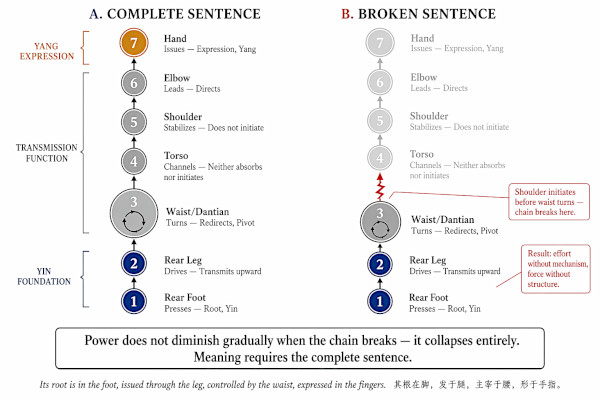
If Single Whip holds opposing functions across the body at once., Small Red Fist (小紅拳, xiǎo hóng quán) clarifies how these differentiated actions are linked into a continuous chain. Performed along a central axis, the movement uses the lower body to drive a compact, inward-turning fist while the rear hand maintains control of the opponent. Despite its name, which suggests aggressive intent, the technique prioritizes whole-body structure over the localized effort of an isolated arm punch. What looks like a single action from outside is organized inside as a chain that runs from the ground through the legs, waist, and arm to the point of contact. Against a resisting opponent, the test is simple: the chain either carries the force through the contact point or it breaks at the weakest link, and the practitioner feels where.
This chain is not merely sequential but relational. Each segment gives rise to the next through a process of mutual succession (相隨), in which no part acts independently and no phase can be omitted without disrupting the whole. In this sense, the movement does not “add” actions together; it allows one phase to resolve into the next without interruption.
Importance of a the chain in a complete sentence
The effectiveness of the whole depends on the integrity of these connections. If the shoulder initiates before the waist has turned, the sequence begins without accumulated force. If the hand issues before the elbow establishes direction, the final action lacks support. Both are errors of trying to do more and gaining less. A break at any point in the kinetic chain interrupts transmission and does more than reduce power. Where continuity is lost, “doing” takes over
This clarifies the classical warning against double-weight. It is more than excess tension. It is a collapse of functional distinction, in which one segment attempts to perform multiple roles at once. In push hands, the same collapse appears between two people. The chain either coheres or degrades. Degrees of connection may exist, but full effect depends on the continuity of the whole.

From Movement to Expression: Learning to “Write” the Body

As training progresses, the practitioner’s focus shifts. In the early stages, attention is directed toward external form: the visible shapes and sequences that define the practice. With time, this attention moves inward, toward the relationships among actions across the body. Movement is no longer judged by appearance alone but by the clarity with which each part fulfills its role.
At a more advanced stage, timing becomes central. The practitioner begins to regulate not only what actions occur, but when they begin, how long they are sustained, and how they resolve into subsequent phases. Initiation, duration, and release form a temporal structure that underlies all movement.
To “write” movement in this sense is to organize both structure and timing into a coherent expression. The body no longer performs isolated techniques. It composes continuous sequences in which each action gives rise to the next. The correspondence to language becomes exact: meaning is carried by the arrangement of elements across time, not by the elements themselves.

Push Hands: The Grammar of Interaction
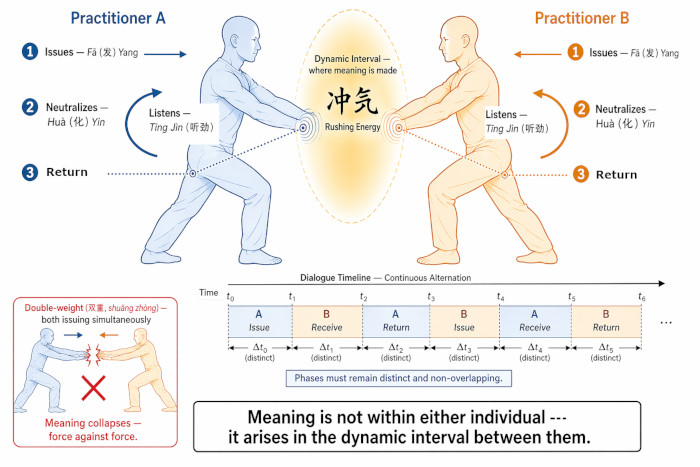
If solo practice develops internal coordination, push hands (推手, tuī shǒu) extends this structure into interaction. What was previously internal becomes relational; what was organized within a single body must now function across two. Push hands is cooperative, so it tests whether the structure survives contact with a live, changing force. Application tests whether it survives the unpredictability of a real encounter..
Between two partners, interaction can be understood as a cyclical process in which force is issued, neutralized, and returned. The three phases are not interchangeable. Issuing establishes direction and intent, neutralizing reorganizes incoming force, and returning completes the cycle by sending that force back. Each phase must remain functionally distinct. If issuing overlaps with neutralizing, incoming force cannot be clearly resolved. If returning begins before neutralization has finished, the response lacks structural coherence.
Pushhand as communication
The clarity of this cycle depends on a primary condition that runs through every phase: listening (聽勁; tīng jìn). When one partner issues, the other listens. In turn, each listens to how the other neutralizes. Listening is an active sensitivity, not passive awareness, that detects direction, magnitude, and change through contact. It allows the practitioner to register incoming force without prematurely imposing a response. To act without listening is to move blindly; to listen without responding is to disengage from the exchange. Both must remain present, and their distinction must be preserved.
What listening detects makes timing possible. At more advanced levels, timing becomes the decisive factor. The practitioner may choose to respond only after an incoming action has fully developed, or to enter before it has completed. Control comes less from force than from the regulation of when actions occur within the exchange.
Within this framework, stillness takes on a specific function. It is not the absence of action, but the presence of stored potential: a condition in which structure is maintained without initiating movement. This stillness invites response while preserving readiness, forming an integral part of the interaction rather than a withdrawal from it.
Failure within push hands most commonly appears as double-heavy. Within one body, it is power on the same sides at once. Between two partners, it is when they clash together at the same moment. In both examples differentiation collapses and force meets force, with no coordinated exchange. Under real resistance the incorrect structure gives way first.
Different movements express different interaction patterns. Six Sealing Four Closing organizes containment and release; Single Whip sustains simultaneous differentiation; Small Red Fist emphasizes direct projection. These are distinct relational configurations that govern how interaction unfolds, not stylistic variations.
As skill develops, the speed of execution increases, but the underlying differentiation remains intact. The phases compress in time, yet do not merge. The practitioner is able to maintain clarity of function even under rapid change.

Completion: From Structure to Language

Push hands and applications completes the progression from internal structure to external interaction. Structure organizes the body, actions define relationships, movements coordinate these relationships across space, and timing regulates their expression across time. These elements are not independent. Structure without timing remains inert, and timing without structure lacks coherence. Only through their integration does movement become functional.
What remains is to ask how this grammar is learned, and what it becomes once it is lived.

Closing

In classical instruction, it is often said:
“Use intention, not force.”
用意不用力。
In this light, the statement becomes more precise. Intention governs the timing and articulation of movement, determining when, and with what quality, actions are expressed. Structure governs the roles of each part, ensuring that every function remains distinct and properly coordinated. When both are aligned, movement acquires clarity, and power arises as a consequence of correct relationship. This is where analysis begins to give way to practice.

The Embodied Literacy of the Lineage

There is a moment in advanced Taijiquan practice that every serious student eventually encounters. The movement has been trained for years: the sequences memorized, the principles understood, the corrections absorbed. Then, in a single exchange with a partner, something shifts. The body responds before the mind has decided. The verb occurs without consulting the noun.
What was studied becomes lived. And what is lived reveals itself to have been present in the classical texts all along, as description rather than instruction. The analysis did not produce the spontaneity. It prepared the body to receive it.
The shift from conscious construction to spontaneous expression is not merely metaphorical. It can be understood as a feature of the Practical Method’s pedagogy. It is no coincidence that the language of grammar and syntax maps so closely onto this art. Master Chen Zhonghua, drawing on his background in linguistics, has used this framework to clarify complex bodily mechanics. The lens is new in vocabulary, but the demand behind it is not. Master Hong had already treated Taijiquan as a discipline of structural correctness, explaining his teaching in the language of calligraphy.
In his essay On the Importance of Fundamentals, Master Hong argues that practicing Taijiquan is inseparable from the logic of the brush, making correct fundamentals the ground for future progress. If a student cannot execute basic strokes correctly, they cannot compose a meaningful character. In Basic Skills for Beginners in Tai Chi (初学太极拳入门基本功), he explains that just as a beginner must write slowly to understand brush technique, a Taiji practitioner must move slowly to perceive the Positive and Negative circles, the foundation of the Practical Method and what we can call the alphabet of the system.
Master Hong formalizes this connection between the martial and the literary in the preface to Hong Style Tai Chi Character and Preface (洪式太极拳品并序), where he asks:
Poetry has character; calligraphy also has character.
The ancients examined these through writing —
can Taijiquan be without character?
「詩有品,書亦有品,古人嘗品之而著為文章,拳可無品乎?」
Master Hong
By invoking pǐn (品), which can be rendered character, quality, or grade, he places Taijiquan within the same evaluative framework as the high literary arts. A stroke in the air and a stroke on paper are governed by the same demand: precision, structure, and internal coherence. One of his students recalled his directive: “Write as you practice Taiji.” The instruction is literal. It demands attention to the orthography of movement, meaning the correct form of each stroke and the correctness of the internal mechanics behind it.

The Map and the Territory

The journey from philosophy to practice is a recognition, not a translation.
The Daodejing encodes being and non-being giving rise to one another, and difficult and easy completing one another, in the structure of xiāng (相). That structure is a reality to be inhabited rather than a position to be held. The practitioner who has trained long enough no longer thinks about Yin and Yang. They move, and in that movement the ancient structure reappears: the verb governing the noun, relationship generating form, the charged interval between poles producing the next phrase. This is the embodied literacy that Master Hong and Master Chen have devoted their lives to documenting.
The
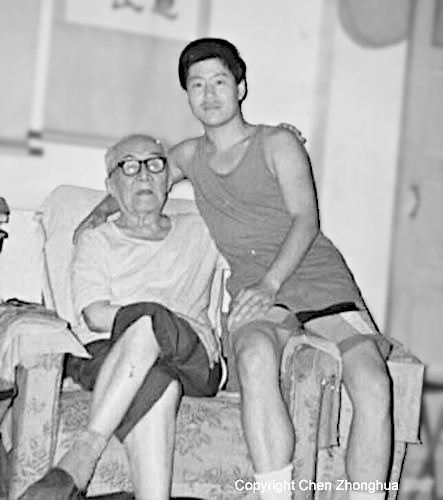
Teacher and Disciple.
The Heart of the Lineage.
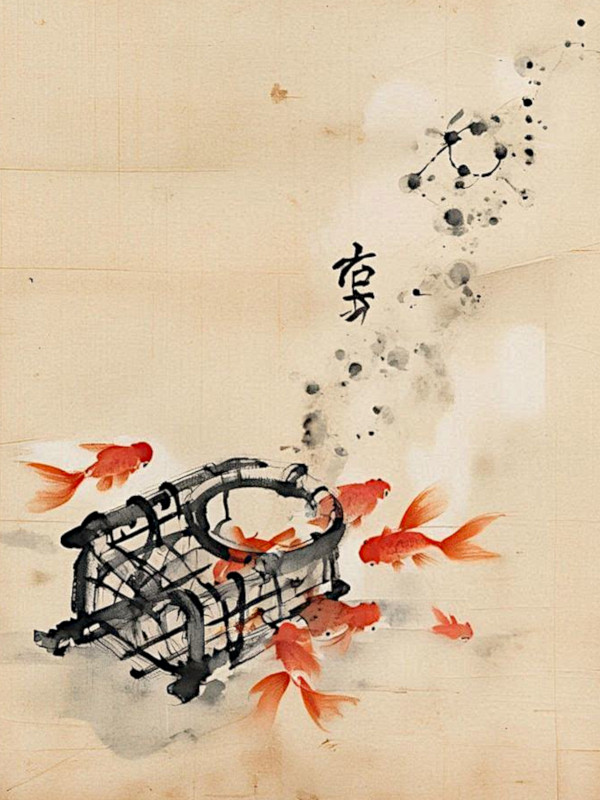
As Master Hong insists, these principles are understood physically first and intellectually second, never the other way around. Intellectual understanding is the fish trap, not the destination. The Zhuangzi‘s fish trap analogy holds that the trap can be discarded once the fish is caught. The fish, the living realization of these principles, is caught only through years of practice under pressure. Yet the trap retains its value, and its value changes with the stage of training. In the early years, the model sorts errors and directs practice. In the middle years, it lets a teacher and student speak precisely about a correction. Later, it recedes, but it remains available to diagnose a failure when the body’s response falls short. To understand why the kua must pivot rather than thrust, or why peng must be maintained at the threshold, clarifies the purpose of training and does not replace it. It provides a map detailed enough to recognize the territory when the body finally enters it.

The Unbroken Thread

The classical texts, the technical instructions of the masters, and the living tradition are not separate domains. They are expressions of the same relational logic at different scales. The Daodejing describes it cosmologically. The Zhuangzi dissolves the fixed identities that resist it. Wang Zongyue, the classical author of the Taijiquan Lun, translates it into principles of movement. Master Hong encodes it in the calligraphic character of form. Master Chen enacts it through correction, where every part fulfills exactly one role.
This thread runs from the empty hub of the wheel of the Daodejing, through the silk-reeling circle of Chen Taijiquan, and into the push-hands exchange of the Practical Method, where two practitioners enter a single relational field. At this level, the boundary between self and other becomes permeable without disappearing.
At advanced levels, the practitioner is no longer merely performing a system. They are participating in a process already underway, one the body joins only after long training. In that process, meaning arises from the relationship between parts and from the timing with which those relationships unfold.
The body does not arrive at a final form.
It enters the phrase that continues.

Appendix A: The Grammar of Efficient Running

The preceding sections have argued that the relational framework developed in this essay is operative within Taijiquan, and not merely descriptive of it. A further question remains: does this grammar illuminate movement that lies outside the tradition entirely? Running offers a test case of unusual clarity. It is a movement every reader has performed, a domain with its own well-developed analytical vocabulary, and a physical activity in which the difference between efficient and inefficient coordination is both measurable and directly felt. If the same verbs and relations that govern silk-reeling and issuing force (fajin) can be shown to operate in running, the claim gains considerably in force: this grammar describes something fundamental about coordinated movement, and not something specific to Taijiquan. If it cannot, the claim is limited to the art.
This comparison is not offered as instruction in running technique, nor as a claim that Taijiquan training produces better runners. It is a demonstration of analytical range. The same framework that clarifies the kua‘s function in Six Sealing Four Closing can explain the relationship between ground contact and forward propulsion in a stride. The grammar holds across domains.

A.i. The Biomechanical Perspective

Contemporary biomechanics approaches efficient running through the lens of energy management. The body is understood as a system of levers and elastic structures whose function is to minimize metabolic cost while maximizing forward momentum.
Within this account, efficiency is often explained through the stretch-shortening cycle: as the foot contacts the ground, elastic energy is stored in the tendons, principally the Achilles, and returned during the propulsive phase. Force is generated through the coordinated extension of hip, knee, and ankle, and transmitted through the body’s kinetic chain toward the center of mass. Inefficiency appears as energy lost to braking forces when the foot strikes too far in front of the body, or to vertical oscillation, where effort is directed upward and not forward. The nervous system partly manages this through reciprocal inhibition: as one muscle group contracts, its opposing group releases, preventing internal resistance from degrading the transmission.
This is a productive account. It identifies the sources of force, traces the path of transmission, and specifies where energy is conserved or lost. What it describes are the components, the energy relationships among them, and the quantities they produce. What governs their coordination, as distinct from their output, is where the relational framework adds something.
Running as biomechanics and language

A.ii. The Relational Perspective: Running as a Grammar of Verbs

Through the lens of the Practical Method, a running stride is not a “stride,” a noun and a unit of locomotion, but a continuous unfolding of relational actions. The question shifts from how much force is produced to whether the relationships between the body’s functional parts are correctly organized.
The primary distinction is the Yin–Yang separation between lower and upper body, defined here by function: the lower body is the base, and the upper body is the frame. The lower body functions as Yin: rooted, driven by ground contact, the engine of propulsion. The upper body functions as Yang: free, quiet but responsive, a frame through which transmitted force can travel without interference. This separation is a functional requirement and not a description of anatomy. When the torso rotates unnecessarily or the arms drive forward to “assist” the legs, the distinction collapses, and one part performs both roles. In the terms established in this essay, this is double-heavy applied to locomotion, producing internal noise instead of coordinated transmission.
The kua governs the boundary between these functions. It is the pivot at which ground reaction force, generated by the leg’s contact and drive, is redirected into horizontal momentum. When the kua operates correctly as a site of mutual transformation (相化), the force generated below does not leak into the lower back or dissipate through unnecessary spinal movement. It passes through. The torso is moved by the transmission that arrives through the kua from below, and not by its own muscular effort. One observable sign is the absence of visible torso twist at speed. This is wúwéi (無為) as biomechanical function: the upper body does not interfere, because interference would be a structural error, the body’s equivalent of a misplaced word.
The kinetic chain, viewed relationally, is an instance of mutual succession (相隨). The foot presses the ground; the leg drives upward; the kua redirects; the torso channels without absorbing; the arm swings as the counterbalancing expression of the opposite leg’s drive. No phase acts independently, and no phase can be skipped without breaking the continuity of the whole. Each action gives rise to the next not through sequential triggering alone, but through the relational condition that each phase depends on what precedes it and conditions what follows. The arm does not swing because the shoulder initiates; it swings because the ground has been pressed, and the chain has arrived there intact.
The condition that makes this possible is sōng (鬆). A tense runner compresses the functional intervals through which force must travel, and a collapsed runner dissolves the structure that gives transmission its direction. Efficient running, which coaches describe as “relaxed power,” corresponds closely to the condition the Practical Method identifies as the prerequisite for any relational verb to operate: release without collapse, structure without rigidity.

A.iii. The Difference in Approach

These two frameworks are not in competition. They operate at different levels of description, and each illuminates what the other does not.
Biomechanics asks what forces are produced and how efficiently they are transmitted. Its account is additive in emphasis: it measures the contributions of individual components and calculates their sum. Elastic energy return is a relationship between components, since tendon and muscle work as a linked system, but it is one measured in energy stored and released and not in role or function. Inefficiency is identified as energy lost to friction, to braking, and to vertical displacement. The framework is quantifiable and oriented toward output. A common training approach to increasing speed is to add strength, for example in the glutes and hamstrings, which can in turn create other problems such as knee imbalance.
The relational framework asks whether the governing relationships between parts are correctly organized. Its account is subtractive: efficiency comes from the absence of internal interference, and not from the maximization of force. Where biomechanics identifies a failure as energy leakage, the grammar identifies the same failure as a collapse of functional distinction, in which a part attempts to do more than its single role within the coordinated whole. Reciprocal inhibition is the nearest biomechanical counterpart to functional distinction: one muscle group releases so that another can do its work without interference. To increase speed, it suggests improving the transfer of energy from the ground to the kua, so that the force already produced arrives intact. This difference can be checked: a coach could compare a runner who adds strength with a runner coached on transmission from the ground through the kua, and measure speed, joint load, and injury over time.
A runner may need both: strength where it is lacking, and clean transmission so that strength is not wasted. Several running methods already emphasize the second. The Pose Method of Running, developed by Dr. Nicholas Romanov, presents running as a skill with its own theory, concepts, and exercises [Romanov, 2002]. It breaks the running gait into a sequence of postures. ChiRunning, developed by Danny Dreyer, holds that greater speed and distance come with less effort through posture, alignment, and relaxation using Taiji as an analogy [Dreyer and Dreyer, 2004]. No coach uses this exact relational framework of the Practical Method, and the point is the shared idea. Both methods for running are biomechanical in nature, and each offers an alternative to adding muscle strength by treating efficiency as a matter of organization instead of added output. Together they show this idea at work in running practice.
The grammar makes visible the organizational logic beneath the mechanics. Force transmission through a kinetic chain is a biomechanical observation. The principle that each node in that chain must perform exactly one function, and that coherence depends on maintaining that distinction, is a claim about organization. The two are compatible and mutually reinforcing. Between them, they describe what efficient running produces, why it is organized the way it is, and what specifically fails when it breaks down.

A.iv. What the Comparison Reveals

The value of this comparison lies in what it supports about the framework itself, and not in what it says about running.
The relational predicates identified in the Daodejing include transformation (相化) and succession (相隨), which running illustrates. They are not categories imposed on Taijiquan from philosophical tradition. They are structural conditions that appear to hold wherever coordinated movement is analyzed with sufficient care, and running gives reason to think so. The kua as a pivot of mutual transformation and the kinetic chain as mutual succession are the same organizational principles, operating in a different body moving through a different task. The upper-lower distinction as functional Yin–Yang separation follows the same pattern. The images illustrate, and the structure is the same.
This consistency supports the central claim of this essay. The grammar of relational verbs appears to be a structural description of how coordinated action works in domains where parts must function together without interfering with one another. One favorable test case does not settle the matter, but it does move the claim beyond a cultural artifact of the Daoist tradition or a stylistic framework particular to internal martial arts. It points to wider application.
The verb does not belong to Taijiquan.
It belongs to movement itself.

The Relational Logic of Artificial Intelligence —
A Partial Application

The practitioner who has internalized this grammar eventually moves without consulting it; the ancient structure operates below the level of deliberation. Yet the framework developed in this work may suggest a logic that does not stop at disciplinary boundaries. It is a relational structure in which power resides in the verb governing a connection and not in either pole alone. The framework seeks to resolve the confusion of mistaking static nouns for the dynamic reality that only verbs can produce. While derived from classical Daoist texts and tested through the rigor of embodied practice, this approach may carry implications beyond the body.
The question can now be asked: what happens when this same relational logic is applied to a system that has no body, with no kua to pivot, no peng to maintain, and no silk-reeling to encode differentiation into muscle? The same grammar that governs the relationship between peng and fajin, or between the kua and the structures it stabilizes, can be applied, carefully and with explicit qualification, to other complex systems. The relationship between artificial intelligence and human intelligence is one such domain. If Taijiquan is a language of coordinated relationships, the interaction between human and machine can be read using the same verbs and relations, shifting the focus from the “entities” themselves to the “verbs” that govern their connection.
This appendix offers that application. It is not presented as an equivalent case. It is an extension, and the argument of the essay does not depend on it. If the comparison fails, the framework still stands on the evidence of the main text and the running test. AI has no body, no qi, no capacity to experience the differentiation of substantial and insubstantial. It cannot enact Yin–Yang separation; it can only model patterns derived from it. The comparison is therefore functional, not ontological: it shows how the grammar operates in a domain where embodiment is absent, and so reveals what embodiment contributes that a system without a body cannot replicate.
The reader is invited to hold this comparison lightly, as a fish trap in Zhuangzi’s terms: useful for catching the fish of understanding, and to be set aside once that understanding is secured. The trap is not the fish. The appendix is not the practice.
What follows is an attempt to think clearly about a new relationship, one that the classical texts could not have anticipated but whose logic they nonetheless illuminate.

B.i. The Wrong Question

The dominant question asked about artificial intelligence (is it conscious? does it truly understand? can it replace human thought?) is, from a Daoist perspective, poorly framed. Each question seeks to define what AI is, to locate its essence, and to assign it a fixed noun. This is the category error the Daodejing warns against at its foundation: the attempt to locate reality in substance and not in relationship.
The more productive question is how AI relates, and not what it is. The task is to ask what verb governs its connection to human intelligence, and not what noun it occupies.
This reframing does not resolve every philosophical question about AI. Those questions remain open. The reframed question makes them easier to approach. When we stop asking whether AI is a threat or a tool, a mind or a mechanism, and begin asking what specific relationship it enters into with human intelligence, the ground becomes more stable and the analysis clearer.

B.ii. The Relational Verb: Reflection

Within the framework developed in this work, every productive relationship is governed by a specific verb. The verb does not describe what either pole is. It describes what they do together.
The verb that governs the relationship between artificial and human intelligence is mutual reflection (相照, xiāng zhào). AI reflects patterns of human thought through computation. Human intelligence, in turn, recognizes its own structures through interaction with AI. Meaning in the exchange arises between them. The reflection is the relationship, and the relationship is where meaning resides.
This is a structural description, and the examples illustrate it. When a practitioner pushes against a partner’s arm, neither arm contains the meaning of the exchange. The meaning is in the dynamic interval between them, in the specific verb that governs their contact. When a human engages with AI, neither the human nor the system contains the insight that emerges, though here only one pole is embodied. It arises in the exchange itself, in the quality of the reflection.
The Zhuangzi offers an image for this:
“The perfect man uses his mind like a mirror. It grasps nothing, it refuses nothing.”
至人之用心若鏡,不將不迎。
AI is a reflection of the self
This mirror arises from emptiness and non-attachment, a cultivated condition of openness that allows reality to appear without distortion. AI does not possess this quality. Its reflection is produced through data accumulation and algorithmic processing, and not through emptiness or awareness. The similarity is functional, not ontological. AI reflects in the way a polished surface reflects: accurately within its range, but without the living responsiveness that Zhuangzi describes.
Yet the functional similarity is real and worth examining. Within its range, AI offers something that human intelligence rarely provides for itself: a patient, consistent, and structurally exact reflection of patterns that would otherwise remain invisible. The practitioner who has trained for decades carries assumptions so deeply embedded that they no longer appear as assumptions. The mirror, however mechanical, can reveal them.

B.iii. Yin–Yang Separation in the Human-AI Relationship

For the reflection to function, the two poles must remain distinct. This is the principle of functional exclusion (相斥, xiāng chì) applied to a new domain.
Human intelligence brings embodied experience, contextual judgment, ethical sensitivity, and the capacity for understanding rooted in lived reality. These properties arise from having a body, a history, and a stake in the world, and they cannot simply be computed. This is the Yin pole of the relationship, defined here by function, as before: deep, rooted, and generative in ways that are not fully visible from the outside.
Artificial intelligence brings computational exactness, pattern recognition at scale, tireless consistency, and freedom from the particular biases that embodied experience introduces. These are real capacities. They complement human intelligence and do not substitute for it. This is the Yang pole: expressive, expansive, and exact within its domain.
For the relationship to function, neither pole should attempt to become the other. Human intelligence that tries to operate like AI, suppressing contextual judgment in favor of algorithmic consistency, loses the quality that makes it distinct. AI that is treated as if it possessed human understanding, as if its outputs carried the weight of embodied insight, is being mistaken for something it is not. The guest is being confused with the host. One observable sign of this confusion is a practitioner who accepts an AI explanation as understanding without testing it in the body. A sign of the relationship working is the reverse: the explanation sends the practitioner back to practice, and the practice either bears it out or corrects it.
The danger, as the main text establishes, is confusion and not replacement. As long as the verb governs and the relationship between the two poles remains clearly defined, both sides remain functional. The moment either pole attempts to occupy the other’s role, the verb disappears, and with it the meaning the relationship was producing.

B.iv. The Fish Trap and Its Proper Use

The Zhuangzi‘s image of the fish trap applies closely here:
“The fish trap exists because of the fish. Once you’ve gotten the fish, you can forget the trap. Words exist because of meaning. Once you’ve gotten the meaning, you can forget the words.”
(Zhuangzi, Chapter 26 (External Things))
筌者所以在魚,得魚而忘筌;言者所以在意,得意而忘言。
A Digital Fish Trap
AI is a fish trap of extraordinary sophistication. It can hold patterns, surface structures, and reflect back the shape of human thought with considerable fidelity. Used well, it accelerates the process of getting to the fish: the insight, the understanding, the embodied realization that is the actual goal.
But the trap is not the fish. No amount of interaction with AI produces the physical understanding that years of Taiji practice develop. No reflection, however exact, substitutes for the embodied knowledge that arises only through the body’s own encounter with resistance, balance, and the living dynamic of another practitioner. The fish trap catches fish and does not become one.
This distinction has practical implications. AI can be used productively to:
Clarify conceptual structures that practice has already begun to reveal, making explicit what the body knows implicitly.
Surface patterns across large bodies of classical text that would take years of scholarship to identify, accelerating access to the tradition without replacing immersion in it.
Reflect back the practitioner’s own expressed understanding in ways that reveal gaps, inconsistencies, or assumptions, which is the reflection described above, functioning as a patient and exact interlocutor that asks nothing in return.
In each case the function is preparatory or reflective. It supports the conditions for embodied understanding without substituting for it. The fish trap is useful when it keeps its place in the process.

B.v. What the Comparison Reveals

The value of this comparison lies in what it clarifies about embodied practice, and not in what it says about AI.
By contrast with AI, the qualities of Taiji training that cannot be replaced become visible. AI can model relational patterns but cannot inhabit them. It can describe ji (機) but cannot feel the threshold between peng and fajin. It can reflect the grammar of Yin-Yang separation but cannot enact it. It can process every classical text ever written about chōng qì (沖氣) without experiencing the charged interval between poles in its own structure, because it has no embodied structure.
What the Daoist framework offers is clarity and not reassurance. AI and human intelligence are neither equivalent nor opposed. They are paired within a specific relational dynamic, each defined by what the other is not. The danger is confusion and not replacement: mistaking the tool for the reality it reveals, the guest for the host. As long as the verb governs and the relationship remains defined, the distinction holds, and both sides remain functional.
In this sense the human-AI relationship supports the central argument of this work and does not challenge it. Power does not reside in either pole. It resides in the verb that governs their connection, in the quality of the relationship itself, and in the clarity with which each side maintains its distinct function within it.
The ancient grammar holds. Even here.
Thinking about Zhangzhi

Leave a Comment
Leave a comment on the content only. For admin issues, please click the "contact" button on the top left.

Previous post: