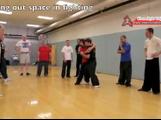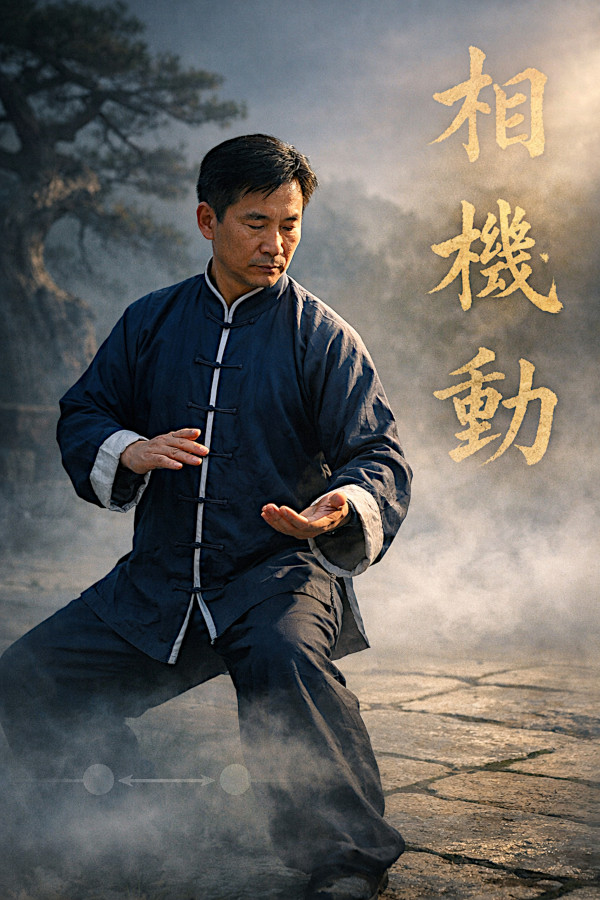
Dynamic Pairs in Action 1

by Ming on 2026/09/21

Grammar of Daoist Dialectics
Master Chen’s Refinement of Daoist Dialectics

Most explanations of Taijiquan begin with qualities: relaxation, balance, yielding. These are not incorrect, but they are imprecise. They describe how the art appears, not how it works.

This essay proposes a more exact frame: Taijiquan operates as a kind of grammar. Its power does not arise from isolated techniques or attributes, but from structured relationships between parts, governed by rules as precise as those that organize language..

Classical Daoist texts provide the earliest articulation of this logic. The Daodejing expresses it through relational verbs: being and non-being generate each other; difficult and easy complete each other. The Zhuangzv dissolves fixed identity, showing that meaning arises only through relation. Twentieth-century masters such as Hong Junsheng and Chen Zhonghua do not merely reinterpret these ideas. They enact them physically. What appears across these sources is not only conceptual continuity, but a shared functional logic.
(This article is based on the lecture notes Dynamic Pairs in Motion
Toronto, 2010.
)

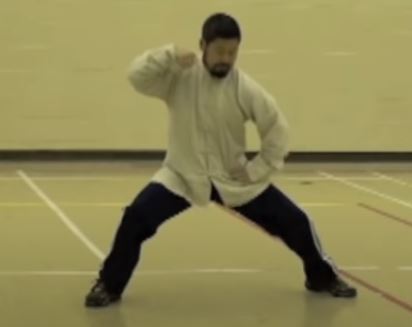
Master Chen explain the Two Scales of Taiji
That logic can be stated simply: identity is relational, not essential. Power resides in the verb, not the noun. What something is matters less than how it relates.This essay traces that principle from text to body: through the mechanics of the kua, the condition of peng, the release of fajin, and the exchange of push hands. At every scale, it finds the same relational logic operating.

Across centuries, a consistent grammar of interaction persists.


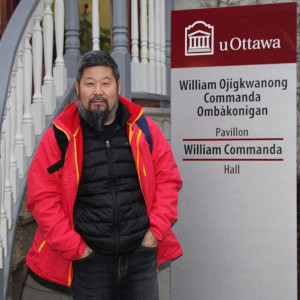
Master Chen at University of Ottawa in 2017
Part One: Relationality Over Essence
Part Two
Part Three

Part One: Relationality Over Essence

In the moment before a Taijiquan practitioner issues force, almost nothing appears to happen. The body settles. The breath neither advances nor withdraws. Then, without visible effort, the partner is displaced.
What occurs in that interval, between stillness and expression, containment and release? The answer lies in the language of the Dao and the paradox of Wúwéi (無為). To understand this interval, the analysis must shift from visible movement to the underlying relational logic that makes such movement possible.

The Priority of the Verb

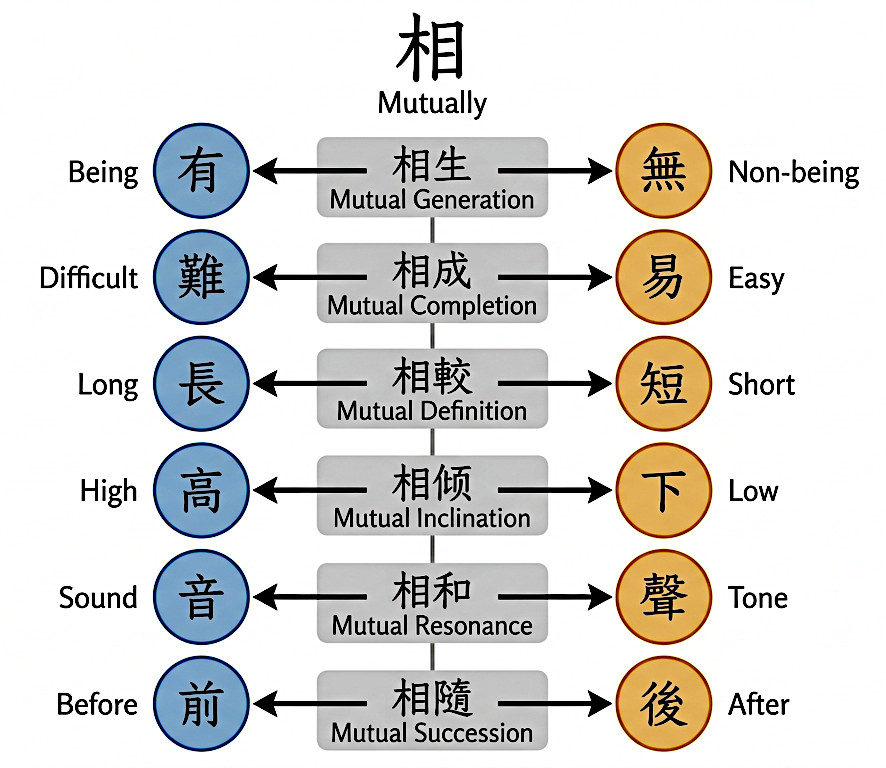
This relational structure is made explicit in Chapter 2 of the Daodejing, where Laozi links paired opposites through the prefix xiāng (相), indicating reciprocal action:

Being and non-being generate each other. Difficult and easy complete each other. Long and short define each other. High and low incline toward each other. Sound and tone harmonize. Before and after follow one another.

有无相生,难易相成,长短相较,高下相倾,音声相和,前后相随。

The following table summarizes the six pairs of reciprocal action, their governing verbs of mutuality and the dynamic:
Pair Verb Dynamic
有 / 无 相生 Mutual generation
Master Chen lecturing on the Two Scales in Perth
难 / 易 相成 Mutual completion
长 / 短 相较 Mutual definition
高 / 下 相倾 Mutual inclination
音 / 声 相和 Resonance
前 / 后 相随 Mutual succession
What appears as two entities is, in fact, a single process. The verb is the living Dao between them.
Two principles follow:
Mutual generation (相生): opposites arise together. “Difficult” has no meaning without “easy”; “having” cannot be conceived without “not having.”
Mutual completion (相成): each fulfills what the other lacks. Neither is sufficient alone; together they form a whole.
These are not abstractions. In Taiji, they are immediately physical: as one side rises, the other sinks; as one opens, the other closes. Fullness and emptiness are not sequential states, but simultaneous phases within a single action.
Master Chen’s emphasis makes this tangible. Top and bottom do not move together, they maintain distinction through opposing direction. Upward and downward are simultaneous, not alternating. Every movement contains its counterpart.

Complementary Negation

If two elements are joined through a specific action, that action must also preserve their difference. The verb connects but also separates.
This yields a principle we may call complementary negation: the action that unites a pair simultaneously maintains its distinction.
Yin and Yang resolve each other only because neither becomes the other. Their harmony depends on maintained difference. Connection is not fusion, but structured tension.
The Daodejing states:
Reversal is the movement of the Dao.
反者道之動
And further:
Yield and be whole; bend and be straight; empty and be full; worn and be renewed.
曲则全,枉则直,洼则盈,弊则新
Each action implies its opposite. To open initiates closing. To advance provokes retreat. The verb contains its inversion.
This tension does not obstruct movement—it generates it.

Against Substance: A Western Contrast

This view departs from a dominant strand of Western philosophy in which meaning is often grounded in stable entities or underlying substances. From Aristotle onward, much of this tradition has treated the properties of things, the “noun”, as primary, with relations understood as secondary or derivative.
This orientation, however, is not uniform. Alternative currents within Western thought have emphasized process and relation. Heraclitus foregrounds flux as fundamental; Alfred North Whitehead develops a systematic account of reality as interrelated events; and Maurice Merleau-Ponty situates meaning within embodied perception. These approaches move closer to a relational ontology, yet they remain primarily descriptive or interpretive frameworks.
Friedrich Nietzsche, in particular, approaches a relational view in his emphasis on tension, opposition, and becoming. However, his account largely concerns how meaning is constituted through contrast and perspective, rather than how such relations are operationalized in coordinated action.
Daoist thought situates relational logic differently. It does not primarily describe how opposites are understood, but how they function. Understanding is measured not by conceptual analysis, but by the capacity to participate in transformation.
In Taijiquan, this distinction becomes explicit: the principles articulated in the Daodejing are not merely interpreted, but systematically trained and physically reproducible. The body becomes the site in which relational processes are organized, tested, and realized.

The Verb as Mechanism

At this point, the argument deepens: relation is no longer treated as descriptive, but as operative. Something that actively produces change.

Zhuangzi and Relational Distinctions

If the Daodejing establishes that opposites are relationally generated, the Zhuangzi extends this into a more radical claim: distinctions are not fixed realities, but relational positions. In the Discussion on Making All Things Equal (齊物論; Qi Wu Lun), Zhuangzi introduces the “this/that” dialectic:
“Without a ‘that,’ there is no ‘this.’ Without a ‘this,’ there is no ‘that.’”
“非彼无我,非我无所取”
This expresses co-dependence (相因): “this” and “that” arise together and define one another. Identity is not inherent; it is relational.
Zhuangzi presses further:
“The ‘this’ is also a ‘that.’ The ‘that’ is also a ‘this.’”
彼出於是,是亦因彼。
Here, distinction itself becomes unstable. What appears fixed is revealed as a shifting relational position. Later commentary reinforces this view: duality is not accidental, but structurally inherent.
The immediate consequence is practical. If nouns are already relationally defined, the verbs linking them cannot be static descriptions. They are active processes that continuously reposition each pole relative to the other.

From Description to Mechanism: The Role of Ji

If verbs are processes rather than descriptions, they must initiate change. This is the role of (機): the pivot, trigger, or activating point of transformation, the condition under which one pole gives rise to its counterpart.
To open is already to initiate closing. To advance is already to provoke retreat. The verb marks the threshold at which one state turns into another.

Awakening to Process: The Dream Analogy

Zhuangzi illustrates this through the metaphor of the dream:
“In the midst of a dream, one does not know it is a dream… Only upon awakening does one know.”
To take an action at face value is to remain within the dream: to see only the noun. To recognize it as part of a relational mechanism, as something that triggers its opposite, is the awakening.
In Taiji, this marks the difference between performing a movement and understanding what it sets in motion. The practitioner ceases to see the arm and begins to see the rotation.
Sweet Dreams are Made of This

Cosmological Extension: The Xici Zhuan

This same logic operates at the level of the cosmos. The Xici Zhuan (繫辭傳) extends the verbs of mutuality (相) structure into fundamental forces:
“Hard and soft grind against each other; the Eight Trigrams stir one another。 ”
刚柔相摩; 八卦相荡。
This structure can be summarized as follows:
Verb Meaning Dynamic
相摩 to grind transformation through contact
相摩 to stir motion motion in one provokes motion in another
Opposites do not merge; they interact, and through that interaction, change occurs. This is relational logic expressed as cosmological mechanics.
Wang Zongyue’s (王宗岳) Taijiquan Lun (《太极拳论》) translates this into practice:
“In motion it divides; in stillness it unites。 ”
动之则分,静之则合。
Division and unity are not fixed states, but phases within a single process. The verb governs their transition.

The Locus of Transformation

If the verb governs transition, it cannot reside in either pole alone. Where, then, does it operate?
The Daodejing (《道德经》) answers in Chapter 11 (第十一章):
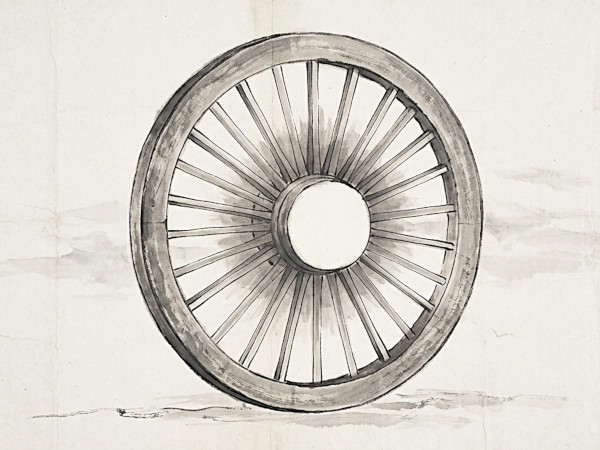
“Thirty spokes share one hub, it is in the empty space that the wheel’s function lies…
What is provides advantage; what is not provides function。 ”
三十辐共一毂,当其无,有车之用……故有之以为利,无之以为用。
it is in the empty space that the wheel’s function lies
The relation between poles lies in neither, but in the interval between them. This is where the trigger ji (機) operates, not as an object, but as a field of potential.
Chapter 42 names this field:
“The ten thousand things carry yin and embrace yang; the rushing energy (冲气) achieves harmony。 ”
万物负阴而抱阳,冲气以为和。
This dynamic chōng qì (冲气) is neither pole, but the movement that connects them. It is the living expression of the verb.

The Verb in the Body: Bridge to Practice

Taken together, these sources articulate a single principle: reality operates through activated relationships.
In Taiji, this becomes directly observable. The body is not a collection of parts, but a system of paired interactions—rising and sinking, opening and closing, advancing and retreating. Each movement is defined not in isolation, but by how it transforms into its complement.
Effectiveness lies in timing. One side moves; the other responds. One expands; the other condenses. The transition between them is an activating point, (機), where power emerges.
To train Taiji is therefore to move beyond positions and into relationships. One does not practice fixed forms, but learns to regulate dynamic exchange. The art lies not in what the body is, but in how one action gives rise to the next.

The Dialectics of Relational Identity

To move from philosophy into practice, these principles must be observed in action. The following examples do not merely extend the theory; they render its structure unmistakable through specific applications. Master Chen Zhonghua utilizes a series of deceptively simple cases, a ‘grammar of symmetry‘, that reveal a consistent rule: a relationship (the verb) functions only when each part maintains its distinct integrity within the connection.
Within this framework, the role of language becomes clear. If the relationship, the “verb”, is primary, then a “thing” is not a fixed essence but a temporary stabilization of function within an ongoing process. The Zhuangzi expresses this succinctly:
“Names are the guests of reality。 ”
名者,實之賓也。
Here, reality (實, shí) refers to lived function, the activity itself, such as the “grammar” Master Chen describes. The name (名, míng) is a guest (賓, bīn): a provisional label introduced for clarity, not an inherent property. Master Chen’s instructional terms are thus functional placeholders for physical states that cannot be fully captured by nouns.
The Zhuangzi develops this further through a well-known analogy:
“The fish trap exists because of the fish. Once you’ve gotten the fish, you can forget the trap ”
(Zhuangzi, Chapter 26 (External Things))
In this light, names and forms are tools. They guide perception but do not constitute underlying reality. In Taijiquan, technical terminology functions as the “trap” used to catch the “fish” of direct physical experience. Taken as fixed truths, these names obscure the relational processes they are meant to reveal. Once function is embodied, the linguistic scaffolding can fall away.

The Singularity of Union

Marriage means staying single
Consider the statement: “Man and woman marry each other.”
At first glance, this suggests union. More precisely, however, it reveals that union is not fusion. The act of “marrying” has meaning only if two distinct individuals remain. If they collapse into a single undifferentiated entity, the relationship itself disappears.
From a Daoist perspective, these are two configurations of qi entering a specific relational state. “Marriage” is not a new entity, but a mode of interaction. The verb defines the relationship, and the relationship depends on the continued distinction of the pair.

Resolution Through Differentiation

This logic deepens with the statement: “Yin and Yang resolve each other.”
Resolution (相和, xiāng hé) is often misunderstood as a blending into sameness. In fact, it requires the opposite. For Yin and Yang to harmonize, they must remain differentiated. Their identities depend precisely on not collapsing into one another.
This introduces a crucial principle: functional non-overlap (相斥, xiāng chì). This is not rejection in the sense of separation, but of maintaining distinct roles. Each side does not become the other; each responds to the other.
Harmony, then, is not the absence of tension but the regulated interplay of difference. It is a dynamic process that avoids both fragmentation and stagnation.

Positional Relativity: “Following” and “Looking”

The same structure appears in the statements: “Top and bottom follow each other,” and “left and right look at each other.”
Here, identity is shown to be purely relational. “Top” has no inherent existence; it is meaningful only relative to “bottom.” Likewise, “left” and “right” arise together as orientations within a system.
The verbs clarify how the relationship operates:
Following (隨, suí): expresses coordinated succession.
Looking (顧 / 看, / kàn): expresses mutual awareness.
These are not metaphors; they are operational principles.
In Taiji practice, “following” governs vertical coordination, preventing stiffness or disconnection between upper and lower. “Looking” governs lateral balance, ensuring that as one side opens, the other closes in response. In both cases, function arises through continuous relational adjustment.

The Ultimate Pair: Life and Death

The full force of this relational logic becomes clear when applied to the most fundamental human opposition: “life and death (生死, shēng sǐ).”
From the perspective of fixed identity, these appear as absolute states: presence and absence. Within the Daoist framework, however, they are joined by a verb: “Life and death transform each other” (相化, xiāng huà).
In the Supreme Happiness (至樂, Zhì Lè) chapter of the Zhuangzi, this principle is illustrated through the well-known account of Zhuangzi following the death of his wife.
“When she first died, how could I not have been affected? But then I looked back at her beginning… in the midst of the indistinct, there was change and there was qi. Another change and there was form. Another change and there was life. Now there has been another change and she has gone to death. This is like the turning of the four seasons。 ”
it is in the empty space that the wheel’s function lies
“是其始死也,我獨何能無概然!察其始而本無生,非徒無生也而本無形,非徒無形也而本無氣。雜乎芒芴之間,變而有氣,氣變而有形,形變而有生,今又變而之死,是相與為春秋冬夏四時行也。”
Zhuangzi does not deny grief; he refuses to fix it into permanence. What he recognizes is the continuity of transformation.
If life and death are treated as fixed nouns, death appears as destruction. Understood as a relational pair governed by transformation, however, death becomes a phase within an ongoing process.
From the perspective of the Axis of the Way (道樞), nothing is lost—only re-positioned within the same field.

The Vitality of the Process

Across these examples—from language to philosophy, from posture to existence, the same principle holds: identity is not a fixed essence but an emergent function of relationship. Within the Daoist framework articulated in the Daodejing and the Zhuangzi, what something is cannot be separated from how it relates. The teachings of Master Chen therefore represent not a reinterpretation but a direct embodiment of these classical insights. YinYang separation is not a division of substance but a differentiation of function within continuous connection. Postures are not fixed shapes but functional instructions: tools that establish relationships within the body.
The reach of this framework extends beyond Taijiquan. Whenever two systems enter into a functional relationship, when a specific verb governs their connection, the same logic applies: identity is defined through interaction, power resides in the relationship rather than in the parts, and confusion arises when nouns are mistaken for the reality that verbs produce.
Two appendices test this claim in domains where the framework was not derived. Appendix A examines efficient running through both a biomechanical lens and the relational grammar of the Practical Method, demonstrating that the same organizing principles: YinYang separation, the kua as pivot of transformation, mutual succession in the kinetic chain are not particular to internal martial arts but describe structural conditions that appear wherever coordinated movement is analyzed with sufficient precision. Appendix B applies the framework to the relationship between artificial and human intelligence, where the absence of embodiment becomes the central question. Together, these comparisons are offered not as equivalents to the practice from which the framework was derived, but as demonstrations of its range and, in doing so, of what embodiment alone makes possible.
When the function is realized, the labels fall away. Like the trap forgotten once the fish is caught, names dissolve, leaving only the living continuity of movement. What remains is not a collection of parts but the vitality of their relationship: the ongoing emergence of structure through interaction. The verb is not merely descriptive; it is the mechanism through which life, movement, and meaning are continuously brought into being.
Yet one question remains. If the verb is the mechanism of life and meaning, if relationship governs everything, what quality of action allows that mechanism to operate without interference? The classical texts give a precise answer: Wúwéi (無為).

Wúwéi: The Grammar of Effortless Action

“In pursuit of learning, every day something is acquired. In pursuit of the Dao, every day something is dropped. Less and less is done until non-action is reached. When nothing is done, nothing is left undone。 ”
(Daodejing, Chapter 48)
“為學日益,為道日損,損之又損,以至於無為,無為而無不為。”
This is perhaps the most misunderstood principle in the Daoist canon. Read literally, Wúwéi (無為) appears to advocate passivity: a withdrawal from action into stillness. Read relationally, through the lens of the relational predicates (相) structure established in Chapter 2 of the Daodejing, it describes something more precise: not the absence of action, but the absence of forced action: movement arising from correct relationship rather than imposed will.
The grammatical analogy makes this immediately legible. A sentence constructed by force, where words are pushed into positions they do not naturally occupy, where the verb strains against its subject, where meaning is imposed rather than generated, fails. Its failure is not located in any single word but in the relations between them: the grammar breaks down. Wúwéi (無為) names the opposite condition: a sentence so correctly organized that it speaks itself. Words do not need to be forced into meaning; meaning arises from their relationship.
In this sense, Wúwéi is not a principle about doing less. It is a principle about relationship. When the relational structure is correct, when each element occupies its proper function within the whole, action becomes effortless, not because effort has been removed, but because it no longer works against the grain of the relationship. The verb governs naturally. The sentence completes itself.

Wúwéi and the Relational Verb

This reframing connects Wúwéi (無為) directly to the verbs of mutuality (相) logic of Chapter 2 of the Daodejing. Each of Laozi’s six relational pairs describes a process that unfolds without forcing: being and non-being do not try to generate each other; they do so as a natural consequence of their relationship. Difficult and easy do not attempt to complete one another; completion emerges from their pairing. The verb is not imposed from outside but arises from within the structure of the pair.
Wúwéi names the condition in which this natural arising is not interfered with. It is not the absence of the verb, but the absence of resistance to it. When a practitioner forces movement, substituting muscular effort for structural relationship, they are not practicing Wúwéi but its opposite: Yǒu wéi (有為), deliberate forcing. This is the grammatical equivalent of a sentence that pushes meaning onto the reader rather than allowing it to emerge.
The Zhuangzi illustrates this through the story of Cook Ding, whose knife glides through the ox without effort:
“I glide through such great joints or cavities as there may be, according to the natural constitution of the animal。 ”
“依乎天理,批大郤,導大窾。”
Cook Ding does not cut; he follows. His knife does not force its way through the ox’s structure: it moves through intervals already present. This is Wúwéi as physical practice: not the absence of skill, but skill so fully internalized that it no longer appears as effort. Action and occasion have become a single relational process. The verb governs without resistance.

Wúwéi as the Body’s Native Grammar

Within the language analogy developed in this essay, Wúwéi can be understood as grammatical fluency. A beginning language student must consciously construct each sentence: choosing the verb, placing the subject, checking agreement. The effort is visible: the sentence may be correct, but it is labored, its grammar worn on the surface. A fluent speaker does not construct sentences; sentences arise. Grammar operates below conscious attention, as the invisible structure through which meaning flows.
Taiji training follows the same arc. The beginner consciously places each part of the body, checking the elbow, adjusting the kua, recalling the foot position. The effort shows in the movement: structurally correct, perhaps, but lacking inevitability. Years of training do not add more instructions; they remove the need for them. The grammar becomes embodied. The body speaks without deliberation.
This is what Master Chen means when he insists that the principles of Chen-style Taijiquan are understood physically first, and intellectually never the other way around. Intellectual understanding is the labored sentence—correct but forced. Physical understanding is the fluent sentence: grammar operating without conscious direction, the verb governing without resistance, movement arising from relationship rather than will.
Wúwéi is not the goal of Taiji training. It is the natural condition of a body whose grammar has been fully learned and therefore forgotten. The practitioner who has entered the gate no longer thinks about the gate. They simply move. In that movement, without deliberate thought, the underlying structure reasserts itself.

Wúwéi and Ji: The Trigger That Does Not Force

One final connection completes the picture. If Ji (機) is the trigger point at which one pole gives rise to its counterpart, then Wúwéi describes the quality of that triggering. A forced trigger jams; the effort of forcing prevents the mechanism from operating. A spring that is pushed rather than released cannot release. What generates transformation at the Ji (機) threshold is not muscular force, but correct relational alignment: the structural condition under which change becomes inevitable rather than effortful.
This is why peng must be neither too tense nor too collapsed. Too tense, and the trigger cannot fire: the forcing blocks the mechanism. Too collapsed, and the threshold disappears entirely: there is nothing left to fire from. The narrow interval between these extremes is where Wúwéi appears physically: readiness without forcing, structure without rigidity, potential without strain.
In grammatical terms, the sentence has been perfectly formed. Every verb is in place. Every relationship is correctly aligned. Meaning does not need to be pushed.
It arrives on its own.
Yet this raises a necessary question. If action can arise “on its own,” without forcing or interference, then what determines whether it arises correctly rather than randomly? Wúwéi does not eliminate structure. It presupposes it. The absence of forced action is not the absence of organization, but the result of relationships so precisely aligned that no correction is required.
This shifts the problem from effort to structure. If effortlessness depends on correctness, then correctness must be identifiable, trainable, and reproducible in the body. The question is no longer how to do less, but how the underlying relationships are arranged such that nothing extra needs to be done.
It is at this point that philosophical description must give way to physical investigation. The relational predicates described in the Daodejing (generation (相生), completion (相成), transformation (相化), and succession (相隨)) cannot remain conceptual if Wúwéi is to have practical meaning. They must be located within movement itself, where their operation can be observed, tested, and refined. What appears as effortless action is the visible result of an invisible structure. The task of the next section is to make that structure explicit, locating within the body the precise mechanical relationships where these ancient principles are realized in practice.

Leave a Comment
Leave a comment on the content only. For admin issues, please click the "contact" button on the top left.

Previous post:

Next post: