 |
The Mechanics of Distinction
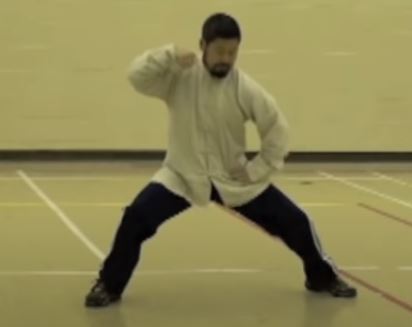
If philosophy is the blueprint, the body is the laboratory. In Part 2, we move from the page to the training hall to examine the uncompromising mechanics of the Chen Style Practical Method. Through a “grammar of symmetry,” we break down the functional role of the kua, the structural necessity of peng, and the explosive coordination of fajin. Learn why “one thing doing only one thing” is not just a training rule, but a mechanical requirement for structural integrity. |
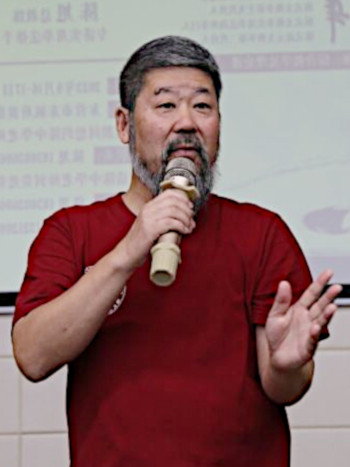
| (This article is based on the lecture notes Dynamic Pairs in Motion Toronto, 2010.) |
|
 |
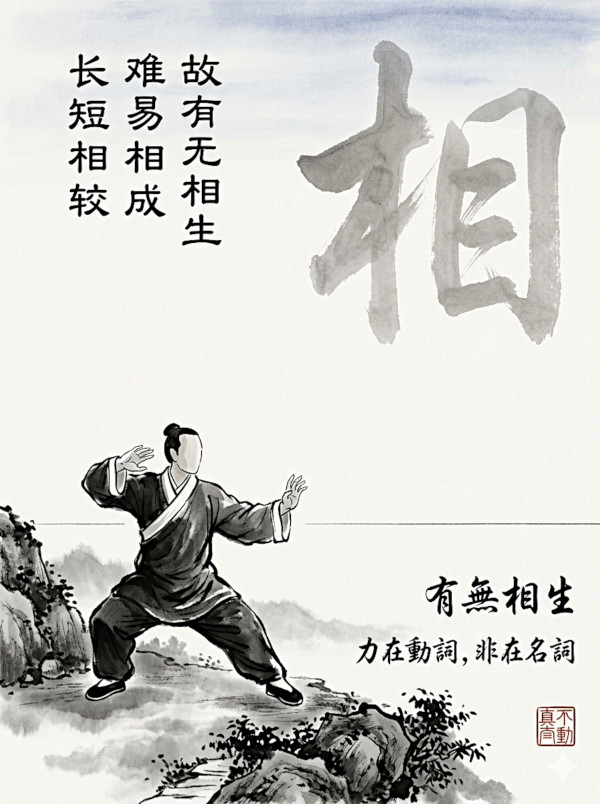
Most explanations of Taijiquan focus on aesthetic qualities like “softness” or “flow,” but these describe how the art appears rather than how it works. In Part 1, we establish a more rigorous framework: Taijiquan as a grammar. Drawing on the Daodejing and Zhuangzi, we explore the shift from “nouns”. Nouns are static, isolated postures. Verbs are relational actions that govern connection. We move beyond mystical interpretation to show how ancient Taoist dialectics function as a technical manual for the body. By redefining identity as relational rather than essential, we uncover a system where power resides not in the individual parts, but in the specific logic of their interaction. |
 |
Part One: Relationality Over Essence
Part Two: The Physics of Relational Verbs
Part Three: Forms as Language
|
Part Two: The Physics of Relational Verbs
From Philosophical Grammar to Physical Mechanism
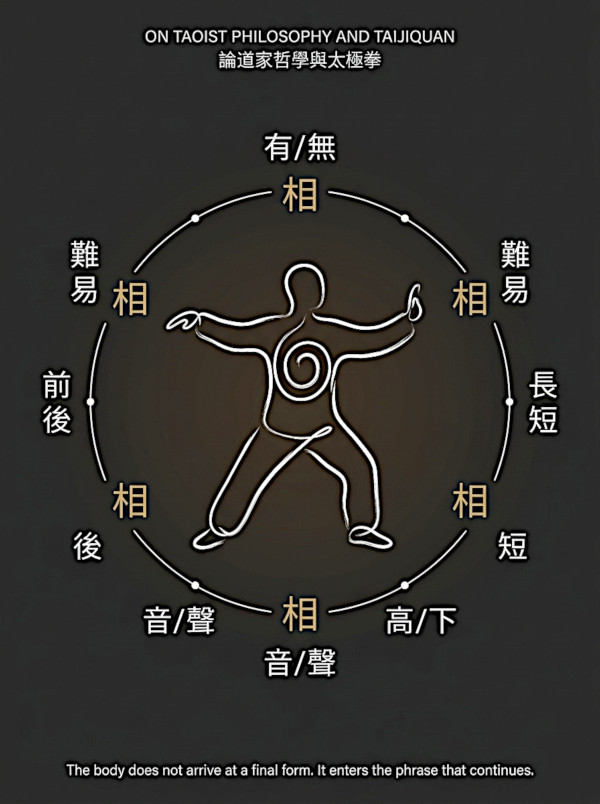
Part One established the relational predicates (相) as a marker of reciprocal relational action: opposites do not merely coexist, but generate, complete, define, and transform one another through structured interaction. The claim of this essay is that Taijiquan does not simply illustrate this principle metaphorically: it operationalizes it. What appears in the classical texts as philosophical grammar emerges in the body as mechanical function. The task here is therefore analytic rather than interpretive: to identify where, and under what conditions, these relational structures become mechanically real.
The First Principle, Made Physical
|
The purpose of this section is therefore not to translate philosophy into movement, but to demonstrate that the same relational structure governs both. Each principle of Taijiquan mechanics can be understood as a specific instance of the same underlying verbs. These principles are silk-reeling, rotational coordination, structural alignment, and explosive release. The verbs are mutual generation (相生), mutual completion (相成), mutual definition (相较), mutual transformation (相化), and mutual succession (相随). What appears as technical variation is, at a deeper level, grammatical consistency.
Within this framework, Yin–Yang is not treated as a conceptual backdrop, but as the most fundamental relational pair through which these verbs become observable. The practitioner does not assume Yin–Yang. They enact it. Every movement becomes intelligible only insofar as it can be understood as a structured relationship between differentiated functions.
|
 |
In Master Hong Junsheng’s Three-Character Canon (三字经), he writes:
|
In Chen style Taijiquan,
The theory is precise but the method is complex. The concept of Yin and Yang, Is part of the interplay. 陈太极,理法精,阴阳理,互变中。 |
 |
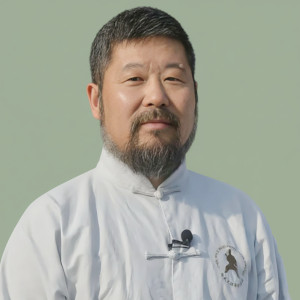
Master Chen Zhonghua makes this methodological stance explicit:
|
“Our style is about continuous physical practice following a set of physical rules for movements based on Yin/Yang. Nothing else. This is understood physically after years of practice, and only then intellectually, never the other way around.”
|
 |
What distinguishes this approach is its insistence that Yin–Yang appear as function, not concept. The sections that follow trace how this principle unfolds across successive layers of training from isolated movement to full application.
The Silk-Reeling Circle: Separation at the Level of Movement
|
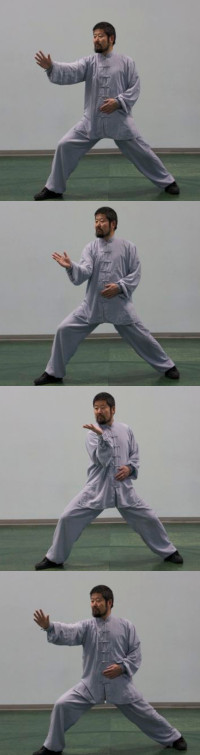
This is the first point at which the abstract relational model becomes directly visible in movement. The foundational training method through which this relational structure becomes physically legible is silk-reeling (缠丝劲, chán sī jìn), most clearly expressed in the Positive and Negative circles (顺缠圈 / 逆缠圈). These movements are often described in terms of coordinated actions: in with elbow, turn with waist, out with hand but such descriptions remain incomplete unless the relationship between these actions is made explicit.
Within the silk-reeling circle, the inward drawing of the elbow and the outward extension of the hand do not occur as separate phases, nor as additive components. They arise together through mutual generation (相生): the extension of the hand depends on the containment established by the elbow, while the inward action of the elbow is defined by the outward trajectory of the hand. Neither action precedes the other in a linear sense; each exists only through the presence of its counterpart.
At the same time, these actions achieve functional coherence through mutual completion (相成). The elbow alone cannot produce structure without the hand’s extension; the hand alone cannot transmit force without the elbow’s containment. Each fulfills what the other lacks. The circle, therefore, is not a shape traced in space but a relational process in which complementary functions continuously give rise to and complete one another.
These are not auxiliary drills; within Chen-style practice, they function as the primary means by which Yin–Yang separation is encoded into movement. When performed correctly, the circle manifests silk-reeling. As Master Hong states:
|
 |
|
“The myriad changes share one source; only silk-reeling is the foundation.”
法万变,不离宗,唯缠法,基本功。 |
 |
Within this framework, silk-reeling is not one technique among others but the generative structure from which all movement is derived. Each circle is an enactment of relational logic. Within a single cycle, the body divides into distinct, complementary functions: the elbow (Yin) draws inward, assuming containment, while the hand (Yang) extends outward, expressing release.
These functions are never blended. They remain distinct and it is precisely this maintained distinction that allows force to consolidate and transmit. Without it, force disperses across the joint, reducing both structural integrity and mechanical efficiency. The philosophical principles of the Daodejing are thus stripped of their abstraction, becoming the very blueprint for mechanical power.
This is codified in the training rule:
The prohibition is not stylistic but structural. It enforces differentiation so that the relational verbs can operate. When this differentiation collapses, with elbow and hand attempting to perform the same function simultaneously, the circle loses its generative capacity and movement becomes mechanically inert.
Silk-reeling thus provides the first clear instance in which the verbs of mutuality (相) structure becomes physically observable. What the Daodejing describes abstractly as paired generation and completion is enacted here as coordinated movement within the body.
Rotation: Mutual Definition Across Scales
Master Hong’s distinction between Self-Turning (自转, zìzhuǎn) and Global Turning (公转, gōngzhuǎn) refines this relational framework by introducing scale. Self-Turning refers to rotation around a local axis, the internal spiraling of a limb. Global Turning describes rotation around an external center, through which the body moves in space. These are often treated as separate layers of technique, but within the relational model they form a single coordinated system.
The relationship between these two scales is governed by mutual definition (相较). Internal rotation becomes meaningful only in relation to external displacement, and external movement becomes structurally viable only when supported by internal rotation. A limb that extends without internal spiraling becomes rigid and disconnected; a limb that spirals without external displacement remains localized and ineffective. Each scale establishes the conditions under which the other can function.
This relationship can be observed in movements such as Six Sealing Four Closing and Single Whip, where the path of the arm through space depends on the internal rotation of the joints, and vice versa. The practitioner does not alternate between internal and external movement. They coordinate them as a single relational process.
Through this lens, rotation is no longer understood as a property of individual parts, but as a function of their relationship across scales. The body becomes a system in which local and global actions continuously define one another, maintaining coherence through differentiation.
Structural Alignment: Differentiation Within Unity
As movement develops, relational logic must be maintained not only across actions but within the structure of the body itself. The primary division is between the upper and lower body often described in terms of Yin and Yang. This distinction becomes operational only when understood as a differentiated relationship rather than a static separation. Within this system, the lower body functions as Yin, rooted and supportive, while the upper body functions as Yang, expressive and adaptive.
These roles do not operate independently, nor do they merge into uniform motion. Their coordination depends on maintaining opposing directions. Master Chen clarifies this apparent paradox:
“Top and bottom follow each other, which means they must move in opposite directions.”
This is not a contradiction but functional logic. Coordination emerges through opposition, not sameness. This relationship is an instance of complementary definition (相較) extended into physical structure: “upper” has no functional meaning apart from “lower,” and stability becomes effective only in relation to mobility.
When this differentiation collapses, with both halves of the body attempting to move in the same manner, the condition known as double-weight (雙重, shuāng zhòng) emerges. Movement loses direction because the relational distinction that defines it has been lost. To prevent this collapse, Master Hong specifies a clear structural constraint:
“The spine rotates without lateral sway, within a functional limit (approximately 45 degrees).”
This 45-degree alignment serves as an idealized mechanical model. In practice, while variation may occur, the underlying principle remains constant: the coordinated activation of vertical and horizontal components to produce spiral force.
The preservation of this distinction requires a specific physical condition: sōng (鬆). Rather than simple relaxation, sōng describes the maintenance of functional intervals within the body: spaces in which relational transformation can occur. Excess tension compresses these intervals, preventing differentiation; collapse dissolves them, eliminating structure. Sōng maintains the conditions under which relational verbs can operate, allowing the body to remain both stable and responsive.
The Kua: The Pivot of Transformation
If relational verbs govern how differentiated elements interact, then transformation requires a locus at which one state gives rise to another. This is the role of the kua (胯), which functions as a primary site of jī (機), the pivot at which differentiation becomes activation. Within this relational framework, the kua is the point at which mutual transformation (相化) becomes physically manifest: stability in the lower body gives rise to movement in the upper; containment transitions into release; inward folding becomes outward expansion.
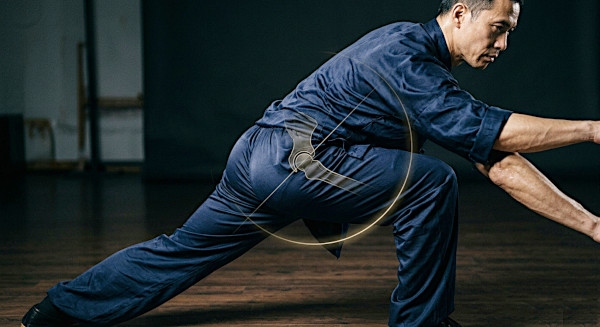 |
Master Chen’s instruction on this mechanism is precise:
“Lock the thigh… lock the shoulder… open the kua.”
|
Here, stability and movement are explicitly separated. The thigh and shoulder provide fixed reference points, while the kua initiates the change. This relationship is mechanically necessary; without a stable reference, movement cannot produce coherent force, and without movement, stability cannot express. This depends entirely on maintained differentiation. When the thigh and shoulder are stabilized, the kua is able to initiate movement as a distinct function. If these roles collapse, with all parts attempting to move simultaneously, the pivot disappears and transformation cannot occur.
This pattern of coordinated opposition repeats across the entire body:
“Hands open, feet close; feet open, hands close…”
These pairings are not stylistic preferences; they are structural conditions for coordinated force transmission. The kua does not produce movement independently; it enables transformation by maintaining the relational conditions under which change becomes inevitable rather than forced.
Sōng : The Condition of Relational Function
The effectiveness of these relationships depends on a specific physical condition: sōng (鬆). While often translated as “relaxation,” in this context it describes release without collapse and structure without rigidity. It is the essential condition under which differentiated functions can operate without interference.
A tense body cannot differentiate, as excess tension compresses the functional intervals required for movement. Conversely, a collapsed body cannot sustain a relationship, as the structure required for the “verb” simply dissolves. Sōng exists between these two failures.
In biomechanical terms, this corresponds to the regulation of muscular tone to allow for both structural integrity and adaptive responsiveness. The relational model describes this as the preservation of functional intervals, the active spaces in which transformation occurs. Without sōng, these intervals are lost; with it, they remain active, allowing the body to remain both stable and responsive.
Push Hands: Mutual Response and Succession
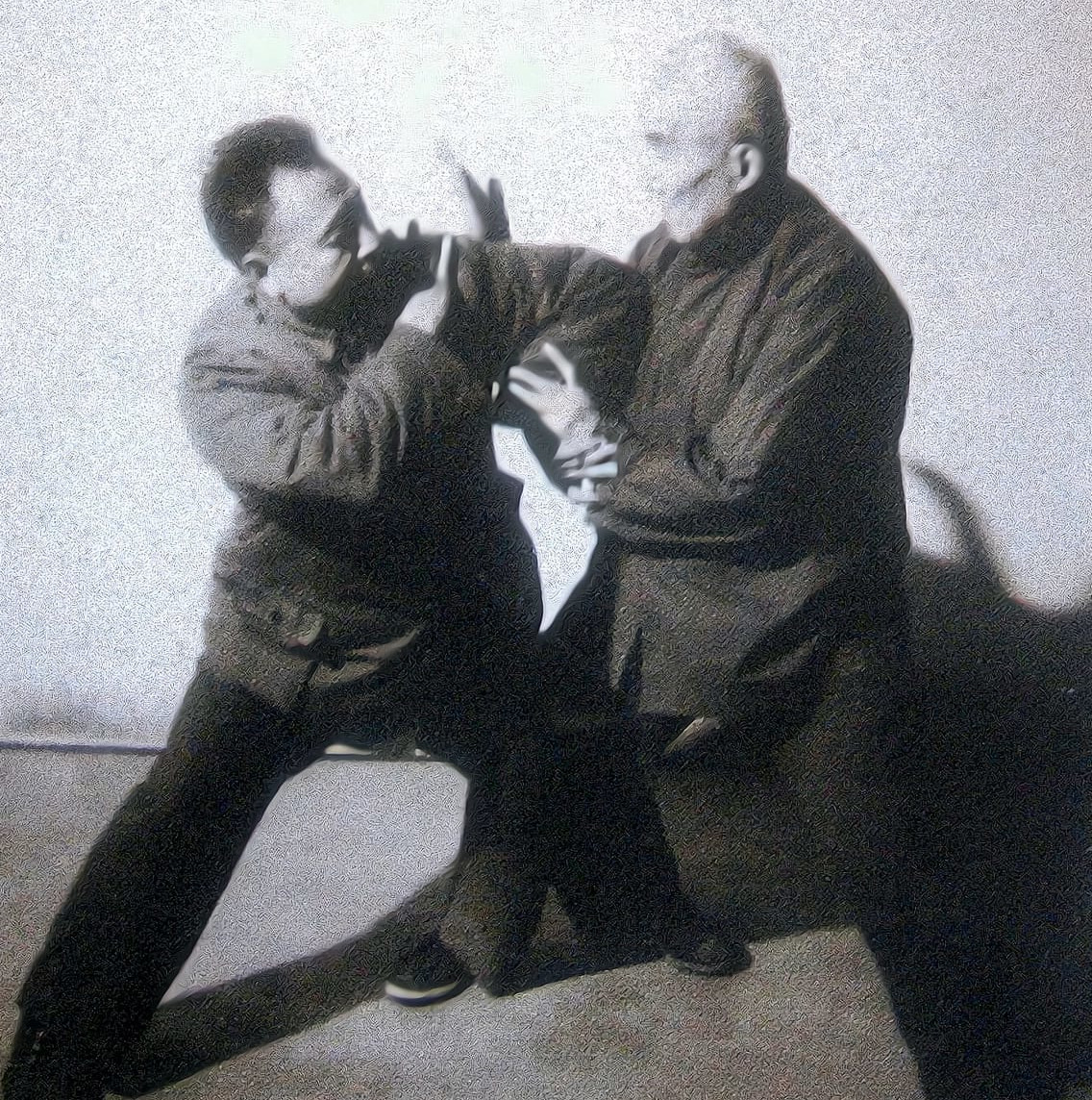
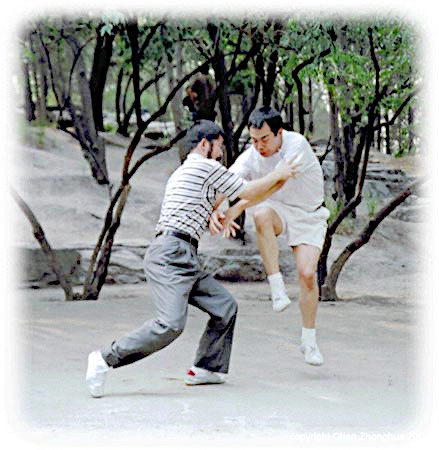
Push hands (推手, tuī shǒu) extends internal structural relationships into the interaction between two practitioners. What was previously contained within a single body now operates across a shared field, making the relational structure directly observable. This practice serves as the ultimate test of whether internal differentiation can be maintained under the pressure of external force. Within this exchange, interaction unfolds as a continuous process of issuing, receiving, and returning. These phases do not occur in isolation; they arise through mutual response (相應), where each action is conditioned by the other: issuing provokes reception, reception reorganizes the incoming force, and returning emerges from that reorganization.
|
The principle of the “verb” remains unchanged even when another person is involved, requiring the root to stabilize and the contact to adapt while ensuring that receiving (化, huà) and issuing (發, fā) remain distinct. At the same time, the sequence of actions follows a pattern of mutual succession (相隨), where one phase gives rise to the next in a continuous chain. If receiving is incomplete, returning cannot be properly formed; if issuing occurs prematurely, the exchange becomes disorganized. These are not blended actions but coordinated phases, a distinction that is mechanically necessary because incoming force cannot be redirected efficiently, nor can outgoing force be properly organized, without separating neutralization from release.
|
 |
Listening (聽勁, tīng jìn) functions as the mechanism through which this relational structure is perceived and maintained, allowing the practitioner to register change without disrupting the sequence. This preserves the distinction between phases while enabling their continuity. Failure in push hands most commonly appears as double-weight (雙重), a state in which differentiation collapses and both practitioners attempt to assert force simultaneously. In relational terms, this represents the breakdown of the governing verbs: response disappears, succession is interrupted, and the interaction reduces to unstructured opposition. The goal of push hands is thus to maintain the integrity of the relational “map” even as the “territory” becomes increasingly volatile.
Fajin: The Concentration of Transformation
Fajin (發勁) represents the most condensed and concentrated expression of relational mechanics. While often described in terms of explosive force, within this framework it is more precisely understood as the moment in which differentiation, coordination, and timing converge into a single, coordinated event. It does not prove the framework in isolation, but it provides its clearest observable instance. Any adequate account of this phenomenon, biomechanical or otherwise, must explain how such force emerges without visible preparation or sustained exertion. The answer lies in the relationship between storage and release, which exemplifies mutual transformation (相化). Stored potential does not exist as a separate phase. It becomes release through the activation of the relational structure. What is gathered is not held and then expelled. It transforms directly into expression.
 |
This process depends on mutual completion (相成), where structural integrity, threshold readiness, and timing align so that each condition fulfills what the others require. Within this model, fajin is not produced but released; the structure has already organized the outcome. This requires three essential conditions to align simultaneously. First, there must be structural completeness, ensuring the kinetic chain is uninterrupted so that force can transmit. Second, there must be threshold clarity, where peng is maintained without rigidity to provide the necessary elastic loading. Finally, there must be release without interference, allowing force to follow the structure rather than being obstructed by antagonistic tension.
|
In biomechanical terms, these conditions correspond to efficient force transmission, elastic loading, and coordinated timing. However, the relational model describes how these are organized in practice: fajin does not arise from the addition of force, but from the removal of obstruction within a fully organized relational system. The practitioner does not add force or produce power; they simply allow the transformation already inherent in the structure to occur. When the “verb” is clear and the functional intervals are maintained through sōng, the transition from storage to expression becomes an inevitable mechanical consequence rather than a forced effort.
Unity Through Differentiation
Across these domains, movement, structure, interaction, and release, the same principle holds. Taijiquan does not operate through isolated techniques or accumulated attributes, but through the maintenance of differentiated functions within coordinated relationships. Each part performs a specific role, and it is through the interaction of these roles that coherence emerges. This structure is summarized in Master Chen’s instruction:
“Each part must complete its role. One thing can only do one thing.”
This does not produce fragmentation; it produces coherence. The relational verbs identified in Part One are not philosophical abstractions imposed upon practice, but are directly observable in the mechanics of the art. Generation, completion, definition, transformation, and succession are not merely interpretive categories, but operational principles. What appears as complexity in technique resolves, at this level, into a consistency of structure. The same grammar appears consistently across scales of the system, from the smallest rotation of a joint to the full exchange between practitioners. Ultimately, effective force in Taijiquan arises from the maintenance of functional differentiation within coordinated unity.
Scope and Integration
This framework does not seek to replace biomechanical analysis, but to complement it. Where biomechanics describes how force is produced and transmitted, the relational model describes how these processes are organized, coordinated, and made reliable through training.
|
The two operate at different levels of description, but they are not in conflict. The relational model provides a unifying structure within which diverse mechanical observations can be understood as instances of a single underlying logic.
In this sense, the transition from Part One to Part Two is not a shift from theory to practice, but a shift in scale. What was articulated as philosophical grammar becomes visible as physical function. The same structure persists.
The verb does not disappear; it remains structurally present.
It becomes the body in motion.
|
 |