
 |
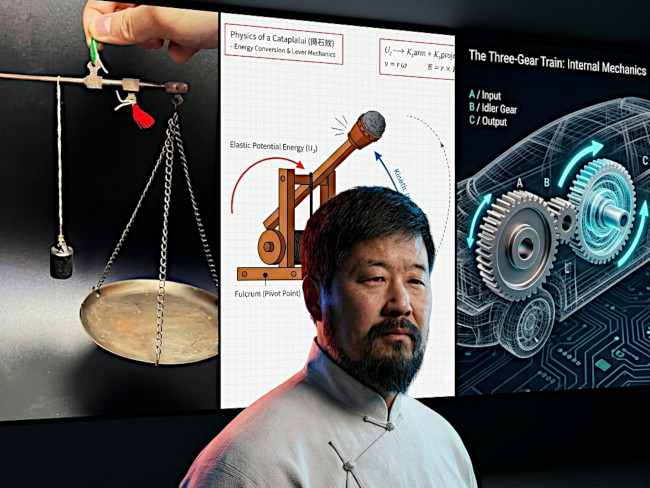
From the quiet wisdom of Wang Zongyue, who likened the body to a level and a wheel, to Chen Xin, who described Taijiquan as the subtle art of measurement, this essay follows a tradition that seeks balance not through force, but through understanding. In the hands of Hong Junsheng, these poetic ideas took on mechanical clarity, revealing the body as a system of “Two Scales”—one to listen, one to respond. Chen Zhonghua carries this vision forward, transforming still diagrams into a living machine of motion. |
| At first, the body appears as a pair of simple tools: the Děngzi, a delicate steelyard that senses and balances incoming force, and the catapult, coiled and ready to release power. Both are levers, turning quietly around a central axis. But levers, bound to their arcs, can only go so far. Then comes the shift: the body is no longer a set of levers—it becomes a system of gears. | |
| (Based on: The Theory of Two Scales: Matching Opponent Force“, Perth, Australia, 2013. |
|
 |
Gears turn without end. They mesh, oppose, and harmonize. One turns, another answers. In this interplay, the ancient idea of Yin and Yang is no longer abstract—it is felt as opposing rotations within the body, generating force through difference. A single movement at the center can ripple outward through interconnected “gears,” producing multiple effects at once, as if the body speaks in several directions simultaneously.In its highest expression, Taijiquan resembles a finely tuned engine. Each part is synchronized, each rotation timed, until power no longer travels in a straight line but emerges everywhere at once. |
What was once called “empty force” is revealed not as mystery, but as mastery—the natural result of a system so well integrated that it exceeds the opponent’s ability to perceive or resist.
In bridging classical philosophy with the language of physics, this essay invites us to see Taijiquan anew: not as something mystical or obscure, but as a living art of balance, precision, and transformation—where the human body becomes both instrument and engineer, measuring the world even as it moves within it.
 |
Part 2
|
Gears in the Taiji Body
Based on: “Lesson Notes by Kelvin Ho (Practical Method Toronto); Based on Master Chen Zhonghua’s June 2021 Online Workshop.
The Two Scales: A System of Gears
 |
Master Chen explains that mastering the “two scales” involves constructing two distinct internal levers using specific muscle groups and skeletal structures. The upper body scale, modeled after the traditional Chinese steelyard (dengzi), is responsible for maintaining equilibrium against incoming force through a process of matching. This requires immense sensitivity, often interpreted as “listening power“(聴勁; ting jin ). |
The second scale is a reversed scale that functions like a catapult, providing the explosive, outward-directed force to which the opponent must react. This is often explained as “expansive power” (掤勁, peng jin). While these two systems operate independently, they remain dynamically unified through a shared point of contact.
The Source of Power: Active vs. Passive Gears
|
Using a gear model provides a more expansive framework for explaining Taiji movements. While a two-gear system removes the linear restrictions of a basic lever, it remains governed by the laws of rotation: for two gears to turn together, they must rotate in opposite directions. This action captures the essence of Yin-Yang separation; in Taiji terminology, adjacent body parts must move in opposition to create functional power. However, even this model is not yet general enough to encompass all Taiji actions.
Master Chen introduces a three-gear system to further generalize the model. When a single “active” gear is rotated, the other two “passive” gears must rotate accordingly. In Taijiquan, we perform one internal action, and multiple, seemingly separate results are produced simultaneously.
|
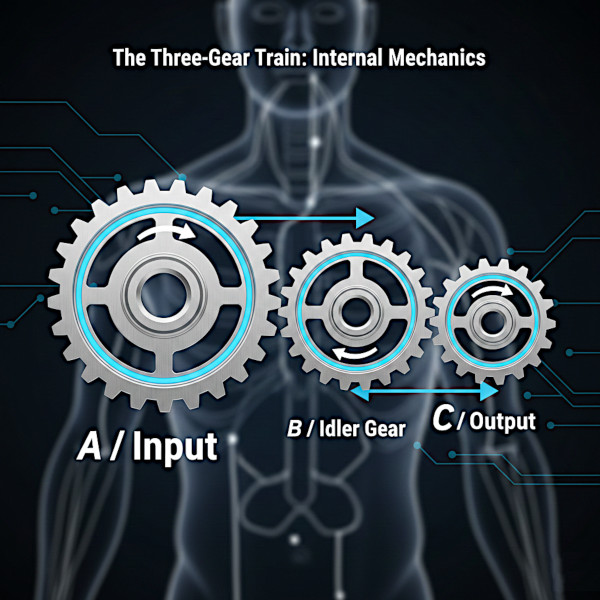 |
If two opponents are in contact with the two passive gears, they may feel force arriving from different directions, unaware that a single “active” gear is driving the entire system. This single gear is the true source of power.Consider the scenario of two active gears and one passive gear. If the two active gears rotate without coordination, the system will jam. However, if they are synchronized correctly, they dramatically amplify the power, speed, and freedom of the passive gear. This is analogous to a multi-cylinder engine synchronized by a timing belt: the action of each piston is added to the others in a harmonious way to produce a singular, powerful output. The three-gear model thus provides a comprehensive description of Taiji movement.
Beyond the Limitation of Time
Concept of Scales: A Historical Overview
The Foundational Theory: Wang Zongyue
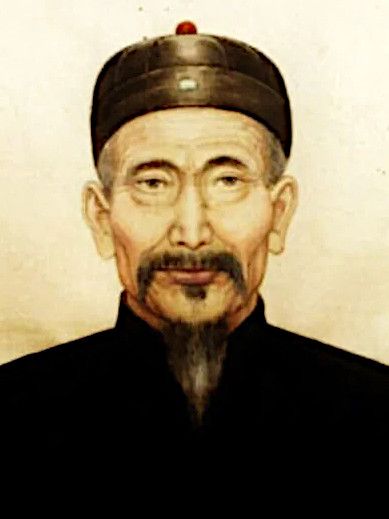
“…Reflecting on the phrase ‘four ounces deflect a thousand pounds,’ it is clearly not a matter of brute force; observing an elderly man’s ability to defend against a crowd, how can speed alone achieve this? Stand like a level, move like a wheel. If one side is heavy, follow; if both sides are even, you stagnate. Often, I see those who have practiced diligently for years but cannot neutralize force; they are invariably controlled by others because they have not yet understood the error of double-weightedness.”(…察“四两拨千斤”之句,显非力胜;观耄耋能御众之形,快何能为!立如平准,活如车轮。偏沉则随,双重则滞。每见数年纯功,不能运化者,率皆自为人制,双重之病未悟耳…)
The Two Pillars of Equilibrium
The Philosophical Evolution: Chen Xin
The Wordplay: Quán vs. Quán
|
Chen Xin utilizes a brilliant Chinese homophone to bridge the gap between combat and philosophy:
• 拳 (Quán): Fist, boxing, or the martial art.
• 权 (Quán): A steelyard scale (a traditional Chinese balance with a sliding weight), or the act of weighing, assessing, and adapting.
By stating “Boxing is a scale,” he defines Taijiquan as The Art of Measurement.
|
 |
The Function of the Living Scale
Chen Xin introduces a radical, holistic concept:
(人之一身,浑身上下都是太极,即浑身上下都是拳)
| Master | Key Phrase | Focus | Application |
|---|---|---|---|
| Wang Zongyue | 立如平准 Lì rú píng zhǔn |
Postural Balance | Avoiding “Double-weightedness” through an upright axis. |
| Chen Xin | 拳者,权也 Quán zhě, quán yě |
Perceptual Assessment | Using the entire body to “weigh” and adapt to intent. |
From Philosophy to Physics: The Mechanical Revolution of Hong Junsheng
The Steelyard vs. The Balance
“Boxing is weighing. Weighing is like the scale… A practitioner must understand how to weigh light and heavy; only then can one know the opponent’s force and adapt accordingly.”(“拳者,权也。权者,秤也。练拳之人必须懂得权衡轻重,方能知彼之力而随之变化。”)
The First Scale: The Structural Axis
“The body is like a scale; the waist is the pivot point, and the limbs are the beam of the scale.”(“身体如秤,腰为秤星,四肢为秤杆。”)
| Component | Scale Element | Martial Function |
|---|---|---|
| Waist / Dantian | Pivot (Fulcrum) | The stationary center that directs all movement. |
| Spine / Torso | The Beam | Transmits torque and structural integrity. |
| Limbs | Extensions of the Beam | Execute large mechanical effects from small central shifts. |
The Second Scale: The Pairwise Balance of Limbs
“Between the limbs, there must be emptiness and fullness, like the two ends of a scale—one light and one heavy—so that movement can operate freely.”(“肢体之间须有虚实,如秤之两端,一轻一重,方能运转自如。”)
Redefining “Double Heaviness” (双重; shuāng chóng)
“If the left hand is full, then the left foot must be empty; if the right hand is full, then the right foot must be empty. By avoiding having the upper and lower limbs on the same side both full, one avoids double heaviness.”(“左手实则左足虚,右手实则右足虚,上下不同实则避免双重。”)
Casual Equilibrium and the Stable Pivot
Why This Matters for Your Practice
Evolution of the Two Scales: Master Chen Zhonghua’s Mechanical Systems
The Two Primary Models: Dengzi and Catapult
The Gear System: Three Critical Configurations (齿轮系统模型)
Breaking the Limitation of Time (打破时间的限制)
| Feature | Hong’s “Two Scales” | Chen’s “Mechanical System” |
|---|---|---|
| Concept | Static Structural Analysis | Dynamic Systems Thinking |
| Metaphor | Levers & Steelyards | Gears, Engines, & Timing Belts |
| Focus | Emptiness vs. Fullness | Torque & Simultaneity |
The Tao of Physics and the Physics of the Tao
The Art and Physics of the Chinese Steelyard
The Physics: The Principle of Moments
|
τload = τpoise
Fload × dload = Fpoise × dpoise
|
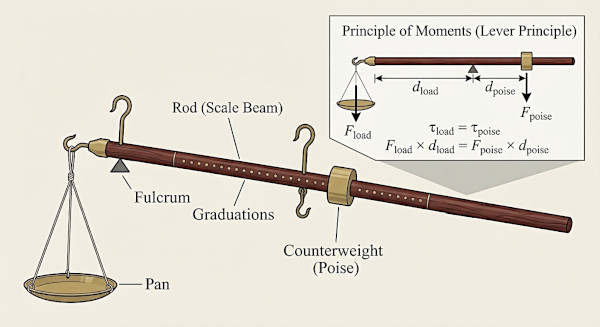 |
| Component | Chinese Term | Physics Variable | Role |
|---|---|---|---|
| Hanging Pan | 秤盘 (Chèngpán) |
Fload
|
The unknown force measured. |
| String Handle | 提纽 (Tíniǔ) | Fulcrum | The pivot point of the system. |
| Sliding Weight | 秤砣 (Chèngtuó) |
Fpoise
|
The constant force used for balance. |
| The Marks | 秤星 (Chèngxīng) | Calibration | Distance units (Scale Stars). |
Děngzi vs. Catapult: A Study in Lever Contrasts
1. The Core Similarity: The Mechanics of the Lever
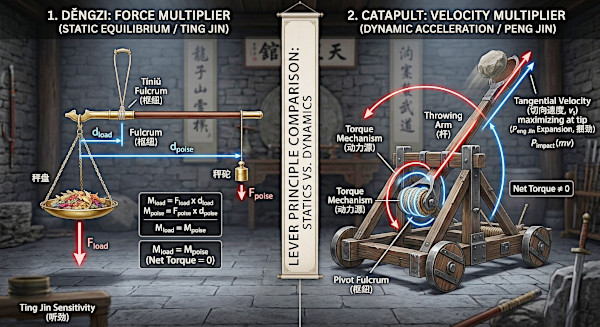 |
The most crucial link between these two devices is their shared structure. A Class 1 Lever consists of three components: a rigid beam, a fixed fulcrum (pivot), and forces applied at different points along that beam. In both the Děngzi and the catapult, the pivot sits between the two competing forces.
|
2. The Differences: Statics vs. Dynamics
| Feature | Děngzi (Scale) | Catapult |
|---|---|---|
| Primary Goal | Precision & Balance | Power & Speed |
| State of Motion | Statics (Stillness) | Dynamics (Motion) |
| Net Torque | Zero (Balanced) | Extreme (Unbalanced) |
| Taiji Phase | Ting Jin (Listening) | Fa Jin (Issuing) |
3. Key Physics Concepts in Taiji Action
Levers and Gears: A Mechanical Comparison
| Feature | Levers | Gears |
|---|---|---|
| Motion Type | Simple Angular Arc | Continuous Rotation |
| Range | Limited (Fixed Arc) | Infinite (360-degree) |
| Axis | Fixed Plane | Versatile/Changeable |
The Simple Model: The Two-Gear System
The Speed vs. Torque Trade-off
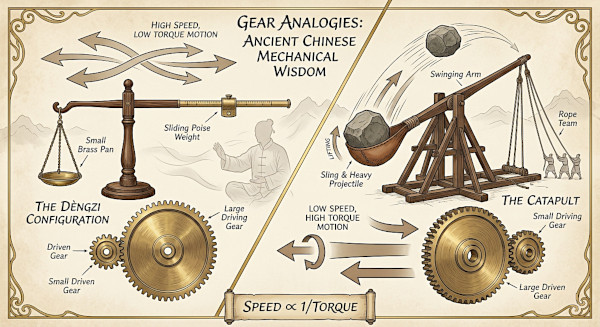 |
The Dèngzi Configuration (Large Driving Small): Increases output speed but reduces torque.
Martial Link: This represents Master Hong’s Second Scale (Pairwise Balance). It is the high-sensitivity “listening” mode used to match the opponent’s speed and measure their force.
The Catapult Configuration (Small Driving Large): Reduces speed but multiplies torque.
Martial Link: This represents Master Hong’s First Scale (Structural Axis). It is the “Turning Wheel” of Wang Zongyue, where the small internal center drives the large external mass to express power.
The Limitation: Opposite Rotation
A General Model: The Three-Gear System
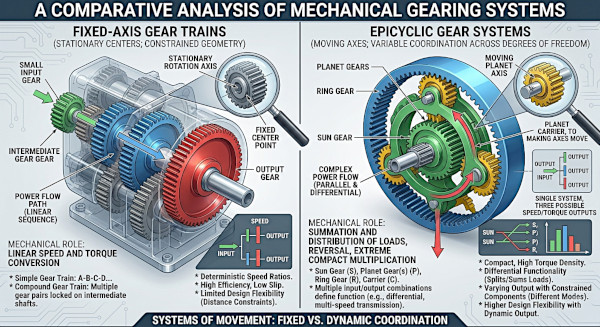
The transition from a two-gear system to a three-gear system resolves a fundamental mechanical limitation. In a simple two-body interaction, motion is constrained to direct opposition. Introducing a third element creates a mediating constraint, allowing motion to be redirected, coordinated, or transformed without mechanical conflict.From a physics perspective, gear systems do not create energy; they redistribute torque and angular velocity under kinematic constraints, while total power remains conserved (neglecting losses). What distinguishes one configuration from another is not the amount of energy, but how motion and force are organized through the system.
Because each arrangement imposes a different set of constraints, it also produces a distinct and predictable functional behavior. For clarity, these recurring behaviors can be described as “personalities”—not as metaphor, but as shorthand for how each system reliably handles force, motion, and coordination.
| All advanced configurations fall into two categories:
• Fixed-Axis Gear Trains (stationary centers; constrained geometry)
• Epicyclic Systems (moving axes; variable coordination across degrees of freedom)
This progression mirrors the practitioner’s development—from local alignment to whole-body integration. |
 |
 1. Simple Train with an Idler: The Bridge of Neutralization
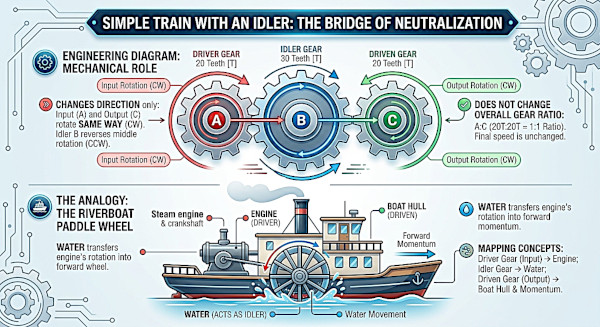 |
Mechanical Role: An intermediate gear reverses rotational direction without altering gear ratio. Torque and angular velocity relationships remain unchanged (ideal case).Physical Principle: Pure kinematic redirection. Functional Personality: The Messenger It does not store, amplify, or resist—it simply transmits and redirects motion faithfully.. |
This is vector redirection without magnitude change—neutralization in its purest mechanical form.
2. The Compound Gear Train: The Rooted Power Transformation|
Mechanical Role: Gears share a common shaft, producing compounded ratios that increase torque while decreasing angular velocity.Physical Principle: Torque (τ) –velocity (ω) tradeoff under power (P) conservation. Based on the equation: P=τ⋅ω Functional Personality: The Strongman It gathers distributed input and concentrates it into high output force. |
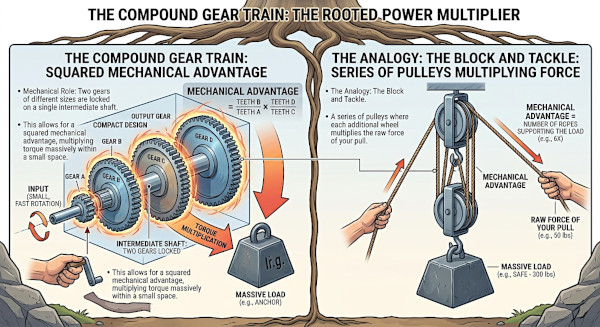 |
Rather than generating new energy, the system converts whole-body mass and ground force into localized force at the point of contact.
3. The Planetary (Epicyclic) System: Coordinated Multi-Degree Integration
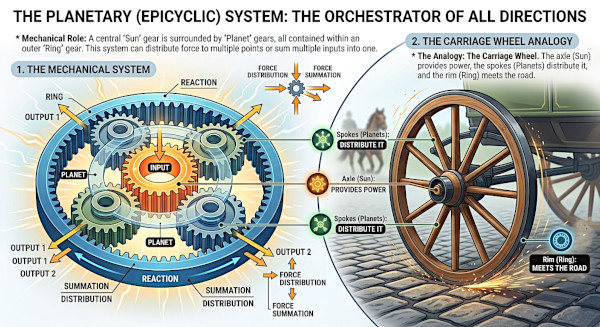 |
Mechanical Role: A central “Sun” gear is surrounded by “Planet” gears within an outer “Ring.” It can distribute force to multiple points or sum multiple inputs into one.Physical Principle: Coupled rotational degrees of freedom. Functional Personality: The Orchestrator It does not act through a single pathway—it coordinates many moving parts into a unified response. |
This enables adaptive response through system-wide coordination, not isolated action.
4. The Reverted Gear Train: The “Coaxial Core”|
Mechanical Role: Input and output share the same axis, preserving alignment while allowing internal transformations.Physical Principle: Collinear transmission of torque. Functional Personality: The Keeper of Center It absorbs and processes change internally while preserving external alignment. |
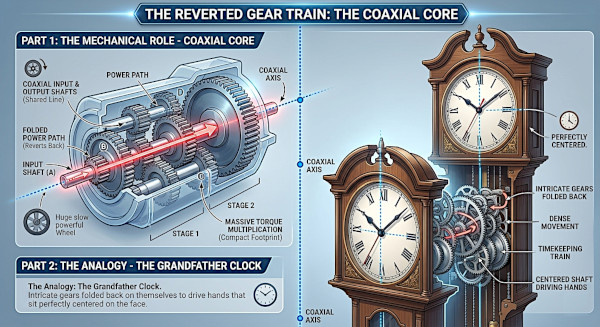 |
The result is apparent stillness supported by continuous internal adaptation.
5. The Differential: The Separation of Yin and Yang
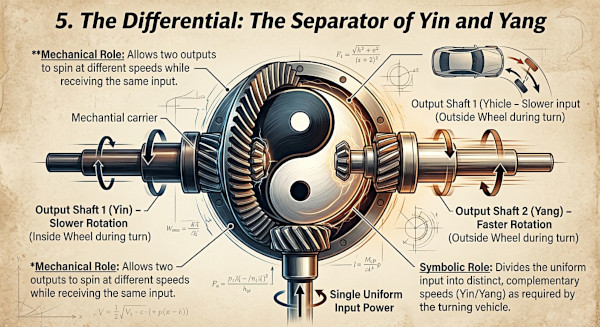 |
Mechanical Role: Splits a single input into two outputs with independent angular velocities under constraint.Physical Principle: Constrained independence of motion. Functional Personality: The Separator It allows unity without uniformity—one input, multiple differentiated responses. |
This prevents mechanical conflict by enabling asymmetry within integration.
| Configuration | Mechanical Function | Physical Principle | Functional Personality | Taiji Expression |
|---|---|---|---|---|
| Simple w/ Idler | Redirect motion | Kinematic constraint | The Messenger | Neutralization (Lu) |
| Compound | Transform torque/velocity | Power conservation | The Strongman | Rooted issuing (An / Ji) |
| Planetary | Coordinate system motion | Coupled DOF | The Orchestrator | Whole-body integration |
| Reverted | Maintain axis alignment | Collinear transmission | The Keeper | Central equilibrium |
| Differential | Split outputs | Constrained independence | The Separator | Full / Empty |
These “functional personalities” are not poetic additions—they are predictable behavioral patterns arising from mechanical constraints.
In Taiji terms, what is cultivated is not force itself, but the ability to:
—all within a single integrated system.
The language of gears simply makes these invisible relationships visible, structured, and repeatable
The Taiji Model: From Specific to Universal
The Lever Model: Localized Power
The lever provides a model for localized force production, where the body operates as a relatively rigid structure rotating about a pivot, as in Peng (Ward-off).Mechanically, this highlights moment arms and torque generation, making it effective for short, decisive actions.
However, lever systems are inherently bounded. They depend on finite angular displacement and cannot fully account for the continuous transformation of force emphasized in classical Taiji writings.
This limitation becomes clear when viewed alongside the principle articulated by Wang Zongyue:
These statements do not describe isolated force production, but continuous redirection and transformation—something a pure lever model cannot adequately represent.
The Gear Model: Continuous & Universal
Gear systems operate through continuous rotational relationships, governed by constraint rather than termination. They do not create energy, but redistribute torque and angular velocity, maintaining uninterrupted transmission of motion.
This provides a direct mechanical parallel to core classical principles:
In modern mechanical terms, these describe a system where motion is not isolated, but propagates through a network of constrained relationships—precisely the behavior of an integrated transmission system.
This is the same principle later made explicit and methodical by Hong Junsheng, whose Practical Method (实用拳法) emphasizes measurable connection, alignment, and force transmission.
The Eight Methods: Functional States of a Connected System
Within this lineage, the Eight Methods (八法; Bā Fǎ) are not discrete techniques, but recurring mechanical states that emerge when the system maintains continuous connection.
The Core Drive (Primary Energies)
The Four Corner Energies (The Directional Shifters)
The Tao of the Machine: A Final Synthesis
|
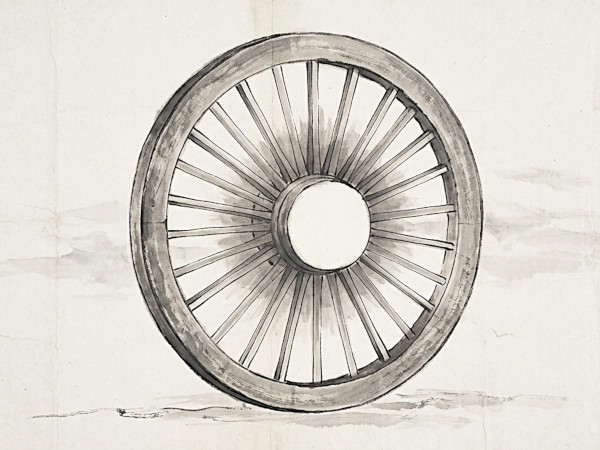
“Thirty spokes share one hub;
It is the empty center that makes the wheel useful.”
三十輻共一轂,當其無,有車之用。
A wheel turns not because of what is present,
but because of what is absent.
|
 |
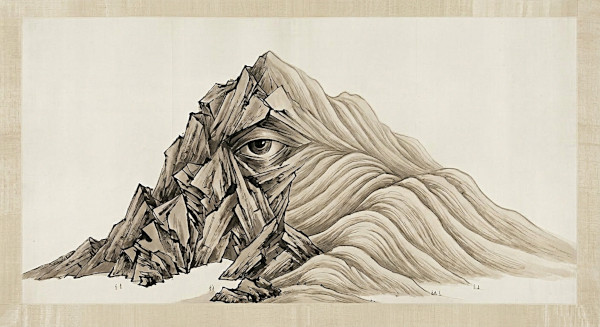
(《題西林壁》 / Tí Xīlín Bì)
|
We do not stand outside the system, observing it.
We are inside it—moving through it, shaped by it.
To understand Taiji is not merely to learn techniques,
but to perceive the structure we are already part of.
And in that realization,
mechanism becomes the Dao.
|
 |

{ 1 comment… read it below or add one }
Nice piece.
It further reveals Master’s historical standing and contemporary value in promoting the spread and development of Taiji.