 |
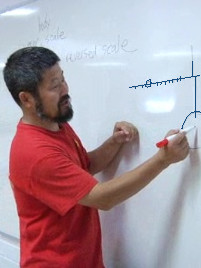
First of all, the original intent of Taijiquan was never as a recreational sport for health. It was a martial art with a rigorous internal focus—one that is distinct from all other systems. This specific art is found only in Chen Village and the branches derived from it.
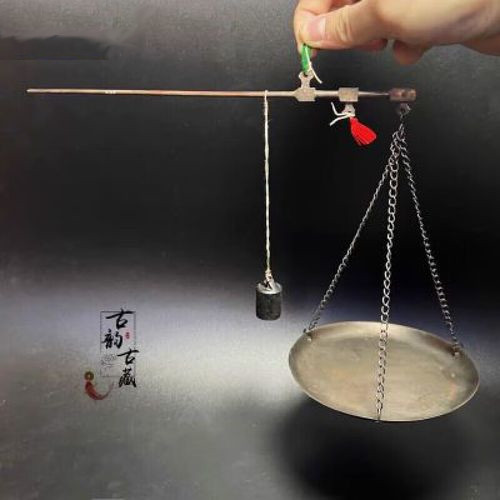
Taijiquan is about balance. Regardless of the method used, Taijiquan will weigh you like a balance scale. This “weighing” is the specialized method of Chen Style Taijiquan, a method absent in other martial systems. |
| While Taijiquan, Xing Yi Quan, and Bagua Zhang are all considered internal arts, Taijiquan is all-encompassing: it possesses what other styles have, but it also uniquely possesses what they do not.This is the method of weighing an opponent. No matter how heavy you are, I only need to nudge the counterweight one tiny notch on the scale to achieve balance. If you were lucky enough to have touched Grandmaster Hong Junsheng, you would understand this immediately; otherwise, it is not easy to grasp.
The scale is an object, and nudging a counterweight is merely an action. So, where is the “internal” in this? If you put one ton of weight on a scale and I move the counterweight just one unit to balance it—and you do not see that as “internal“—then you will never find the internal in this world. To seek intangibles like Jing (劲), Qi (氣), and Shen (神) without understanding this mechanics is to put the cart before the horse. |
|
| (This article is based on the Interview with Chen Stylist Chen Zhonghua by Guo Yi, first posted in 2011.) |
|
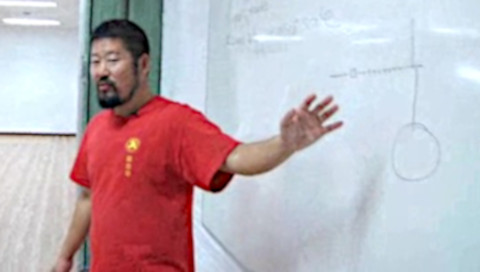 |
Indeed, Taijiquan is simple: it is Yin and Yang. However, it is one thing to say it, and quite another to do it. More accurately, you must train yourself to possess the ability of a scale. We are not turning you into a literal object; the scale is an analogy. In fact, the human body is far more capable than a simple scale, as it can possess several scales simultaneously. |
This is not inherently difficult. First, you establish Yin and Yang. Once they are present, the rules emerge: one side is Yin while the other is Yang, with the center acting as the affixation—the central equilibrium. Everything else is derived from this.
Modern practitioners often dislike simple things, and furthermore, there are few left to teach this. You cannot discover the true nature of Yin and Yang by yourself. It is not the commonly known “3/7” or “4/6” weight distribution, nor is it simply “one foot solid, one foot empty.” It is not just black and white, left and right, or top and bottom. Yin and Yang are not merely antonyms learned in school. When you properly experience them through Taijiquan, you realize they are qualities that language cannot fully describe.
 |
Part 1
Part 2
|
Words of Master Hong
Practical Method: Three Word Classic /
(iv) Body Technique
陈式太极拳实用拳法三字经
(四)身法
杠杆理,支重力;
如磅秤,称粮米,
物加重,砣随移,
使重心,得随遇,
守中立,莫挪移。
Leverage logic: pivot, weight, and power.
Like a platform scale, weighing grain and rice.
As weight is added, the counterweight shifts.
Direct the center to find balance anywhere.
Guard the center; do not waver.
| Central to Hong Junsheng’s innovative methodology is the principle of the ‘Two Scales of the Body‘ (两个秤). This principle dictates that the body must operate as a system of coordinated opposition, where adjacent segments move in inverse directions to generate and channel internal power (劲; jìn). This mechanical logic serves as the foundation for his most famous theories: the elimination of ‘Double Heaviness‘ (双重; shuāngzhòng), the interplay between ‘Orbital and Axial Rotation‘ (公转与自转; gōngzhuàn yǔ zìzhuàn), and the maintenance of ‘Adaptive Equilibrium‘ (随遇平衡; suíyù pínghéng). |
 |
Theory of Two Scales
Based on: The Theory of Two Scales & Matching Opponent Force (Lesson and Demonstration) “, Perth, Australia, 2013.
Upper Body Scale – Dengzi (戥子)
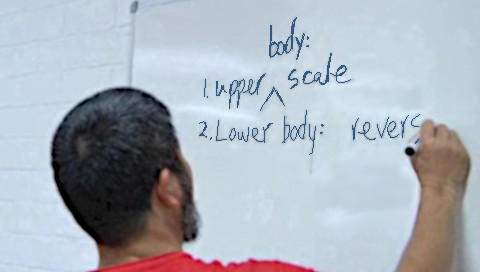 |
Master Chen begins the lecture: “The upper body must maintain a scale, [the ability to measure the incoming force], and the lower body must [also] utilize a [scale—one that functions inversely to the upper body, which is why it’s known as a] reversed scale.””[The function of the scale of the upper body can best be described using a Chinese steelyard called a Dengzi (戥子).]” While this provides a clear mechanical model, Master Chen offers a caveat regarding his explanations: “I’m not a scientist… I use [these examples] merely as analogies because I don’t really understand the science [the detailed physics behind them].” |
| Even with no academic training in physics, Master Chen uses his [experience in teaching and linguistics] to create these mental models. To him, the examples he described simply make sense as a way to communicate movement. “They are analogies, not ‘real science‘ to me. If you find them [those examples] scientific, that is good for you.” In this light, the Dengzi is not a literal formula, but a teaching tool designed to help the student visualize how the body maintains balance through micro-adjustments. |
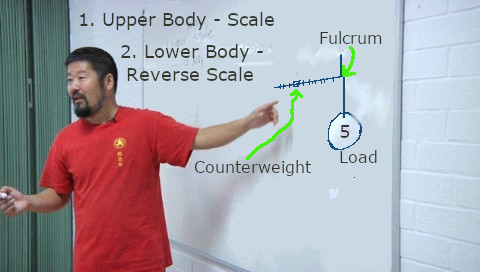 Dengzi, the upper body scale |
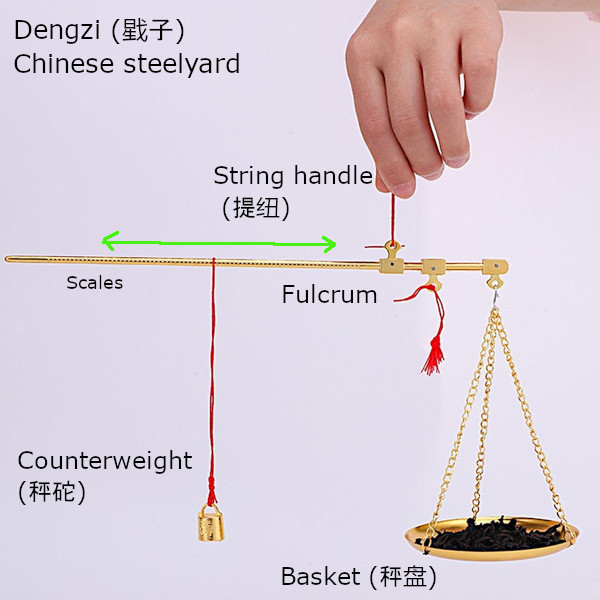 |
“Observe the Chinese steelyard, or Dengzi, shown here in Figure 1. It consists of a straight rod with three primary components: at one end is the pan or basket (秤盘; Chèngpán), where the load is placed for weighing; in the middle, the scale is suspended from a string handle (提纽; Tíniǔ) which serves as the fulcrum; and on the opposite side of the fulcrum, a small counterweight (秤砣; Chèngtuó) is moved along the rod to achieve balance.This adjustment is indicated by the green arrow in Figure 1. The rod features a graduated scale (markings) used to determine the exact weight of the load once equilibrium is reached. In a Dengzi, the further the counterweight moves from the fulcrum, the more ‘weight’ or counter-force it exerts. Ultimately, the function of a Dengziis to maintain balance as a first-class lever.” |
“The Taiji that Hong taught is based on this principle: no matter what you do to me, I only move a tiny bit. You can exert a lot of force, but even if you add twenty pounds of power, my heel responds with a movement so slight you can’t even see it. It remains perfectly balanced. This is the Taiji of the upper body. Once the upper body can maintain this equilibrium against your force, it is called matching. Once you achieve this match, your upper body must consistently maintain that same degree of precision.”
Lower Body Reverse Scale – Catapult (彈射)
“[At the same time, when your upper body is matching your opponent’s incoming force,] you can [apply a force] with your legs. But when you do it with the legs, [the function of the lower body] is the opposite [of the action of the upper body. You are not trying to achieve balance; instead, you are seeking an imbalance. Hence, the action is described as being opposite to the upper body].”
| “The function of the lower body scale is best described using a different mechanical model: the catapult (彈射). While the catapult is still based on a First-Class Lever—featuring a rigid rod connecting a load to a counterweight—its purpose differs fundamentally from the Dengzi. Figure 2 illustrates this catapult using the same mechanical components, but with a different principle of operation.In a Dengzi, balance is achieved by shifting the counterweight’s position along the rod. In contrast, a catapult utilizes a fixed position and a counterweight that is as heavy as possible to launch the load with explosive force. This larger, dominant weight is shown in Figure 2; as a result, the pan is driven upward. In Taiji training, this lower-body action is called a ‘reversed scale.’ As Master Chen summarizes: ‘And so this is reversed because you regard your opponent’s size and power as something minuscule [compared to the fixed counterweight of your own base].’ |
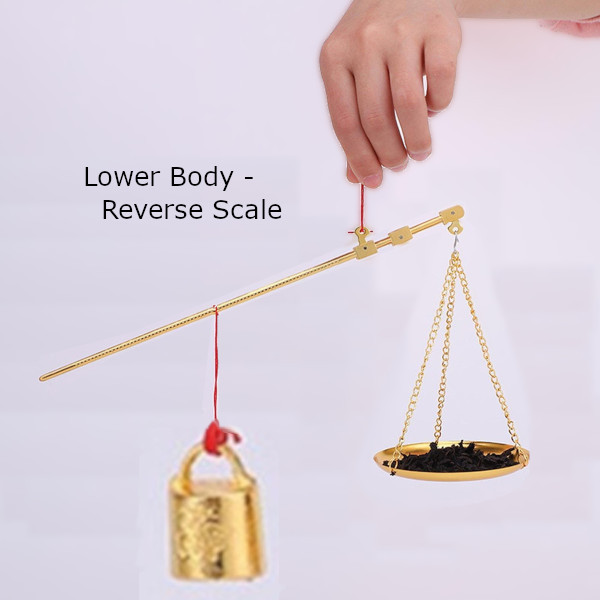 |
Demonstration of the Two Scales
Master Chen demonstrates the ‘Two Scale’ model with a student in Figure 3. Figure 3A shows the initial position, where the student uses both hands to grab Master Chen’s biceps and pins his arms to his sides.
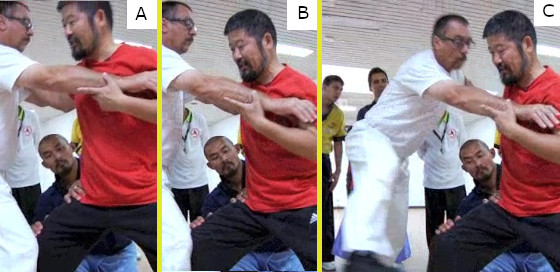 |
In response, Master Chen holds the student’s elbows to halt their forward momentum. Once the student’s progress is stopped, they continue to apply pressure.Master Chen then explains the upper-body scale: ‘The counterweight on the top is [the] elbow and shoulder.’ This state of balance is captured in Figure 3B. Next, Master Chen applies the lower-body scale, explaining, ‘The counterweight at the bottom is my quad and knee.’ |
He describes the internal action of the lower body as follows: ‘I’m going to reverse [the position of the kua; the front kua now points up and the rear kua drops]. So [there is] no move [or external displacement]. [Instead], this one [the rear kua and the tug in of the tailbone leads the counterweight] went far down. Making [this] one little drop [means] you can’t take it, because it’s [now] underneath you.’ The final result, shown in Figure 3C, is the student stumbling backward as the ‘reversed scale‘ launches their force.”
Master Chen contrasts the Taiji method with ‘normal’ physical reactions. He states: ‘The normal one [reaction against a push] we [Taiji practitioners] call Double Heavy (双重; shuāngzhòng).’ This concept is best explained through a practical comparison. In a normal reaction, such as in wrestling or grappling, if an opponent pushes, you might resist by matching them with your whole body—including shifting your base. pushing back with your feet and moving the point of contact to get a better vantage point.
Master Chen observes: ‘Can you see that [this reaction] is excessive?’ He then outlines the Taiji approach: ‘[First], match [the opponent’s force with the upper-body scale], and then [adjust the internal structure of the lower body to create the leverage necessary to move the opponent. For example, by opening up the kua]. You move the bigger one [, the lower scale that has more power]. ”
“So, the first action [matching] is to weigh you [with the scale of the upper body]. The second action [is to use the reverse scale of the lower body to create the reaction in your opponent].
[Remember, this is how a catapult works:] we put a heavy rock here [on one side of the fulcrum; this big rock serves as a counterweight]. On the other side [the far end], there is only a small rock with a fire in it. When released, the small rock flies into the enemy field [causing damage]. So, that is the concept [of how a catapult historically functions].
| The student holds Master Chen’s right forearm close to the elbow with both hands. Master Chen places his right hand into the crook (Antecubital Fossa) of the opponent’s elbow. Master Chen tells the student:”[Secure the hold on my forearm and] lock the three points to feel [my power], and [use] a larger stance to feel [that you are stable].”Figure 4A shows this initial position. Master Chen instructs the student to start pushing his arm. In response, Master Chen pushes back with his hand, using just enough power to stop the student’s forward momentum. |
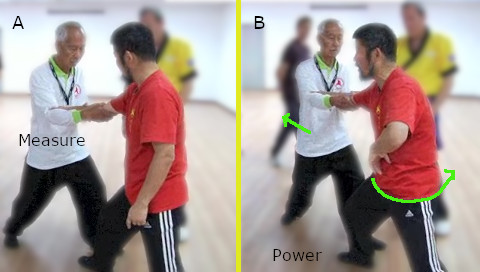 |
Master Chen explains: “[When I have equalized the incoming force from my opponent,] this is matching [with the scale of my upper body]. Once I match [my power] to him—”
Master Chen points to his front kua.
“—you see that this [front kua] has a lot of power. Once I match [the incoming power with my upper body, then] this move here [with the front kua] has a huge impact [on the opponent]. [This kua movement acts as the reverse scale, or catapult, for the lower body].”
This final position is shown in Figure 4B. The overall posture of Master Chen remains nearly identical to the initial position, with only a slight change in the position of the front kua which causes the reaction from the student.
Two Scales is a Monkey Wrench
Master Chen uses a physical analogy to explain this Taiji action of the ‘two scales.’
‘So, [this action is] the same as a monkey wrench.’
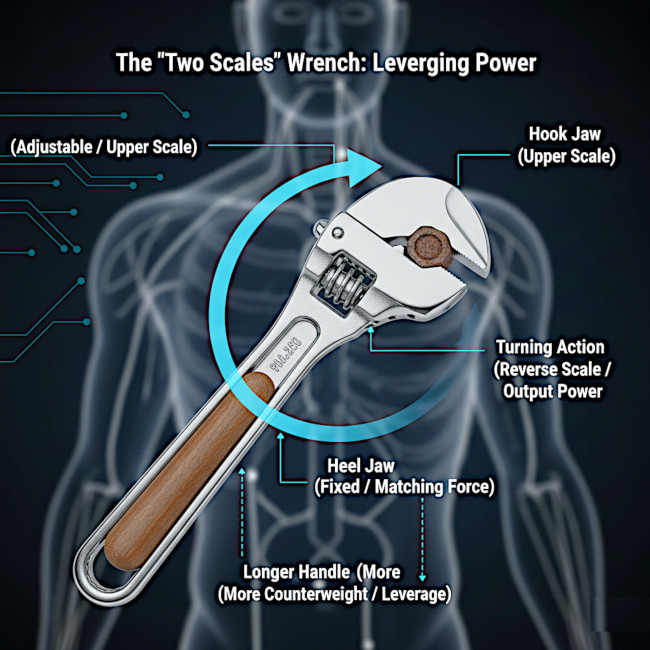 |
On a monkey wrench (or a standard pipe wrench), as shown in Figure 5, the parts that grip the bolt are called the jaws. Specifically, the top is the Hook Jaw, the adjustable part that moves up and down; the bottom part is the Heel Jaw, the fixed part at the base of the opening, which is usually part of the main handle.This [configuration] represents the requirement of the upper scale: the action of matching is equivalent to the tightening of the jaws on a monkey wrench. Once this action is completed [and the grip is secure], the power of the reverse scale is equivalent to the turning of the wrench. Consequently, a larger counterweight [in the lower body] is equivalent to a longer handle on a monkey wrench, [providing greater leverage].” |
Returning to the Taiji practice: “The movement of the Dantian is very important. In the beginning, the movement is actually two actions combined.
| In the first move, your hand is far from your opponent. You must—some people say “relax,” but I don’t use that word [The concept of ‘relaxation’ … does not exist within this system] — you must not fight back. Simply find a way to anchor on him. That is all. Use no [local] power; just find a way to [place an] anchor on him.Once anchored, you then use this [the lower body, such as the kua, dantian, and legs] to do the “fight” [the issuing of power].’ |
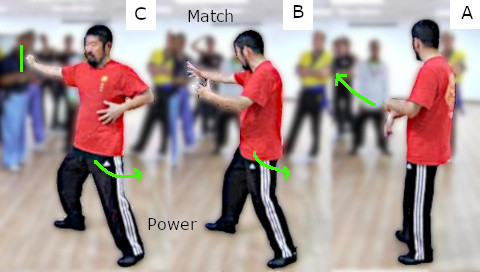 |
Figure 6 shows Master Chen demonstrating each of these actions through the extension of his right hand. First, Figure 6B, the hand establishes an anchor on the opponent without fighting back or using local tension. Second, figure 6C, once the connection is fixed, the Dantian and Kua (the lower body engine) provide the necessary force to complete the extension and displace the opponent.
Exercise to Practice the Two Scales
Master Chen demonstrates the ‘two scales’ exercise based on a grappling scenario. A student stands to Master Chen’s right, placing his left leg in front of Master Chen’s right leg. The student wraps his left arm under Master Chen’s right armpit and across his stomach. Master Chen holds the student’s left wrist with his left hand—not to struggle, but to provide a sense of stability. Simultaneously, Master Chen drapes his right arm across the student’s body, and the student locks Master Chen’s right wrist.
In a standard application, this position is the precursor to an arm bar. By locking the wrist and applying pressure to the elbow and tricep, the student could potentially break the arm. Master Chen ensures the student has a secure hold, as this is the first step of ‘measuring.’
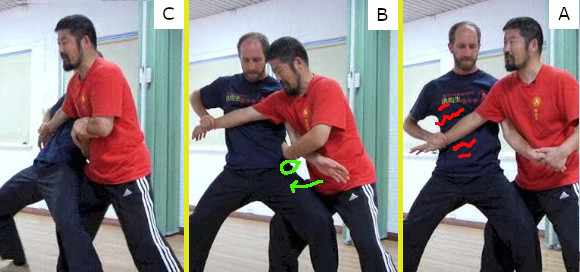 |
‘Put it [your arm] in a secure position,’ Master Chen instructs. ‘Once you are stable, I am not fighting you here [at the elbow contact point]. [You feel that ] I am fighting here [at the end of the right hand].’ This initial position is shown in Figure 7A. |
During the initial demonstration, Master Chen stops. ‘You’re pretending,’ he tells the student, reminding the audience of the necessity of mutual, honest practice. ‘I did it [the initial Taiji action] wrong because I started fighting him [with the arm] instead of just placing it.’ This error is shown by the red arrows in Figure 7A. When Master Chen uses the arm, the students can easily fight back so the exercise turns into a conflict of strength.
Master Chen repeats the technique. ‘I never fought [with my right forearm]; I [simply] moved into a position across his body. Now, the fight is here [at my front kua].’ This corrected action is shown in Figure 7B. Master Chen notes, ‘Can you see this fight? It is very difficult because we instinctively want to move our hands.’
He concludes by emphasizing the ‘Inside-Outside’ divide: ‘The arm just occupies the empty space. Now, the fight is inside—in the kua, the dantian, and the legs. The outside [the arm] does not move. When done right, your opponent’s head must hit the floor.’ The final result for this exercise is shown in Figure 7C.
“Once you understand the purpose of this exercise, you must learn to feel it,” Master Chen cautioned his students. “When you feel something is wrong, stop. Do not fight the technique.”
Because this exercise is rooted in a high-stakes combat application, Master Chen demonstrated the movement with a seasoned instructor to reinforce his warning. “I’ll show you exactly how this is meant to function in an application, especially if your opponent is very strong.”
| As a safety precaution, Master Chen positioned a second student behind the instructor to catch him in the event of a rapid fall. This initial setup is illustrated in Figure 8A. Master Chen places his right forearm across the instructor’s chest—indicated by the green line—to gauge the level of resistance. He then activates the “reverse scale,” utilizing the front right kua to power the Taiji action. |
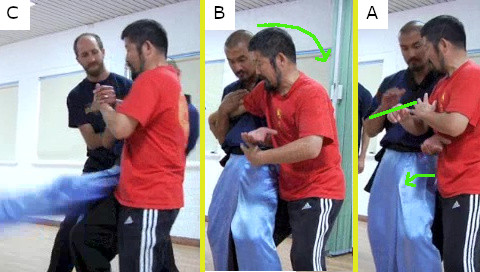 |
In Figure 8B, a green arrow indicates the instructor’s head being forced backward. Master Chen explained the mechanics: “With this move here, the leg flies up while the head plunges down. Can you see? If you aren’t being supported, the head lands first… it will hit the floor violently.” This rapid, dangerous descent is captured in Figure 8C.
In Figure 9, Master Chen demonstrates the specific portion of the Yilu form upon which this exercise is based. The sequence begins with the placement of the right elbow—a movement many practitioners mistakenly interpret as a simple elbow strike.
| In the context of the “Two Scales” theory, however, the initial placement of the elbow (and subsequently the forearm) represents the use of the first scale, the dengzi. This action is designed to gauge the opponent’s resistance. Once that resistance is matched and stabilized, the second action engages the “reverse scale,” or catapult, to achieve the desired outcome. |
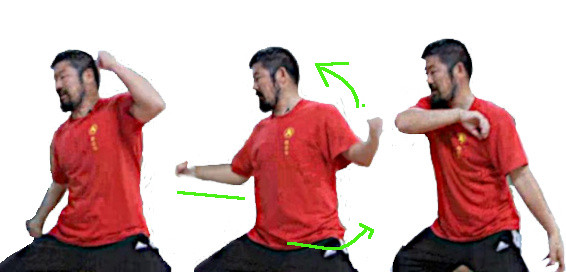 |
The green arrows in Figure 9 illustrate the synchronized movement of the rear left kua and leg, alongside the left hand, which provides the actual force for the technique. Without a firm grasp of the “Two Scales” theory, an observer might assume the right arm is executing a strike; in reality, the right elbow and forearm are simply following the opponent’s trajectory, devoid of any independent, local power.
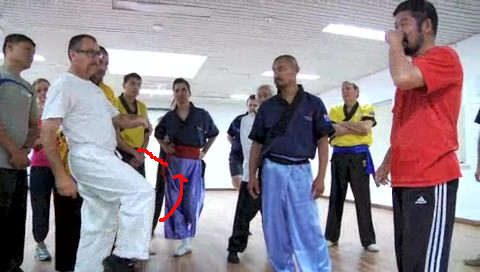 |
A student sought clarification by demonstrating a standard MMA technique: a cross-body clinch followed by a leg sweep, as illustrated in Figure 10. Master Chen’s response was immediate: “That has nothing to do with this exercise. From a Taiji perspective, that type of technique is totally ‘fake’.”He explained that the student’s example relies on a direct physical conflict—a struggle of force against force—which contradicts Taiji principles. “Everyone swears I kick them with the front leg,” Master Chen noted, “but if you watch my videos, I never move it.” |
The sensation of being kicked is actually a sensory illusion caused by the “Two Scales” in action. Master Chen clarified the physics: “Because I press you down with my forearm, it feels like I am pushing you up with my leg. Your feeling is relative.”
In this Taiji application, the body acts as a see-saw. When the forearm applies downward pressure on the upper body, the opponent’s lower body naturally flips upward to compensate. The leg merely maintains contact and remains stationary; it is not the source of power. The opponent’s foot moves not because of a kick, but because the structure of their own body has been manipulated by the downward force at the contact point.