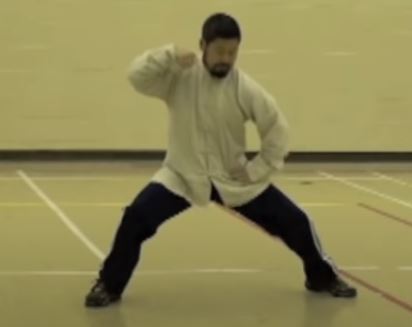
- (2nd move of pound mortar) Don’t move the center. Turn and stretch the other side to adjust to the turn. First stretch the rear shoulder, then the rear kua, then the rear foot.
- Pull is with rope, push is with stick.
- Distinguish between power and angle. Don’t fight through, adjust and find the angle instead.
- Need 3 pts to line up. E.g. finger, elbow, rear elbow. 2 points already form a line – 3 need to have real alignment.
- Aim at the nose. First with the finger then the elbow. Don’t move the contact point and don’t fight it either. It is a distraction.
- Make the finger to elbow a stick and aim it with the body at the nose.
- Once aimed lock the body and only move the feet.
- Every move has to catch the opponent. Don’t just turn around in place; carve. Rotation is useless without a poke / a catch.
- Lock the whole leg structure and go over like a board falling. 碾 nian (grind). Don’t take the shortcut, go all the way over.
- Put the foot in without pushing (use the kua)
- Pull with your toe
- Don’t push!!
- Step in front foot
- Pull in back foot
- Open the back to connect to rear kua
- Sink shoulder to poke finger
- Open rear kua / knee
- (Additional notes: keep the stick, don’t let your wrist go, control its aim with your body
- Aim at the tanzhong or nose
- Don’t raise the shoulder or move the shoulder forward, it only goes down
- Get under the opponent without collapsing or fighting
- Closer the rear foot is, the deeper underneath the opponent you are)
- Need to get engagement with the touch and never lose it. Have to catch the opponent with every adjustment. Needs to have a poke at their center
- Make the body like a chair. Can support the force without strength. Bone connects to the floor, allows other movements around the structure.
- Always engaged, never neutral. Changes between legs by turning the gears.
- Solid – Move inward (in with elbow no hand, out with hand no elbow). In first then out.
- Torque accumulates until the size can’t take it. Many micro rotations until it breaks. Not moving allows it to accumulate.
- Don’t say its mysterious, identify something even if you are wrong. You can adjust it to be more correct.
- If its not contained the power / the stretch has no meaning, it is lost. Needs a ceiling and a floor. The neck must not lose power. It must be straight to transmit power. 5 necks: neck, wrist, ankle.
- Necks are like chains in a way. Certain ways of moving, they are loose, other ways they are stiff. String of 9 pearls: Tighten the string the beads are on, it is stiff like a spear. Loosen it and it is flexible to change shape.
- Power on the elbow.
- Work on being able to separate the axis (core) and the lock.
- Initiate with small counterweight then add the big counterweight (dantian) to flip the scale.
- Rubbing when making fist. Can increase power by giving yourself resistance. Rub against yourself. Like rubbing your fingers against each other. Now the fist rubs, and the armpit rubs, and elbow and kua rub.
- Upper dantian – keep the point locked on to the opponent.
- Line it up to the arm, the 7 in knife.
- Stretch the tanzhong point back, keeping the body parallel.
- Magnet (dipole) no matter how it’s divided, there are two poles in each magnetic part.
- Kua and elbow evenly stretch to/away from center.
- Back arch, butt arch.
- Inward move. It all tightens up so you are a compressed cannonball. It does not change shape, it wedges in with the feet. If you overextend, your structure loses integrity.
- The fight is for strategic points. The points are like voids that you stretch from / to. I saw them as black holes. Closing space is like getting sucked into a point near the opponent.
- One such point is the midpoint between the elbow and the kua. If you occupy the opponent’s space they have nowhere to escape to. Stretch towards like a parachute.
- Stretch away from the point by arching. Stretch towards also by arching. The arch lets the tension even out.
- Stretch and rotation without combining create area (pressure). Need to carve space with rotation. Otherwise you are just spinning in space.
- Switch foot kick to step without popping.
- Create a wedge and move it forward without changing the wedge.
- Fall to wedge in. (Go with the opponent’s push but gain more on the foot)
- Fall lets foot come forward.
- 顶天立地 head stretch creates crowbar.
- Rubber cord exercises: lean and get distance, then go into horse stance (straight vertical) to get used to the feeling of being brought over the edge.
- Pay attention to elbow leading. Kua and elbow pull to center point.