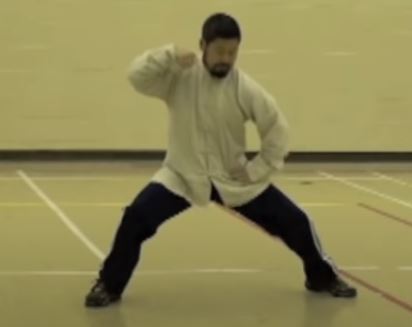
In the Practical Method system, the wrist and hand are given special emphasis from the very beginning.
Following Master Chen Zhonghua’s teaching, the practitioner is very often met with phrases such as:
Referring to the Yilu form(一路), “setting of the wrist”, “the wrist needs to be straight and open”, “tile hand”, “ the lines of the five fingers connect to the elbow in one dot“, “open is not the same as flexible”, “the wrist (and joints) need to be open enough, so that the power can go through”, and eventually, for the Cannon Fist (炮捶): “the stretch of the wrist and hands needs to match the one of the ankles and feet”.
In all of the above elements, the fundamental principle of separation needs to be trained to be present as well.
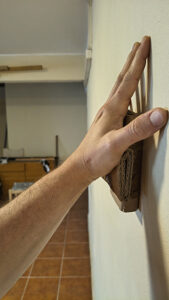
Starting simple, while training our pushing on the wall exercise, I noticed that there was no separation of the wrist and hand, as the vertical surface of the wall was causing the wrist to bend, and when touching with the fingertips, the base of the hand (palm) was not touching the wall.
The first step was to add a stick horizontally on the wall and place the base of the hands on it. So, at this point, I experienced a form of separation, as there was independent movement on the rest of the hand and fingers, while adding force.
Then, I had to somehow maintain the wrist in a straight position while stretching. So, I made these two tools for training by pushing the wall.
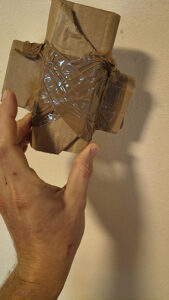
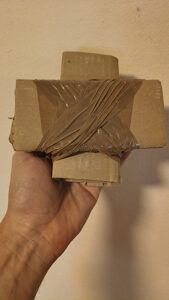
Following is a video with more tools to work on the hand joints and massaging (按摩) of our Laogong point (PC8), while grabbing (opening/closing):
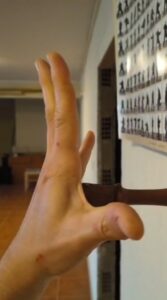
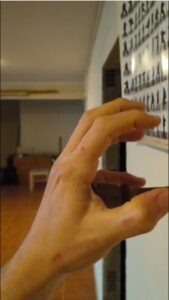
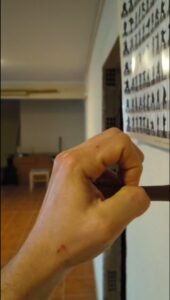
https://www.youtube.com/shorts/8dFXBJddGUQ
The advantages of using such tools are that:
- They provide separation between the base of the palm and the rest of the hand.
- Also, the wrist can be kept straight to provide a wider stretch, or the power to go through, reaching the fingertips.
By exploring further the opening of the hand joints by using different tools or surfaces, I noticed that many parts of the body also started to gain mobility, which were before evidently fused, or “rusty” in PM terms.