I. Learning Journey: From “Listening to Theory on Paper” to “Feeling the Force Up Close”
My initial learning primarily involved attending online classes with Master Chen Zhonghua, which mainly focused on theoretical understanding and had little exposure to offline practice. I later had the opportunity to experience Master Chen’s techniques in person in Zhongshan and Guangzhou, where I truly felt the difference between practical application and pure theory. The movements I saw with my eyes often required me to rely on imagination to reproduce them when I tried to perform them myself, which was far from the actual experience of practicing in person.
This time in Shenzhen, I was fortunate to receive close guidance from Coach Kelvin Ho, who personally demonstrated the techniques and broke down the mental methods. This experience was immensely rewarding, as it allowed me to truly internalize many theories that I had previously only heard about, and to feel them in my body.
The most profound overall realization I had is this: many things cannot be truly mastered by merely listening to theories or imagining them in your mind. Even if you develop some subjective sensations through practice, it does not equate to true mastery. Without repeated, face-to-face practice on your body and without the instructor breaking down the underlying principles and secrets, you will never know what the true standard is. This is what is referred to as “internal skill and mental method”—simply looking at the external form or listening to the explanations is not enough.
II. Core Practice Movements and Practical Corrections (Methodology Section)
The most valuable aspect of offline practice is that it fully connects the “misconceptions, correct principles, and bodily sensations” of each movement. Below are the key training movements I focused on correcting this time:
1. Five Bow Stretch and Dantian Convergence Training (Finding the Fixed Point by Holding onto a Rail)
Previous Misconceptions: I used to understand “stretching” as tightening my muscles, using force, and making my body rigid. I would perform the movements based on my imagination, feeling that I was using force and that my body was becoming rigid, and I thought that was sufficient stretching. I also had no fixed reference point during practice and relied entirely on subjective sensations to adjust.
Kelvin’s Correction: True stretching involves evenly extending every part of your body, with all five bow forces converging toward the dantian. During training, you can use a rail as a reference point and a fixed point, holding one end steady and focusing on the internal stretching of your tendons, rather than relying on your muscles to make your body rigid.
Real Body Sensation: I had always thought I was achieving dantian convergence, feeling force in both the front and back of my abdomen. However, when Kelvin touched me, he found that my entire body was soft, and the stretching was not at all effective. I had previously experienced cramps in certain areas when stretching, which I mistakenly thought was a sign of incorrect practice and stopped. In fact, the cramps were a sign that the stretching was effective and that I was actually working on the right areas. Those movements that felt comfortable and easy were, in fact, not producing effective stretching and did not involve the concept of yin and yang.
Correct Standard: When your entire body is evenly stretched and all five bow forces are directed toward the dantian, a very firm core will naturally form inside the dantian. The front and back of your abdomen will simultaneously create a unified tension, rather than relying on the abdomen to press itself rigid.
2. Wall Pushing Exercise…
Past Mistakes:
Previously, when practicing the Wall Pushing Exercise, I understood it as “connecting my hand directly to my foot, pressing my abdomen, and then a force would go to my hand and another to my foot, causing my body to bounce out on its own.” However, in practice, most of the time I ended up jumping out myself, and I never truly developed the “stretching” force.
Kelvin’s Correction:
The true Wall Pushing Exercise involves pushing the force to its limit, with all the force ultimately converging in the dantian (lower abdomen). It relies on the stretching of the entire body to generate a unified force for pushing, rather than the limbs actively jumping or bouncing. The core principle is the continuous “stretching” throughout the body, not a localized force of collision.
Corresponding Logic:
This also confirms a general principle: if you want to achieve result B, you cannot directly do B; instead, you must do A, which is related to B. If you want to generate a unified outward force, you cannot directly pursue “bouncing out”; instead, you must focus on stretching your entire body and gathering the force in your dantian, and the result will naturally follow.
3. Correction of the Details in the Buddha’s Warrior Pound Mortar
Left Hand Reverse Circle Phase:
When the left hand circles to the right, the stretching of the elbow is completely insufficient. It only goes through the motion’s appearance without developing a continuous stretching force.
Kicking Out and Opening the Hips Phase:
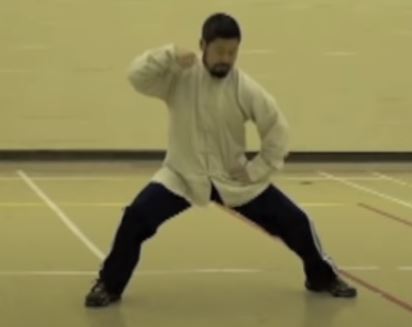
When performing the kicking motion, the stretching of the two tendons in the thighs is not sufficient. The correct method is to fix the right leg as a stationary point, completely stabilizing the right side of the body, and only opening the left hip. The entire process should focus on the internal stretching sensation of the tendons.
Body Sensation:
When practicing according to this principle, you will quickly feel a cramping sensation. This is a sign that the stretching is sufficient and that you are truly working on the exercise. This is entirely consistent with the underlying logic of the Five Bow Stretching.
III. Core Insights and Cognitive Upgrades (Experience Section)
1. A Complete Redefinition of “Stretching”
This was the biggest cognitive breakthrough in this session. I had always thought I understood stretching and had developed some sensations based on my own understanding, so I believed I had mastered it. However, after receiving hands-on guidance from Kelvin, I realized that without being physically touched, corrected, and repeatedly tested by Kelvin, I would never truly know what “real stretching” feels like.
Mistaking “Tightening” for “Stretching”:
Previously, I thought stretching meant tightening the muscles and making the body rigid. In reality, true stretching is even and continuous, involving the pulling of internal tendons, not the stiffness of external muscles.
True Stretching Happens When You’re Still:
A comfortable movement does not involve stretching. Only when you maintain a pulling sensation while still can you truly perform stretching training. The comfort you feel when moving is essentially an escape from stretching and does not distinguish between yin and yang.
Cramps Are Positive Signals:
I used to stop practicing because I was afraid of cramps. In fact, cramps are precisely a sign that the stretching is sufficient and that you are reaching areas you haven’t worked on before. They are an essential part of the progress process.
2. A Deeper Understanding of the Essence of Practical Method and Force
Long Strikes Against Short, Not Big Against Small:
I used to hear Master Chen say, “Power comes from length, from long striking short, not big striking small,” and I treated it as a mantra. Now I truly understand: force is not about brute strength or size, but about the “length” of the body’s stretching. When the movement is done correctly, the opponent is naturally sent out, and there is no need to exert extra force.
Indirect Force and Dantian Power:
First, make the upper body rigid and stretch it out, then use the dantian to drive the force. I can occasionally succeed in using this method of indirect force, but when I do, I don’t feel a strong subjective sensation. Moreover, in the early stages, I need the opponent to cooperate by becoming rigid in order for the force to reach their center.
The center is the sole target of power: Kelvin described the core point of this power as the “center.” Just like pulling the trigger of a gun, I can currently achieve a state where my own movements remain “unmoving,” but I still cannot precisely aim at the opponent’s center—without an accurate point of impact, the true bouncing and explosive power cannot be effectively generated.
By practicing according to a fixed template up to now, my movements have become largely standardized in form, but I still cannot consistently produce the effect of making the opponent bounce away. I usually need the opponent to cooperate by becoming rigid and guiding the power to their dantian (lower abdomen) for it to work. The core reason for this is a lack of sparring experience: I have only achieved standardization in my own movements, but I have not yet trained to accurately target the actual point of impact on the opponent’s body. I have personally tested this on Kelvin, touching different parts of his body such as his knees, back, hands, chest, and shoulders, and in each case, he bounced me away. I have truly experienced the legendary state of “the entire body being a dantian, where power can be generated from any point of contact”—any point of contact can transmit power directly to the opponent’s center.
Only when I can achieve a state where power automatically targets the opponent’s center from any part of my body can I generate true bouncing and explosive power. Otherwise, it is merely a superficial imitation of the form. To make up for this, I need to repeatedly test and adjust on different people, gradually refining the accuracy of my power in targeting the opponent’s center.
Power metaphors from concept to physical sensation: Several power models that Master Chen often mentions—such as a rubber band stretched taut at both ends with the middle naturally bouncing up; the opposing tension in drawing a bow and shooting an arrow; or a triangle pressing down on one end with the other two ends pushing outward, or fixing one end and only pushing outward from the other—were previously just theoretical concepts. Now, through stretching and dantian training, I have truly experienced these sensations in my body.
3. The subtleties reveal true skill: The hidden cost of advancing and retreating
A problem that is extremely difficult for me to notice but is of critical importance: after each step forward, I often unconsciously retreat a little bit, and the power is lost, making it impossible to continue with the subsequent movements.
This “loss of power” is extremely subtle. There are many parts of the body, and if even one part relaxes slightly, the entire power dissipates. When I am in the midst of the movement, I can hardly perceive this subtle retreat, which is why offline coaching is irreplaceable—only an observer can accurately capture these subtle losses that are difficult to see with the naked eye.
4. The foundational methodology of learning martial arts
A procedural approach is a necessary path for beginners: Truly correct movements often do not produce a strong physical sensation for beginners, so they cannot replicate them through self-perception or practice them correctly on their own. In the initial stage, one must strictly follow the procedures provided by the teacher, such as using reference points or practicing according to fixed guidelines, to gradually build the correct body awareness through the procedure, and only then can one gradually move away from the procedure.
Teacher correction + repeated practice is the only path: One cannot rely on imagination to “understand” the technique. One must constantly have the teacher point out the problems and repeatedly correct them oneself in order to gradually approach the correct state.
The sign of progress is “discovering new problems”: true progress lies in being able to notice details that were previously completely overlooked. If you feel there is nothing new and that you already know everything, it is often a sign of stagnation and the most likely point at which you will give up. Only when you have truly practiced to this level can you understand the things at this level. The deeper your skill, the more details you can see.
5. Consistent Underlying Principles
In the early stages of learning, it feels like a person who is visually impaired touching an elephant, seeing different techniques and forms—such as evenly extended power extension, grappling positions, or fist striking techniques—and assuming they are independent and unrelated. However, as one’s understanding deepens, it becomes clear that all techniques share the same core logic of “dividing into yin and yang.” This theoretical framework can be applied across all practical scenarios.
Understanding is hierarchical. Each time you delve deeper into a level, you gain a new and fresh insight into the same principle. Everyone is moving in the same correct direction, but some are closer to the finish line than others. Along the way, you will inevitably encounter bottlenecks. Many people give up during these bottlenecks, thinking, “There’s nothing new, I already know it all,” but in fact, the bottleneck is the eve of a breakthrough.
6. Universal Principles Extending to Life
The principles in martial arts are entirely applicable to life:
If you want to achieve a certain result B, you cannot directly focus on B and force it. Instead, you must first establish the prerequisite A that is connected to it. Once A is properly done, B will naturally follow. The more you deliberately pursue the result, the less likely you are to achieve it. By doing every detail of the process correctly, the result becomes a natural byproduct—it cannot and should not be pursued deliberately.
IV. Comparison and Summary of Online Theory and Offline Practice
Previously, I had been studying online with Teacher Chen and had absorbed a large amount of systematic theory, but I had always remained at the level of “knowing” and had not truly internalized it in my body. This time, Kelvin’s offline guidance essentially brought these abstract theories into my physical reality:
Master Chen talked about “yin and yang.” Before, it was just a concept from books, but now, through the sensations of “stretching vs. comfort,” “stillness vs. movement,” and “fixed vs. open,” I have experienced the true distinction between yin and yang.
Master Chen talked about “long striking and short striking.” Before, it was just a mnemonic concept, but now, through the sensation of five evenly stretched “bows” and the continuous extension of my fingertips during strikes, I have experienced the “long” power, not the brute force of “big.”
Master Chen used metaphors like rubber bands, bows, and triangles to describe power. Before, these were just mental images, but now, through practical exercises like pushing against a wall, pulling on a railing, or opening my hips, I have felt the real tension and unified power.
Master Chen talked about “the whole body being one Taiji, and every part being the dantian.” Before, this was just an abstract concept, but now, I am gradually realizing the direction of practice: “the whole body is hands, the whole body is dantian, and wherever you touch, power can be generated, and every strike can hit the center.”
V. Current State and Future Direction
At present, I still cannot achieve a uniform stretch throughout my entire body. When I encounter resistance or a threat to my center during pushing hands, I still unconsciously tense my hands, causing my overall power to become unbalanced. I am still in the phase of my body becoming rigid, and I know that a rigid body is vulnerable to being hit, but I also understand that this is a necessary stage of progress.
At the same time, I have identified my current core weakness: my movement framework is already largely able to follow the template and perform standard actions, but my accuracy in aiming my power at the opponent’s center is insufficient. I lack experience in sparring with different opponents, which prevents me from achieving the bouncing effect in my power delivery.
I am fully aware that I am still far from true martial arts mastery, but the direction is clear. Moving forward, I will not pursue the results of generating power or striking effects. Instead, I will always keep in mind the principle of “practicing the form as if there is an opponent, and pushing hands as if there is no one”—focusing not on winning or losing, but simply on practicing the form and completing each movement fully. The effects will naturally follow when the movements are correct.
On one hand, I will continue to refine the details of my stretching and whole-body power, ensuring that every movement is executed solidly. On the other hand, I will repeatedly test my power against different people, accumulating experience in sensing the center of balance. Through repeated practice, I will gradually deepen my awareness—being able to constantly discover new issues and new details is a sign of progress.