 |
“Miscellaneous Poems of the Jihai Year, no. 5.” (《己亥杂诗·其五》)
— Gong Zizhen (龚自珍, 1792-1841)
|
||||||||
| Gong Zizhen (龚自珍), a Qing dynasty poet and reformer, wrote these lines in 1839 as he left Beijing. They are words of departure, but not only of sadness. The fragrant blossom has fallen from the branch, yet its story is not finished. It returns to the earth and, in another form, gives something back to the flowers that follow.
I think of a teacher when I read those lines. A teacher eventually leaves us. The voice becomes a memory, and the hands that made a correction are no longer there. The person who spent a lifetime working to understand an art becomes its history. But the work does not end. It passes into the students who received it. It appears again in their practice, in the questions they ask, in the corrections they make, and eventually in what they pass on to others. |
|||||||||
⸻⸻⸻⸻⸻⸻⸻⸻⸻⸻⸻⸻⸻
陳式太極拳
洪均生宗師
Chen Style Taijiquan ‧ A Tribute
Hong Junsheng at 120: A Double Jiazi
洪均生诞辰一百二十周年:双甲子
A single Jiazi is a lifetime. A Double Jiazi is a legacy.
◆ ◆ ◆ ◆ ◆ ◆ ◆
An Anniversary That Matters
饮水思源
When drinking water, remember the source.
When drinking water, remember the source.
On March 24, 2027, the Practical Method community will mark an unusual milestone: 120 years since the birth of Master Hong Junsheng (洪均生, 1907-1996).
For Chinese people, 120 years is not simply another round number. It is two complete Jiazi (甲子), two full turns of a sixty-year cycle. The number carries particular weight when we think about a teacher. A teacher’s life ends, but what he taught does not end with him. It passes into the hands of students, and from them into the hands of others. After enough time has passed, it becomes difficult to see where one person’s work ends and the lives of those who followed begin. That is why this anniversary deserves to be remembered.
One of my teachers was a fighter with undeniable, proven combat experience. Yet when I tested his system against the Practical Method, it did not work for me. Neither did my own skills. I could hold my own against other students, but against the Practical Method I was helpless. I thought I knew something about the world. In truth, I was a frog at the bottom of a well, mistaking a circle of sky for the heavens.
I had tried to build speed and power the hard way: lifting weights, hitting sandbags for countless hours, sparring in every style I could find. It never brought much success. So I went in the opposite direction. I gave up training the muscle to focus on the mind, spending long hours in standing meditation (站桩, zhàn zhuāng), practicing sōng (松), the art of relaxing. I became very good at relaxing, and very good at falling asleep. Two opposite roads led to the same dead end.
The Practical Method was a third path: neither more muscle nor more relaxation, but structure. It actually trains toward the Taiji ideal of “four ounces deflects a thousand pounds” (四兩撥千斤). That ideal is not myth but physical reality. The first time a technique worked because of correct principle rather than raw strength, I realized how much of what I had trained was beside the point. Much of the years that followed was unlearning. This series that follows is my small way of saying thank you.
一
What Is a Double Jiazi?
双甲子解
「
The traditional Chinese calendar is based on a sixty-year cycle called the Jiazi. It is built from two sets of symbols: ten Heavenly Stems (天干) and twelve Earthly Branches (地支), the latter familiar as the twelve zodiac animals. The two sets are paired in order, like two gears turning together, and the same pairing does not recur until sixty years have passed. The system is woven into everyday Chinese life, from traditional almanacs and zodiac birth years to the calendars used in Daoist practice. The cycle takes its name from its first pairing, Jiazi. Two complete cycles make 120 years, a Double Jiazi (双甲子).
The number also carries a deeper meaning in Chinese medicine. Classical texts, including the Yellow Emperor’s Inner Canon (《黄帝内经》), discuss the natural lifespan of a human being (天年, tiānnián), traditionally understood as 120 years. Whether or not we take that literally, the idea is a compelling one: a full human life, measured in two turns of the calendar.
When we celebrate the 120th anniversary of someone’s birth, we are not merely counting the years. We are looking back over a complete cycle with gratitude, and asking what remains. For Master Hong, there is a great deal to remember.
」
二
Master Hong’s Road to Taijiquan
求道太极
「
Master Hong Junsheng was born in 1907 and died in 1996, at the age of ninety. His road to Taijiquan did not begin with a great ambition to become a martial artist. He was a frail young man from a scholarly family (书香世家) in Yuxian County, Henan Province. Then he read a newspaper report about a Peking opera actor who had regained his health through studying Taijiquan. For someone who was sickly, that must have been an intriguing possibility, and Hong went looking for a teacher. After twists and turns, he finally became a disciple of Chen Style master, Chen Fake (陈发科), in 1930.
That beginning has always struck me as significant. Many people come to Taijiquan for health, whether because of a physical problem or a feeling that their body no longer does what they want. Hong was no different, but health was only the beginning. He spent fifteen years studying under Chen Fake, an exceptionally long period of continuous discipleship that shaped the rest of his life.
In 1944, Hong moved to Jinan, a city where Chen Style was still little known. He spent the rest of his life there teaching and refining his understanding of Taijiquan, and through his efforts the style took root and eventually spread far beyond it.
That reach is easy to take for granted today. We can find teachers, books, videos, seminars, and students almost anywhere, and the art can seem as though it has always been there. It has not. For decades, Hong labored in obscurity, teaching it one student at a time, through the Japanese invasion, the civil war, and the Cultural Revolution, living in poverty the whole time.
」
三
The Work of a Lifetime
毕生心血
「
Hong’s major work, Chen Style Taijiquan Practical Method (《陈式太极拳实用拳法》), was published in 1989 by Shandong Science and Technology Press. The book presents ideas that became fundamental to the Practical Method, including the revolution and rotation of the hands (手法的公转与自转) and the principle of dynamic balance (重心随遇平衡原则).
What I find important about Hong’s work is not simply that he explained Taijiquan in more detail. He tried to bring the art back to things that could actually be observed and tested. He wanted students to discuss and to experiment, and he was willing to criticize what he regarded as falsification and pretension. Taijiquan has accumulated a great deal of language over the years, and some of it becomes a substitute for experience. Hong kept bringing the discussion back to what was actually happening. He made what is abstract physical. It is no accident that he named his approach the Practical Method.
He also believed that the quality of the art could not be separated from the quality of the person practicing it:
人有品,拳亦有品,拳品高低实以人品为主。“People have character, and martial arts have character;the quality of a martial art is ultimatelydetermined by the quality of the person.”
If the quality of the art reflects the quality of the person, then practicing it correctly is not a technicality but a form of integrity. Hong held himself to that standard. For years he tried to understand the structure of the Chen forms. His analysis of the two principal forms led him to identify variations of positive (顺, shùn) and negative (逆, nì) circles as fundamental to the movements. Those circles are familiar to Practical Method students today, but behind them was a lifetime of looking. We inherit the conclusions, and we do not always see the years of practice, doubt, observation, and correction that produced them.
」
四
What We Inherit
衣钵真传
「
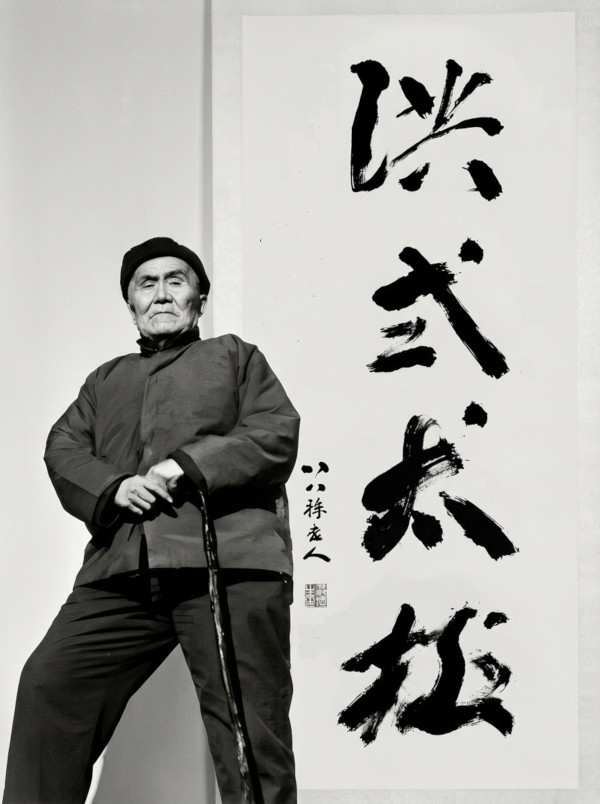
In 1995, Hong wrote the calligraphic banner “Hong Style Taiji” (洪式太极), formally naming the transmission that had grown out of his work. He died the following year, on January 23, 1996.
What happens to a teacher’s work after that? Some of it remains in books, and some in photographs and memories. Some remains in the words students remember hearing. But the most important part has to remain in practice, and that is particularly true of Taijiquan. A book can explain a movement, but it cannot move the body for us. A teacher can point something out, but the student still has to spend the years discovering whether the words match what the body is doing.
I remember one time at a workshop. After a long intensive session, I was tired and frustrated, and I asked Master Chen Zhonghua three questions in a row. What muscles should I use? What is the feeling? What is the feedback? I wanted a checklist. He gave me a puzzled look, as if I had never attended his workshop. “There is no feedback,” he said. “Just don’t move.”
I decided he had not understood my question, so I did not ask again. It took me ten years to see that he had understood it perfectly. I was the one who had not recognized the answer. I had been asking what to do, and he was telling me what to stop doing.
From the stories Master Chen tells about Master Hong, I suspect Master Hong would have given me the same answer.
Transmission in the Practical Method is personal in just this way. We receive something from someone else, and then we have to make it our own through practice without losing what we were given.
Hong’s work eventually reached far beyond Jinan. His disciple, Master Chen, carried the Practical Method to students around the world, and what had once been a teacher working with students in Jinan became an international community of practitioners. When we practice today, it is easy to forget how unusual that journey has been. A movement we may take for granted has passed through several generations of teachers and students before reaching us. We are late in the story, but we are still part of it.
」
五
March 24, 2027
三月二十四
「
According to the Practical Method lineage, Hong Junsheng was born on the seventeenth day of the second month of the Chinese lunar calendar in 1907. In 2027, that lunar date corresponds to Wednesday, March 24. Some sources give March 30 as the Gregorian date associated with his birth, but for this commemoration, March 24 is the primary date being observed.
The date is important, but it is not really what interests me. What interests me is the opportunity it gives us to stop for a moment. Most of us spend our training time looking forward, trying to understand the next movement, solve the next problem, improve the next form. An anniversary asks us to look backward. Who was the person who made this possible? And what, after all these years, have we actually received from him?
」
六
Repaying a Kindness
知恩图报
「
This blog thread is an independent project and a personal contribution. Over the next few months, I will focus on translating Master Chen’s Chinese account of Master Hong’s biography, together with some of Master Hong’s writings. I am doing this because I have benefited from this art for many years, and whatever understanding I have gained did not begin with me. It came through other people. This is one small way of acknowledging that.
I hope others will do the same in whatever way feels natural to them. Some may have studied with teachers in Master Hong’s lineage. Some may have read his book for years. Others may have encountered his work only recently. Some may have a story about a teacher, a training session, a particular correction, or a moment when something finally made sense.
Those stories belong to this commemoration too. If you would like to share one, the comments below are open, and a link or a few lines is enough. These things can seem small at the time, but they show how we have thought about our own practice. A tradition is made from such things.
」
双甲子 ‧ A Double Jiazi
Hong Junsheng did not live 120 years, and the Double Jiazi does not mean that he did. The number marks 120 years since his birth, two complete cycles since the beginning of his life. But there is another way to think about it.
When a teacher dies, the teaching goes on. Something remains in the students. Something remains in their practice. Something remains in the questions that continue to be asked. And something remains for future generations, even when they will never meet the teacher in person. After one hundred and twenty years, we have completed two cycles, and we find that the person we are remembering is still present in what we do.
Master Hong’s life ended in 1996. His teaching did not. It is there whenever someone practices the art seriously, questions what they have been told, tests it against reality, and then passes on what they have learned. That is how a teacher stays with us.
One Jiazi is a lifetime.
Two Jiazi are a reminder of what a lifetime can leave behind.
薪传双甲,道继千秋。
The flame passed through two cycles; the Way endures for ages to come.
◆ ◆ ◆ ◆ ◆ ◆ ◆