Interview with Master Hong Junsheng

by Ming on 2026/07/24

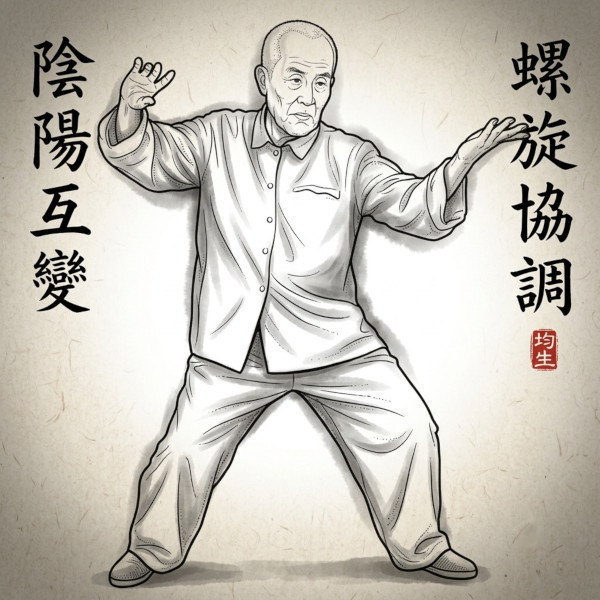
Drawing of Hong

Beyond self-defense: A blueprint for living.

Master Hong Junsheng transformed Chen Style Taijiquan by grounding esoteric martial concepts into direct, testable reality. A lineage heir to the legendary Chen Fake, Hong demystified the art through clear, everyday language, as detailed in his landmark work, Chen Style Taijiquan Practical Method.

At the core of Hong’s teaching is precision over brute strength. Beginners must construct a rock-solid foundation through basic forms before chasing elusive concepts like internal energy. True relaxation isn’t collapsing into limpness, just as true strength isn’t rigidity; it is maintaining active, living tension (Peng) while remaining fluidly connected to an opponent. All motion relies on spiral mechanics—combining body rotation with limb revolution—demanding an upright, centered posture. By mastering dynamic balance (continually alternating empty and substantial weight), practitioners transition from reactive defense to effortless, proactive control.

Ultimately, Hong demonstrated that Taijiquan extends far beyond martial application or physical exercise—it is a holistic system of self-cultivation rooted in Taoist philosophy. By replacing raw power with unified mind-body intention, the art unlocks mental clarity, emotional composure, and sharp adaptive intelligence. Authored by disciple Zhang Shengjian, this reflection emphasizes that true mastery requires disciplined practice, authentic mentorship, and profound engagement with the art’s philosophical roots. Strip away the mysticism, master the mechanics, and Taijiquan becomes an inexhaustible blueprint for lifelong resilience.

Adapted from a post by Kelvin Ho:
“Conversations with Grandmaster Hong Junsheng on Taiji”
based on a Chinese article by Zhang Shengjian (張生健)
September, 2003


⸻⸻⸻⸻⸻⸻⸻⸻⸻⸻⸻⸻⸻

陳式太極拳
洪均生宗師
Chen Style Taijiquan  ‧  A Memorial Tribute
In Memory of Master Hong Junsheng
洪均生宗師紀念文
Teachings, Reflections, and the Living Legacy of Chen Style Taijiquan

◆   ◆   ◆   ◆   ◆   ◆   ◆

Part One
A Portrait of the Master

師門傳承  ‧  Lineage and Legacy
Master Hong Junsheng (洪均生) was a towering figure in the Chen Style Taijiquan (陳式太極拳) world — a direct disciple of the legendary Grandmaster Chen Fake (陳發科), from whom he inherited an art of rare depth and power. His skill was profound, his expression fluid yet formidable, and his influence reached far beyond China’s borders. I consider myself truly fortunate to number among his disciples.
During his lifetime, under the guidance of our teacher Han Baoli (韓保禮), we had the privilege of attending Master Hong’s lectures on Taijiquan principles and techniques regularly. Each session left us richer in understanding. What set Master Hong apart as a teacher was his insistence on grounding the art in observable reality (師爺講拳很尊重客觀事物,比較唯物), a commitment to what is tangible, testable, and true — reflected in the very title of his landmark work, Practical Chen Style Taijiquan (《陳式太極拳實用拳法》).
In practice, this meant breaking complex principles down into plain language, drawing on the familiar rhythms of everyday life to illuminate what might otherwise seem abstract or esoteric. He met each student where they were, adjusting his instruction with care and patience — always teaching to the person in front of him, never to a generalized ideal. It was teaching in the truest sense: direct, honest, and deeply human.

Part Two
The Master’s Own Words

口傳心授  ‧  Transmission of Teaching
The following passages record Master Hong’s teachings as delivered to his students.
His voice is direct, grounded, and unmistakably his own.
On Foundation and the Basics
築基練功

Intention () and energy () — these are things that cannot be seen or touched. Do not chase them at the beginning. What you must do first is learn the form (架子) correctly, according to the rules, and build your foundation through diligent practice of basic skills (基本功). Think of it like building a house: if you want the structure to stand firm and endure, you must first dig the foundation trench (地槽) deep and true, and lay the foundation (基礎) with care. Only then can you build something that lasts.
It is the same with Taijiquan. Once you have learned the form correctly and your basic skills are solid, the breathing will coordinate naturally, without forcing. In time — and it will come in its own time — you will begin to feel the body relaxed and the breath flowing smoothly (體鬆氣順). That feeling cannot be rushed. But it will come.

On Relaxation and Softness
鬆柔之道

Everyone speaks of relaxation and softness (鬆柔), but you must understand relaxation () correctly. Relaxation does not mean going limp () — and it does not mean falling apart (). Equally, strength () does not mean rigid () or tense (). These are not the same things, and confusing them will lead you astray.
In the beginning, everyone carries brute force (拙力) in their body, shaped by the habits of daily life and labor. Taijiquan exists precisely to correct this. The process of shedding brute force is itself the process of learning true relaxation. But this must be handled with great care — very often, the moment a student stops using force, they go too far and lose connection (). That is not relaxation — that is collapse.
You must hold firmly to the principle: when the opponent is strong, I am soft; stick, connect, cling, and follow (人剛我柔,沾連粘隨). You follow according to your own intention, on your own terms. Only then will you achieve the state where the opponent finds resistance while you move freely (人背我順).
You must maintain Peng energy (掤勁) at all times, never losing it. Yet you must never allow substantial force (實勁) to appear — because the moment it does, you have created a point of leverage (著力點). Seek your understanding in the form (拳架). Find the feeling through mutual exploration with your partners. That is where the art lives.

On Upright Posture and Coiling
立身中正

Chen Xin (陳鑫) said it plainly: Taijiquan is the method of coiling (太極拳纏法也). But how to coil requires serious study. Many books repeat the terminology — inward and outward coiling (裡纏外纏), left and right coiling (左纏右纏), clockwise and counterclockwise coiling (順纏逆纏) — and yet these descriptions alone cause more confusion than clarity.
Let me offer you a better way to understand it. Think of revolution and rotation (公轉和自轉). The arcs traced by the limbs as they extend and retract are revolution (公轉), while the turning of the torso and limbs upon themselves is rotation (自轉). Every movement — retraction () and release (), opening () and closing (), rising () and descending () — must travel along a spiral. There are no exceptions.
Have you ever seen a spiral that wobbles and sways as it turns? Of course not. This is precisely why upright and centered posture (立身中正) is not optional — it is the structural condition that makes true spiraling possible.
And then there is equilibrium in response to circumstance (隨遇平衡). When you practice alone, move as though someone is already there (無人若有人). The Taiji Classics (拳論) will then open naturally: where the opponent is heavy, there you become empty (左重則左虛,右重則右虛).

On Neither Too Much Nor Too Little
無過不及

Taijiquan is easy to speak of and difficult to practice. Why? Because it is an art of the method arriving first (後法先至). We say: if the opponent does not move, I do not move; but the moment they stir, I am already there ahead of them (彼不動我不動,彼微動我先動).
Only when you have practiced until you are truly light in body and deeply relaxed (身輕體鬆), until every joint moves with freedom and ease, will you be able to clearly listen to and sense the opponent’s force (聽勁) — and then act before they do. Practice as if facing an opponent (無人若有人), every time, without exception.
Neither too much nor too little (無過不及) means exactly right (恰到好處). The timing must be exactly right. The spacing and dimension must also be exactly right. There is no approximation in this art.
True following () is active — constantly searching, within the act of yielding itself, for the moment when you hold the advantage (人背我順). This is what the Classics mean: when the opponent is strong and I yield, that is called flowing away (人剛我柔謂之走); when the opponent is at a disadvantage and I am in harmony, that is called adhering (人背我順謂之粘). These are not two separate actions. They are one continuous, living response.

On Speed and Slowness
快慢相濟

Speed is a relative matter. The Taiji Classics say it directly: slow hands yield to fast hands, weak yields to strong (手慢讓手快,有力打無力). These are innate, natural abilities that require no training (先天自然之能). Speed is the expression of flexibility and responsiveness (靈活). Under ordinary circumstances, slow can never overcome fast — any claim otherwise has no foundation and does not reflect reality.
How then do we understand slowness in Taijiquan? It refers to moving through the form with evenness and consistency (均勻行拳走架). Within that steady movement, you seek to feel a particular quality of force — what I call supporting or bracing force (撐勁). Think of a fisherman who has hooked a fish: he cannot yank the line — it will snap. He cannot release it — the fish will escape. He must find exactly that living tension between the two. That is supporting force.
When you find this quality of force, you will naturally achieve sticking, adhering, connecting, following, neither resisting nor losing contact (沾粘連隨,不頂不丟). And once truly connected, the question of speed resolves itself. This is what the Classics mean: meet urgency with urgency, and follow ease with ease (急來急應,緩來緩隨). It is not a strategy. It is simply what happens when connection is real.

On Using Intention Rather Than Force
用意不用力

Force () is a natural ability. Having great strength is certainly a fine thing. But the real questions are: how do you use it, when do you use it, and how much? These are matters of skill (技巧), not raw power. Intention () is simply thought. Every person uses intention already — the only question is whether you are paying attention to it.
When you bring your mind fully to one point — the mind intent on one purpose, the force directed to one place (心往一處想,勁往一處使) — and your hands, body, and steps all arrive together as one (手到身到步到) — then something remarkable becomes possible.
In the moment of releasing force (發放), you gather the whole body’s power into a single point, drawing the rebound force of the earth (返彈力) up through your structure and transmitting it into the opponent. You will then launch the opponent as easily as pulling weeds from the ground (薅草). The roots simply give way.
It is not that we do not use force. We do not use brute force (拙力). What we use instead is skillful force (巧力). The difference between these two is the difference between the art and the absence of it.

On Double Weighting
雙重之辨

Double weighting (雙重) is a genuinely controversial issue. Wang Zongyue’s Taiji Classics state: double weighting leads to stagnation (雙重則滯). This stagnation arises from not understanding dynamic transformation (運化). Many interpretations exist — but all share the same flaw: they have not started from practical reality. We must not revere the ancient and dismiss the present (厚古薄今). We must extract the essence and discard the dross (取其精華,棄其糟粕).
I will tell you honestly: I myself went astray on this question for a time. Through my teacher’s guidance and direct experimentation, I finally understood: double weighting means that in the coordination of hands and feet, both cannot be fully substantial () at the same time. In the first movement — Vajra Pounds the Mortar (金剛搗碓) — when the left elbow drops and grinds outward, the left hand is substantial () while the left foot stepping forward is empty (). One is substantial, the other is empty — always.
Every joint, every subtle shift throughout the limbs — all must observe the living balance of emptiness and substance (虛實). To truly understand double weighting, you must go earnestly into practice and grasp what the Classics warn: a deviation of a hair’s breadth leads to an error of a thousand miles (差之毫釐,謬之千里).

Part Three
A Student’s Reflection

感恩師恩  ‧  Gratitude and Remembrance
Listening to 師爺 speak about Taijiquan was like being drawn into the spell of a master storyteller. Time would dissolve without warning — more than once, we looked up to find that lunchtime had long since passed, and yet no one wanted to leave. After each session, our own teacher Han Baoli (韓保禮) would demonstrate for us what we had just heard, and slowly, gradually, another layer would open up. I confess that I am not the sharpest of students — much of what 師爺 shared still lay beyond my full grasp. And yet even a partial understanding was a gift beyond measure.
It was no surprise that our Japanese friends called 師爺 a Taiji superstar (太極巨星). His foundational skill (功底) was profound, his principles and methods (理法) meticulous and inexhaustible. To sit with him was to stand before a treasury of Taijiquan knowledge that had no visible bottom.
In 1996, 師爺 passed from this world at the venerable age of ninety. It was a loss felt not only within the Taiji community in China, but across the international community of practitioners who had been touched by his teaching. For those of us who carry his lineage, the only fitting response is to study with seriousness, practice with diligence, and strive to be worthy of what was entrusted to us.
師爺‘s art, his thought, and his culture are all rooted in the soil of Taoist philosophy (道教). To truly understand Taijiquan — not just its movements, but its meaning — one must go deep into the Taoist theory of Yin and Yang (道家陰陽理論) from which it grows. There is no other foundation.

Part Four
The Deeper Gifts of Taijiquan

太極之益  ‧  The Gifts of Practice
For those of us who love and practice Taijiquan, the questions of what we are truly learning, how to learn it well, and what we are ultimately seeking — all flow directly from our understanding of the philosophy that underlies the art. Some come seeking health and fitness (健身). Others are drawn by martial application (技擊). Still others are captivated by the beauty of flowing movement. Each is a legitimate door into the art — but all exist at the level of technique (). They are expressions of the art, not yet the root of it. As we deepen our study, we must learn to perceive the thought and culture (思想與文化) that lives inside the technique, pressing further into its vast and profound philosophical meaning (博大精深).

An Expansion of the Spirit
開闊胸懷

The movements of Taijiquan are relaxed, rounded, supple, and alive (鬆圓柔活). Their inner meaning runs deeper still: flowing like clouds and water (行雲流水), stillness within movement (動中有靜), movement within stillness (靜中有動). To practice with this understanding is to feel yourself drawn into the rhythms of the natural world (大自然). Over time, a boldness and magnanimity of spirit (豪邁) grows naturally from within. This is the expansion of the heart and mind (開擴胸懷) — one of the quiet, lasting gifts of the art.

A Steadying of the Mind
穩定心態

In daily life, we often say: may you have a good mood every day (祝你天天有個好心情). But a good mood grows from something deeper: a grounded, well-ordered state of mind (心態). Taijiquan cultivates this quality through concentrated spirit and settled breath (凝神靜氣), composure and calm clarity (沉著冷靜), and a governing theory of harmony that applies as much to how we meet the difficulties of life as to how we meet an opponent’s force. Once you genuinely possess this steadiness, you will be able to adapt with the principle of guiding events according to their own momentum (因勢利導) and arrive at decisions grounded in genuine understanding.

A Deepening of Self-Cultivation
提高修養

Master Hong once said: Taijiquan is a martial art of intelligence, and a martial art of culture (太極拳是聰明拳,是文化拳). The level of one’s skill (功夫) is a concrete reflection of one’s character and integrity (人品), cultivation and refinement (修養), and the breadth of one’s knowledge. To truly master Taijiquan, you must draw on philosophy (哲學), literature (文學), medicine (醫學), mechanics (力學), and aesthetics (美學). Taijiquan does not just train the body. Practiced with sincerity and depth, it trains the whole person.

An Enhancement of Your Capabilities
提高能力

The governing principles of Taijiquan — the mutual balance of hardness and softness (剛柔相濟), neither resisting nor losing contact (不頂不丟), neither too much nor too little (無過不及), yielding and extending in response to the opponent (隨屈就伸) — reshape how you see the world and how you move through it. The art quietly teaches you the deeper logic of overcoming the strong with the soft, prevailing over the large with the small (以弱勝強,以小勝大). Not through force, not through aggression, but through intelligence, timing, and an understanding of how forces naturally move and transform.

A Union of Health and Martial Skill
健身技擊

Taijiquan offers something that general exercise cannot: a scientifically and rationally integrated practice that cultivates both fitness and well being (健身) and martial skill (技擊) within a single, unified art. These two dimensions deepen each other. It requires no special time, location, venue, or equipment (時間、地點、場地、器材) — making it genuinely accessible to people of all ages and all walks of life (廣大人民群眾). This is Taijiquan’s remarkable generosity: it meets you where you are, gives you what you need, and always has more to offer.

Conclusion
A Life Well Lived

結語  ‧  Closing Words
When we gather together everything that sincere Taijiquan practice offers, the picture that emerges is remarkable. Through dedicated training and continuous learning, a Taijiquan practitioner can cultivate: a broad and generous spirit (博大的胸懷), a stable and grounded mind (穩定的心態), refined character and cultivation (良好的修養), outstanding capability in meeting life’s challenges (卓越的能力), a strong and healthy body (強健的身體), and a wise and perceptive intelligence (睿知的頭腦). These are treasures that will serve you for the whole of your life (一輩子受用不完的寶貝).
But let us be honest about what this requires. It requires diligent, earnest, and unsparing practice (刻苦認真的鍛鍊). And it requires something that no amount of solo effort can replace: the living transmission through word and embodied demonstration (言傳身教) of a truly qualified and enlightened teacher (明師) — someone who has genuinely walked the path. This is why lineage matters. This is why we remember 師爺.
In the end, the path forward is clear: keep learning, keep inquiring, and press ever deeper into the Taoist thought and culture (道家思想文化) and the vast and profound philosophical meaning (博大精深的哲理內涵) that lives at the heart of Taijiquan. Do not be satisfied with the surface. Do not stop at technique. Let the art lead you all the way down to its roots — and then let those roots guide how you meet the world, how you handle what arises, and how you choose to live.

那樣,你就會受益無窮
The benefits will be without end.

Zhang Shengjian  張生健
September 2003  2003年9月
Zhang Shengjian is a staff member of the Mass Sports Division of the Lianyungang Municipal Sports Bureau (連雲港市體育局群眾體育處). A devoted student of the Hong Style Chen Taijiquan lineage, he wrote this piece in humble tribute to his teacher’s teacher — 師爺 Hong Junsheng (洪均生) — whose teachings continue to illuminate the path for all who follow.

◆   ◆   ◆   ◆   ◆   ◆   ◆

Leave a Comment
Leave a comment on the content only. For admin issues, please click the "contact" button on the top left.

Previous post: