|
|
|
What draws the modern world toward Traditional Chinese martial arts?
Some arrive through history. Others are pulled in by philosophy—by the enduring balance between wen (文), the refinement of the mind, and wu (武), the discipline of the body. But for many, the first spark comes from somewhere else entirely: the world of wuxia (武侠).
At first glance, wuxia looks like fantasy—stories of wandering heroes, hidden masters, and impossible skill. But in function, it plays a role not unlike the Western epic or the tales of knight-errants. These are stories about hardship, moral choice, and transformation. They endure because they carry something deeper than entertainment: a cultural memory of what it means to live with loyalty, responsibility, and honor. Writers like Jin Yong (金庸) understood this well. In his stories, the martial world is never separate from society. It is society—refined, intensified, and revealed through conflict. Within these narratives, we encounter the wulin (武林), the community of martial artists, and the jianghu (江湖), the broader world of relationships, reputation, exile, and obligation. These realms may appear distant or romanticized, but the abilities they contain are not simply inventions. They are exaggerations—compressed expressions of real training, real discipline, and real human experience. In this way, wuxia transforms life into story. Memory becomes myth; practice becomes legend. The boundary between what is lived and what is imagined begins to blur. And it is here that something interesting happens. When we turn to the life of Chen Zhonghua, that boundary grows unexpectedly thin. |
|
 |
His story does not sit outside the wuxia tradition, nor is it an imitation of it. Instead, it reveals how such stories come into being in the first place. The patterns we recognize in fiction—hardship, transmission, endurance, responsibility—are not inventions. They are drawn from lives like his.
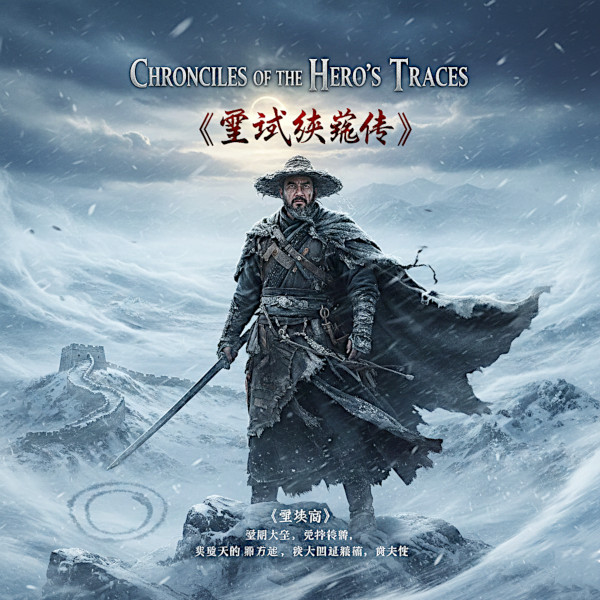
To see this more clearly, it helps to look at wuxia not as history, but as a kind of narrative framework—a lens. Imagine a familiar quintessential wuxia tale, The Legend of the Snowbound Wanderer: Traces of a Hero in the Land of Frost (朔风独行客, Shuofeng Duxingke): |
The training is not easy. It unfolds across years, shaped by isolation, hardship, and persistence. There are moments of departure—times of leaving home, crossing distances, enduring uncertainty. What is forged is not just ability, but identity.
And in the end, what matters most is not victory, but transmission: what is carried forward, and what responsibility comes with it.
This is the structure of a wuxia story.
It is also, in many ways, the structure of a real life.
What follows, then, is not a comparison between fiction and reality, but a recognition: that the so-called “play” and the world it reflects are not separate at all. One is simply the dream through which the other becomes visible.
Legend of the Snowbound Wanderer
《雪域侠踪传》
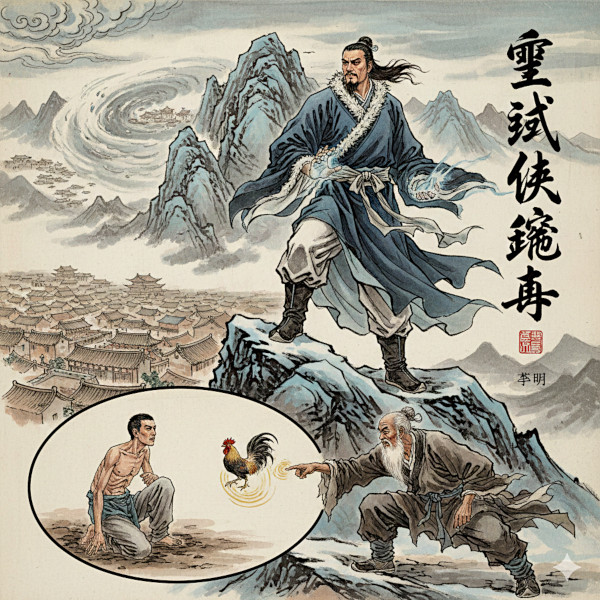
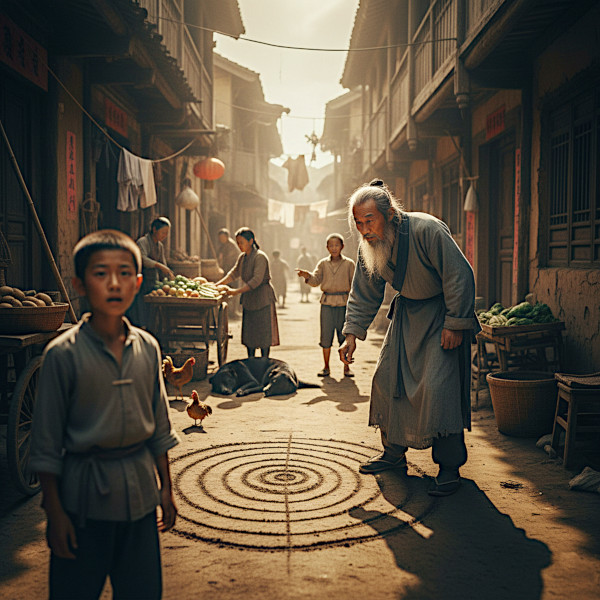
and found an old man tracing circles in the dust.
The Tale / 缘起
a fading flame awaiting the wind of spring.
|
The neighbors laughed. Children mocked. Now and then the old man fought stray chickens for abandoned scraps. There was nothing about him that resembled a master.
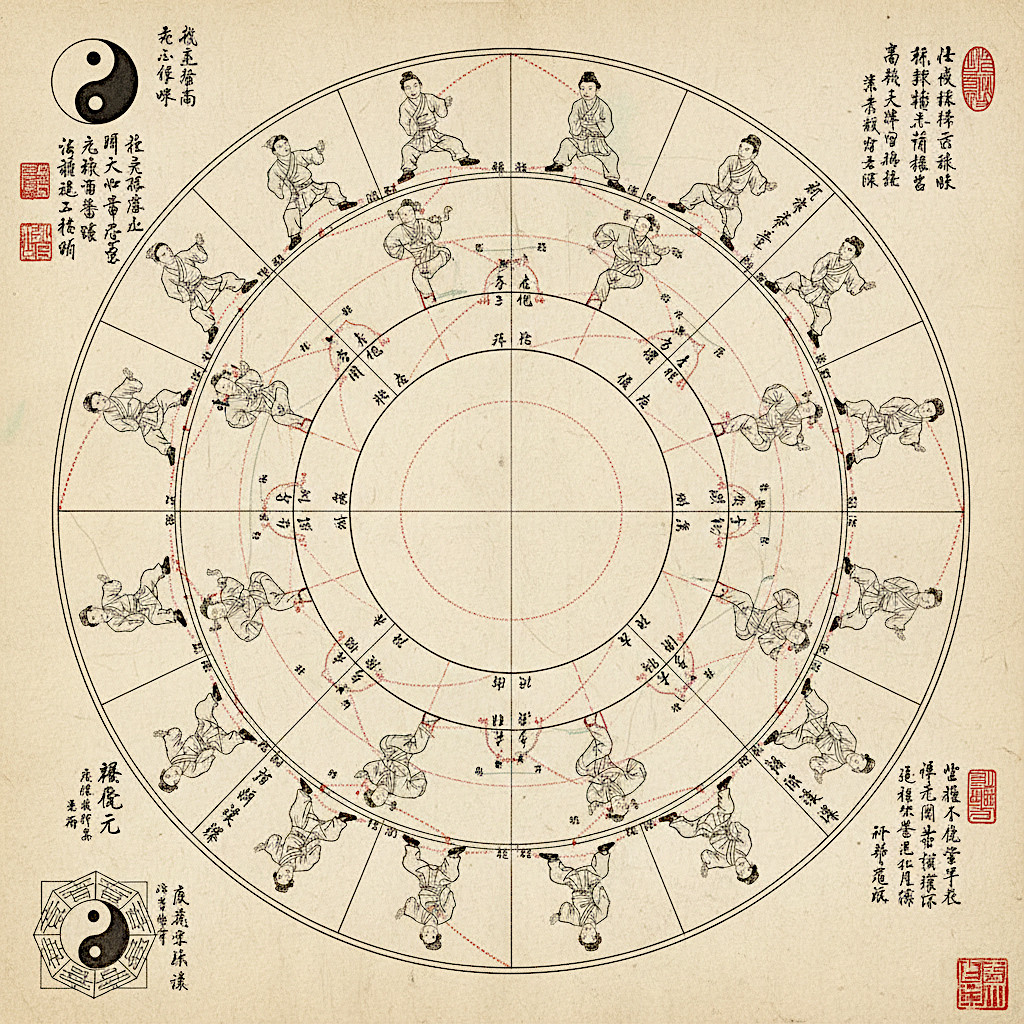
Yet the youth witnessed what the others could not, and the more he saw, the less he dared to laugh. Those casual arcs contained advance and retreat, fullness and emptiness, life and return. They were maps of Heaven and Earth etched in the mire.
|
 |
 |
“灵犀一点通玄窍,真气一线贯长虹;
枯脉周身皆复起,暗劲随心自化成。”
With a single spark, insight broke through—
true qi arced like a rainbow. Withered channels stirred to life; hidden strength bloomed like a flower. |
Like drifting duckweed, he was cast beyond the frozen passes.
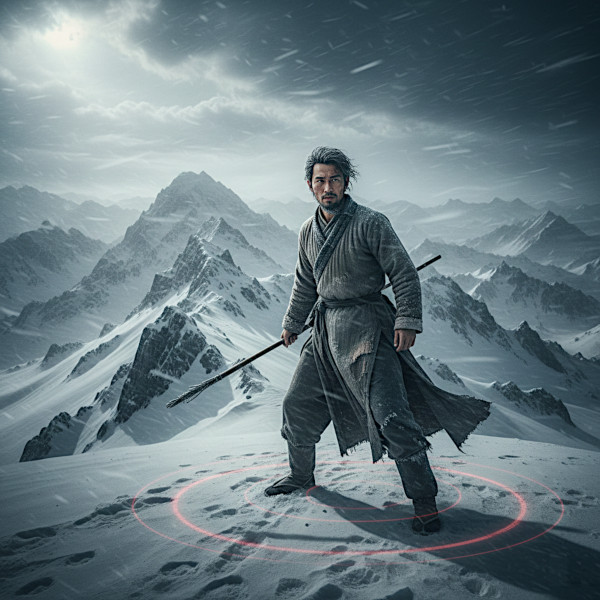 |
“百战磨成霜雪刃,南北由人论短长;
形孤影只临风雪,终为塞外独行人。”
Through a hundred trials,
the frosted blade was honed; let North and South dispute their claims. Alone in wind and snow he stood— the Wanderer beyond the frontier. |
What needed to be resolved did not lie in movement.
Then he turned south.
|
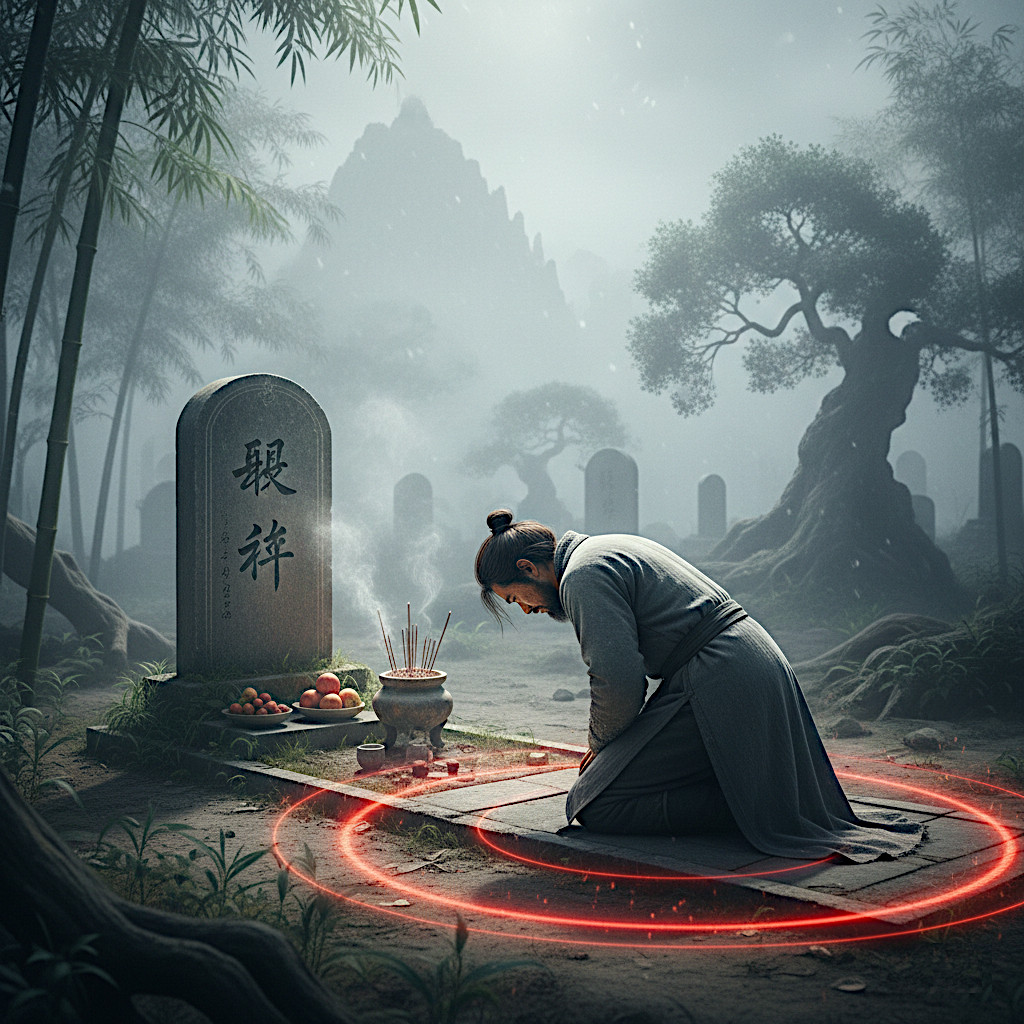
“恩师驾鹤乘雷去,真道何堪委尘埃;
半生霜雪成钢骨,万里归来续旧盟。”
My teacher rode the crane amid thunder—
yet the Way lies fallen in the dust. Half a lifetime of frost has forged these bones; across ten thousand miles, I return to honor the bond. |
 |
but to keep the flame alive.
What once was sketched in mortal dust
is now made whole for all ages.

一笔浑圆生万法,
孤踪独步入朔风;
归来不问来时路,
满身霜雪归画中。One rounded stroke gives rise to ten thousand laws.A solitary path endures the northern gale.Upon return, ask not where home may lie—in frost and snow, he steps into the painting.
The story ends, but something in it lingers.
Not the events themselves, nor the figure of the wanderer, but the pattern—the quiet sense that this path, though imagined, feels strangely familiar.
As if what was compressed into a single point is now expanding again in the mind of the reader.
We recognize the hardship.
We recognize the waiting.
We recognize the slow shaping of a life through practice.
And at some point, the question begins to shift.
Are these stories merely inventions?
Or are they reflections—distillations of lives once lived, and lives still unfolding?
It is here that the boundary begins to blur—
between fiction and memory,
between narrative and practice,
between the dream and the one who dreams it.
The Dream and the Dreamer
Why Myth Sustains Martial Practice
In the Zhuangzi, Zhuang Zhou dreams he is a butterfly, drifting freely, unaware of himself as a man. When he awakens, he is left with a question that cannot be resolved: was he a man dreaming of being a butterfly, or a butterfly now dreaming he is a man?
Training unfolds within a similar uncertainty.
We practice movements whose origins we have never witnessed. We embody principles passed down from teachers we have never met. Over time, history softens into story. A century has passed, and the life of Chen Fake have entered legend. Hong Junsheng lived with outward simplicity, yet through uncompromising discipline, his practice became something more than personal—it became transmissible, almost mythic. Today, Chen Zhonghua continues that current—not simply preserving stories, but generating them through relentless, daily refinement.
Repetition, by itself, exhausts the body. Precision alone cannot sustain a practitioner across decades. What carries someone through thousands of corrections—through frustration, through long plateaus invisible to others—is the sense of participating in something larger than technique.
It transforms solitary drills into part of a lineage. It reframes difficulty as refinement. It allows the practitioner to step into a story where persistence has meaning, and where time is not wasted, but accumulated.
In this sense, myth is not falsehood. It is orientation.
It binds method to memory and discipline to imagination.
The myth and the method advance as one.
but to take part in something that extends beyond ourselves.
Through disciplined practice, we make it real—
and in doing so, it remakes us.
Thus the Way continues.
道脉长存