Feb 12
Exercise: You must go over
1. Opponent pushes on your chest
2. Raise arms and go over push
You have to be willing not only to fall, but to launch yourself at the opponent.
Put that intent of launching at the opponent into going over.
Stick example:
Picture a stick being pushed into the ground, at ~45 degrees.
Normal is to push it a couple inches, and allow it to return.
What we’re doing is launching it over until it’s on the ground (180 degrees).
Use that energy when you “go over”.
Feb 13
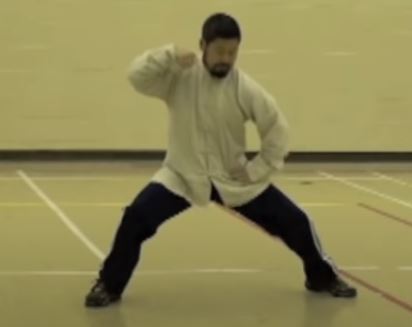
In first part of first move (Gin Gong pounds the mortar)
Right hip opens, hands don’t leave the center in the first hand motion.
Hold on as if arm wrestling, you’ll have freedom of motion.
if you’re fighting, you can’t move freely.
Don’t fight, you can have freedom.
Use Taiji power, don’t fight.
Be like a vice, just hold on.
The turn is a split on the front knee & back hip (and right knee into right hip)
If you’re not doing it right, you’re moving somewhere else.
The right way is knees not hips
The elbows go one way, the knees split (in direction) in support.
Talk to yourself when it doesn’t work.
Not feeling good is an indication of correctness.
The body as a stick, tight but not stiff.
Don’t use power, use position
Talk yourself through it, form, posture, stuck.
Philosophy:
Chinese (Mandarin) doesn’t conjugate.
Understand is a yes/no question.
Not “I think I understand”, or “I want to understand”
The focus is on the object, not you or them (the subject).
No “I understand”, understand?
Continued:
Imagine a mirror, check the mirror, are you still there?
The reflection is there when I am, gone when I’m gone
Understand?
Don’t get stuck thinking, follow the direction.
How do I find the spot that isn’t moving?
Do it first, then look.
It doesn’t exist
Listen to Sifu, not the “I can’t do it”.
Don’t assume Sifu doesn’t know what he’s saying.
Taiji is different because it’s simple.
We always make up something complicated.
There’s only one move in Taiji, it’s all the same.
This is the formula:
Don’t move the hand (contact point, direct spots)
Indirect. Never direct.
Don’t fight.
Go through the form and find the direct spots.
Don’t move them
Move anything else.
———————–
Become little children, follow the instructions
If Sifu mentions hands or elbows,
focus on those parts,
not the knee, back or other parts.
Two dots is just a large dot.
A real line needs 3 dots.
Sifu’s finger is always pointing at the opponent’s nose
or if they are very tall, at their solar plexus.
The elbow has to be on his nose, in the same line as the finger.
Front hand and elbow are one unit,
back elbow is another separate unit
Kua would be a third unit.
Two points always line up
We want to lock them
The third point lines them up.
The body is 2D, one unit.
3D object, 2D force
In 6 sealing, 4 closing,
EVERYONE rises.
It’s a compression.
Triangulation
Two lines, when they cross
becomes a dot.
If the opponent grabs your hand
you must touch them indirectly with your elbow.
Compression is a position, not a power.
Exercise:
Put a board on the body.
Pull with toes
Heel out, lock ankle
Knee straight, one piece
Core is to lock it.
Grinding
Look up “Chinese medicine grinding wheel”.
Nian – grind
————–
Don’t be stiff or loose.
Picture a triangle of the shoulder, elbow, and hand
The problem is that moving the bicept moves the forearm.
The move should be shoulder -> elbow, elbow -> hand.
We all do straight line shoulder to hand, or a curved line from shoulder -> hand.
What we’re seeing is not what he’s doing.
Power comes from the back leg, the front is to pivot & stabalize.
Step in, stretch from back foot into forearm.
Find a position where you can stretch.
Don’t push until you can stretch.
The stretch backwards is always too small. Make it bigger
A strech doesn’t move.
Horse stance comes from sitting on a stone horse just taller than you can reach the ground.
Sit on the stone horse, stretch till you can reach the ground.
Rear kua, knee, foot; go backwards to create the stretch.
Have it go to the foot on contact.
This is the elbow to hand stretch.
Kua to elbow stretch is more difficult
Rear foot to kua stretch
—————————
Adherance
Use the board (on chest of partner)
Don’t touch the board (with your hand)
become one with the board (with your hand)
Showed by moving the board with the hand.
There’s only enough room on the peak for 1.
Don’t push the hand, hit the hand.
==========================================
Feb 14 (Valentine’s Day)
Do the first 13 without hands.
People were floating on top, shallow on the bottom.
Need to be condensed, compressed, not loose.
Split into the legs, 1 (on top) becomes 2 (both legs)
Not an equilateral triangle.
Adjust a bit, become solid, like an expensive camera lens on a tripod.
Make a chair out of your body. It sits on your legs and feet.
Engaged mode: No looseness, no neutral
Correct move: Structure
Incorrect move: Strength
The arm must always be on a table, not in the air.
Redirect power to the floor.
You cannot fight earth.
Upper body not connected: Floating
Lower body not connected: Shallow
Kua to floor
Shoulder to floor
elbow to floor
hand to floor.
Once you are very stiff, the only movements allowed are in the joints.
Rubbing against each other
start with fingers and thumb (see grinding / nian above)
Philosophy:
The name that can be named is the name.
Find the solid from the empty.
In with elbow, no hand.
Out with hand, no elbow.
Solidness is easy to find
Emptiness is not
There’s only one “on” position
all others are off
find the hollow (not solid) position.
Are you looking for nothing?
Nothing is everything
Board exercise:
Use the center to catch the 4 corners
Put a board at your back,
hold one of their arms with both of yours.
pull back into it without coming apart.
Put a board on their back,
pull with fullness
Use one to access all.
Use one dot to access their whole body.
Pull
drop knees without changing angle
step back to pull in
If they’re too loose, stiffen them up ~ hitting.
Elbow into hand with a screwing action
Torque:
We apply torque to objects
when applied to people, they swear.
In Taiji, torque: produce power with rotation
accumulates until the size cannot take it.
Never say an action is mysterious.
Hypothesize.
Ask: What are the mechanics?
Look to see what’s being done differently.
Test and verify. This is hard to do.
Sensitivity is never the same.
—————-
Big toes are “big foot fingers”.
Wrists (and ankles) are necks.
Necks can move some ways, but stiffen up in others
String of 9 pearls:
able to tighten and pull taut into a spear.
loosen and its back to a string.
Secret of Taiji is the body is that way.
One model of structures. 9 pearls, pull the string.
Story of people touching Hong’s back unexpectedly, and finding themselves on the floor.
Exercise:
Do the first 13 with the elbow looking for the kua. Elbows follow the kua.
Separate exercise:
emphasize the heel.
The heel is for turning & grinding.
Try the form with the heel.
Walk on the heels.
Flat foot is dead
On heels, the energy comes out.
Exercise:
Arch against the wall.
Find weak points
practice grinding all over the body.
There is a gymnastic bard through each of us.
Hold onto it, don’t let it go.
Through the middle of your sternum. Going ahead of you.
Point it at the opponent, keep it always on them.
You can make a lot of moves. Don’t let go of the bar.
========================================
Feb 15
Set up a groove with your structure, like a half-pipe or a waterslide.
Let their action be the water on that waterslide.
When you have the structure setup and lock the structure during their action, the action will respond to the structure and the lock.
Switching is to squeeze the space out.
Spoon in yogurt, don’t stir it, scoop it (cut it), and pick it up.
Moving reduces the size of the lever. Don’t move.
————————
Mirror what they’re doing
like a clap
do unto them as they’re doing unto you.
Move the middle
3 moves today, only foundations, no techniques, just habits.
Elbows like a crankshaft on a train engine
Shoulder and hands on a circular track
lock shoulder and elbows lightly.
100% locked will break
95% too much slack
There needs to be a gap in gears.
too close and they become 1
too far and they never interact and become separate and unrelated
Yilu choreography
1. learn the body parts and how they interact
2. understand how they move
3. elbow and kua have a trained relationship, like an orbit.
4. Catalyst
Exercise: fight for the strategic position
Move kua and towards each other
Hand is heavy, elbow is pulling
Ratio: hand is 10, elbow is 9
elbow causes hand to move
Hand is reserved for striking
elbow, shoulder, kua do the hitting
With 3, one is negotiating
Separate exercise:
press hand into wall or corner
hand
elbow
center
with every move, the size is a punch
I replace you as the center, you have to spin around me.
tight like a bow and string. Then poke from the kua
Have to stretch.
Expand the kua, not just in this exercise.
It’s a position. In the future just be there.
Use this when they’re strong.
When they’re soft, poke them
Make the body into a dipole.
If you split it, there’s just more dipoles.
—————————————-
Snowplow exercise.
When they push in, the top goes back.
The bottom goes in.
The wedge does not change shape.
45 degree drill (foot is bigger than shoulder)
front leg drives in, back leg his the front leg
often done sideways
Level 3 Taiji dance
get on 45 degree sideways
hit one foot with the other
repeat
You have to feel like you’re falling down.
The correct move is a fall.
Then reverse
instead of head going back, foot shoves in.
Don’t bend
stretch hard against a hand
be the stick you’re pushing over
Touch the sky into the ground.
Remember, the opponent does not exist.
Exercise 1: going over the threshold
Rubber cord under foot
Use the kua to pull it straight
have it be taut at belt
cord should stay taut when arm is straight up
elbow at belt level
rotate 90 degrees.
Ex 2.
Same with cord from someone behind
punch should be straight ahead
structure only, not muscles.
Ex 3:
around the waist, facing anchor.
lean away from anchor, put yourself on a cliff
Ex 4
face away from anchor
run away from the anchor
quickly find straight up and down
anchor and elastic should pull you back in a surprised way