 |
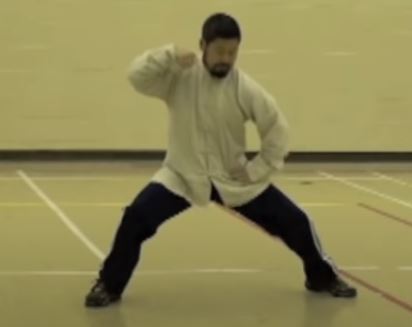
Today’s lesson is on the concept of the Three Rings of Tai Chi (太極三環). Don’t be fooled by the fancy name; this is simply a perspective on a fundamental theory: In Tai Chi, the bare minimum, the essential building block, is a sequence of one, two, and three. We can call this idea the “Principle of Three“. Everything else in the practice—all techniques, coordinated movements, and combinations—is built upon this simple 1-2-3 sequence. For example, 1-2-3 is one complete set. A longer form is just a repetition of this principle: 1-2-3, 1-2-3, and so on. |
| I want to illustrate how prevalent this core idea of “Principle of Three” is, not by explaining how it works in the body yet, but by showing how deeply rooted the concept is in fundamental Chinese thought and is essential for Tai Chi training. | |
| (This is Part 1 of a five part article based on the Three Rings of Tai Chi filmed in 2010, Edmonton, Canada.) |
|
|
Part 1
|
Part 1
System of Three
From Simple Trigram (卦) to Complex Hexagram (六十四卦)
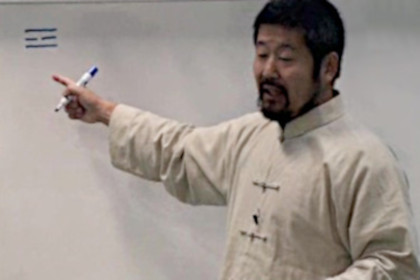 |
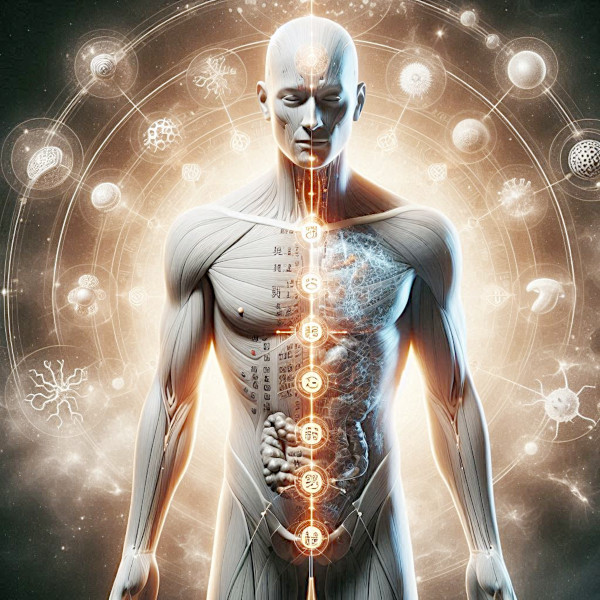
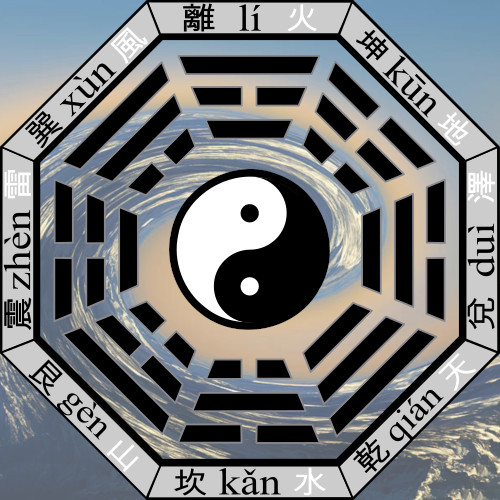
The core patterns of Chinese classification and writing are fundamentally built upon the Principle of Three. This concept is famously visible in the Book of Changes (易經, Yì Jīng), one of the earliest and most influential Chinese texts. The Yì Jīng uses a set of symbols known as the Eight Trigrams (八卦, Bā Guà) for divination. The simplest unit, or “note,” in this system is the trigram, which is composed of three lines. These lines, representing the most basic concepts, can be combined in eight different ways to form the full set of trigrams. |
|
To represent complex issues beyond the basic ideas, the system needed to expand its symbolic vocabulary. The Yì Jīng achieves this by using the three-line trigram (卦) as its basic building block. The eight distinct trigrams form the Bagua (八卦). The complete Book of Changes (Yì Jīng) is built upon figures called hexagrams (六線卦), which are formed by stacking one trigram atop another.
For example: |
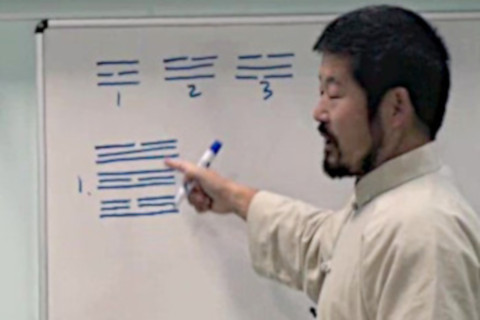 |
This stacking process demonstrates how the simple Principle of Three expands exponentially to map out the totality of cosmic and human experience. |
 |
Three Rings of Tai Chi (太極三環)
 |
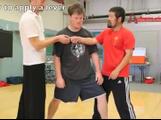
This is precisely what we see in our practice. The Three Rings of Tai Chi (太極三環) are simply another name for the one-two-three sequence, or the three points required to make a physical action, like a lever (槓桿), function effectively. The entire foundation of the art rests on this universal “Principle of Three“.
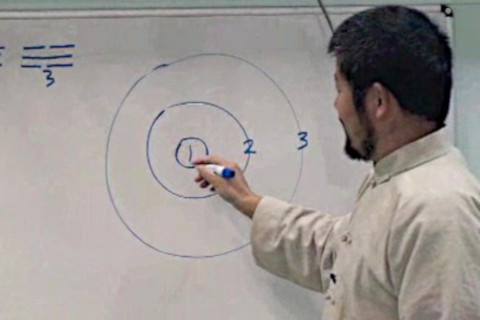
“I’ll first draw a rough sketch, then explain its structure, and finally, we’ll demonstrate how it works.” |
This instructional diagram features three concentric rings, which serve as the foundation for the model. For both consistency and clarity, we utilize a standardized labeling system, moving sequentially from the innermost circle outward:
| Ring Number | English Terminology | Chinese (中文) |
|---|---|---|
| Ring 1 (R1) | The Center Ring; Inner Circle | 内圈 (Nèi Quān) |
| Ring 2 (R2) | The Middle Ring; Middle Circle | 中圈 (Zhōng Quān) |
| Ring 3 (R3) | The Outermost Ring; Outer Circle | 外圈 (Wài Quān) |
Mastering this nomenclature is key to unlocking the function and mechanics of the human body as viewed through this lens. Fundamentally, the model describes the body’s structure by segmenting it into three distinct functional layers: the fixed core, the lever arms, and the mobile extremities. In applications like Tai Chi, each ring performs a specialized role—from power generation to buffering and, finally, external application.
Ring 1: The Center Ring (内圈)
| The Center Ring (Ring 1) represents the core of the body, which can be thought of as the trunk or torso, and serves as the fundamental Fixed Asset of the structure. Precisely defined, the core extends vertically from the crown of the head (at the Bai Hui point, 百會) down to the perineum (at the Hui Yin point, 會陰), and spans laterally from armpit to armpit. This is the fixed structure of the system, including the head and the entire trunk, which cannot be moved or detached without fundamental damage. Analogously, this core is the fixed asset, like the essential and immovable foundation and walls of a house. |
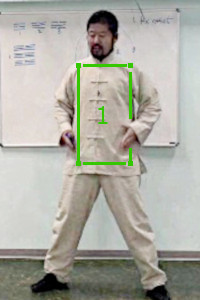 |
In Tai Chi, this ring is the definitive source of power. This central role is captured by the Chinese term Nèi Quān (内圈), which defines the Inner Circle as the body’s central axis of rotation, encompassing the head, shoulders, hips, and perineum (内圈:身体的内部转动中心。包括头、肩、胯、会阴).
Ring 2: The Middle Ring (中圈)
| The Middle Ring (Ring 2) comprises the lever arms of the body, utilizing major hinge joints (elbows and knees) to facilitate large, directional movement. This segment is the functional bridge, connecting the anchored power of the core (Ring 1) to the speed and precision of the hands and feet (Ring 3). Within the symmetrical structure of Ring 2, the upper arm and thigh link closest to the core, while the forearm and lower leg extend the motion outward. Functionally, Ring 2 is attached to the fixed core (Ring 1) via the shoulders and hips and controls the finer movements of the hands and feet (Ring 3) through the wrists and ankles, making it the major element that allows for reach and stride. |
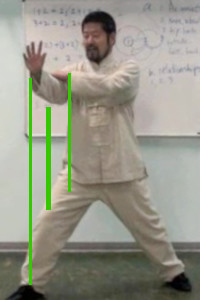 |
Crucially, in Tai Chi, this ring acts as the essential buffer segment. This concept is captured in the term Zhōng Quān (中圈), which literally defines the middle circle as the movable parts of the body—specifically including the shoulders, elbows, hips, and knees (中圈:身体的移动部分。包括肩、肘、胯、膝。). Ultimately, Ring 2 possesses the ability to either moderate the force transmitted from Ring 1 or control the velocity of the outer extremities (Ring 3), allowing for a nuanced and adaptable application of power.
Ring 3: The Outermost Ring (外圈)
| The Outermost Ring (Ring 3) represents the periphery and the extremities—the most mobile parts of the body, which can be defined as the movable assets. This layer consists of the segments furthest from the core: the hands (from the wrist outward) and the feet (from the ankle outward). These segments include the small joints of the fingers and toes that allow for the greatest dexterity and direct interaction with the external world. In Tai Chi, these extremities are considered the weapons or the movable assets, much like external tools or equipment that are carried and deployed. |
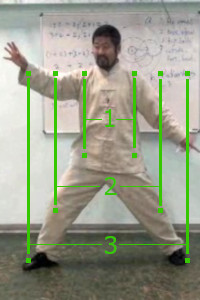 |
This concept is formally captured by the Chinese term Wài Quān (外圈), which defines the outer circle as the body’s fixed points: the hands, feet, and head (外圈:身体的不动部分。包括手、脚和头). This reference to ‘fixed points‘ emphasizes that these segments act as the external anchor points or limits of the system, interacting directly with the ground or an opponent.
Dual Perspective
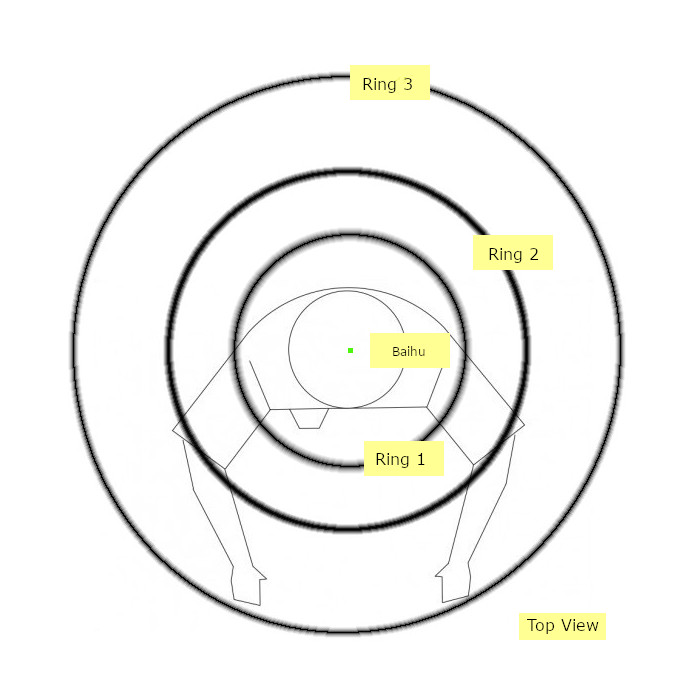 |
The Three Rings of Tai Chi is a fundamental concept illustrating that the inner pillar must remain unmoving—it cannot deviate—to maintain balance and power. This principle can be clearly understood through a dual perspective. Viewed from overhead, the body organizes into three concentric rings. The First Ring (内圈 – Nèiquān), acting as the Fixed Asset or The Core, is the stable central column defined by the shoulders and kua (hips), with the spine at its axis, encompassing the Trunk, Head, and Perineum. |
The Second Ring (中圈 – Zhōngquān), or the Lever Arm, occupies the middle range of motion and is delineated by the Shoulder, Elbow, Hip, and Knee joints, serving as Semi-Fixed Assets that generate force and redirection. The Third Ring (外圈 – Wàiquān), or The Extremities, represents the outermost extension reached by the Hands, Feet, Fingers, and Toes, functioning as Movable Assets for attack and defense. When considered in three-dimensional space, this theory provides a 3D model of the body, translating the rings into a central, stable column (Ring 1) and two outer columns (Rings 2 and 3, the limbs) that move around the core, allowing us to understand the functional interplay and connections of the body beyond a simple, flat, two-dimensional view.
| Ring | Role | Asset Analogy | Key Anatomical Components |
|---|---|---|---|
| 1 | The Core | Fixed Asset | Trunk, Head, Perineum (Central Axis) |
| 2 | The Lever Arm | Semi-Fixed Assets | Shoulder, Elbow, Hip, Knee (Major Joints) |
| 3 | The Extremities | Movable Assets | Hands, Feet, Fingers, Toes (Periphery) |
Ultimately, the mastery of the Three Rings lies in using the movable periphery while ensuring the fixed core remains perpetually stable and on-axis, making it the unchanging engine of all external movement.
Connection to Internal Arts Theory
This core three-ring structure directly relates to the concept of The Six Harmonies (六合 Liù Hé) found in internal martial arts. The principle of the Six Harmonies is built on coordinating these internal and external segments (e.g., how the hand harmonizes with the foot, and the elbow with the knee). This deeper theoretical link will be the subject of a future lesson.
The Relationships
The Mathematical Foundation: Permutations
 |
Now that we have clearly defined the three rings, we move to the second, more dynamic layer of this theory: The Relationships.
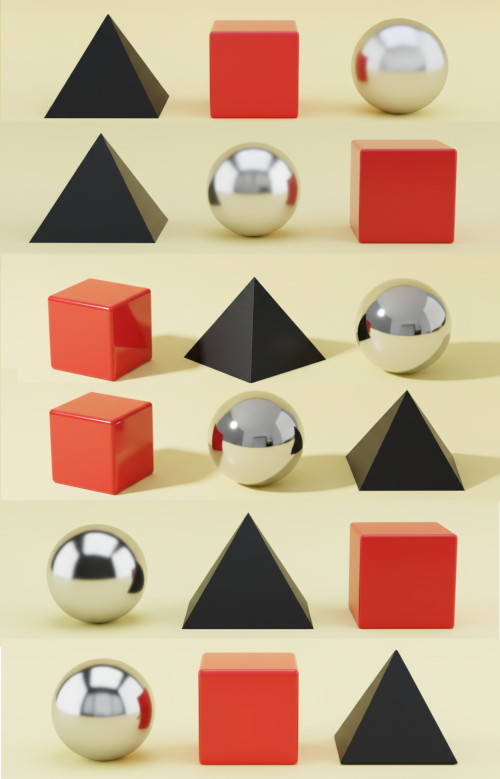
We established our three core elements: Ring 1, Ring 2, and Ring 3. The simple question is: How many ways can these three independent elements interact? This falls into the mathematical domain of permutations. A permutation asks: Given three objects, what are the possible unique arrangements or sequences in which they can relate or move? |
While three distinct objects allow for six total permutations (3! = 6), the specific requirements and limitations of Tai Chi mean only certain arrangements are physically relevant or functionally powerful.
The Four Functional Relationships
Energy is native to every Ring. When any two are paired, their energies combine to forge a new, potent energy form. We will first analyze the four pairings that yield powerful Type 2 Energy. These combinations are all built upon Ring 2, the primary lever. The four setups—consisting of two primary sequences and their reversed counterparts—prove that the direction and order of the transfer are key to unlocking their full potential.
| Sequence | Formula | Description |
|---|---|---|
| Relationship 1 | 1 + 2 = 2 | Core-Driven: Core (1) driving the Limb (2). (Action originates from 1, delivered to 2). |
| Relationship 2 | 3 + 2 = 2 | Extremity-Supported: Extremity (3) supported by the Limb (2). (Action originates from 3, delivered to 2). |
| Relationship 3 | 2 + 1 = 2 | Externally Anchored: Limb (2) action instantly anchored by the Core (1). (Action originates from 2, delivered to 1). |
| Relationship 4 | 2 + 3 = 2 | Internally Articulated: Limb (2) driving, articulated by the Extremity (3). (Action originates from 2, delivered to 3). |
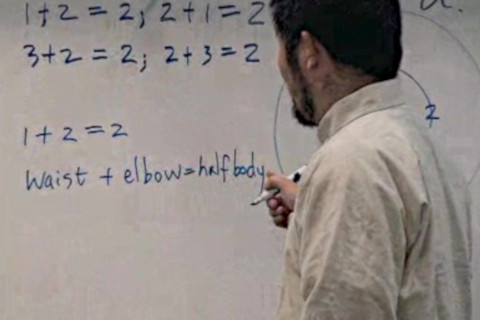 |
Master Chen often uses a concise shorthand to express his “relationship formula,” such as 1 + 2 = 2 . This notation can be confusing because it doesn’t represent numerical addition but rather labels for the energy of distinct objects—specifically Ring 1 and Ring 2. The order of the terms is crucial, signifying a logical, non-commutative relationship rather than a mathematical one. The first term (‘1’) represents the origin of the action, and the second term (‘2’) represents the destination or designation of the action. |
The action described can be interpreted in several equivalent ways:
|
The overall unified behavior resulting from this relationship is termed Type 2 Energy with is denoted by the ‘2’ on the right hand side of the formula. This is because the resultant energy is understood to be composed of two combined components.
Detailed Example. Relationship 1 : 1 + 2 = 2
The formula 1 + 2 = 2 concisely expresses that the energy of Ring 1 (core) combined with the energy of Ring 2 (Joint) results in a stronger combined Type 2 energy.
Physical Application:
|
|
In both the upper and lower body examples, the combination of the two rings creates a strong, unified motion, defined as Type 2 Energy. This concept is the basis for Relationship 1, which fundamentally defines the body’s structural integrity and kinetic efficiency.
Therefore, Relationship 1 can also be expressed as the formula:
“Waist + Elbow = Half the body”
This formula emphasizes that the coupled action of the Waist (as part of the Core/Ring 1) and the Elbow (Ring 2) represents a core mechanical half-division of the entire operational body structure.
Three Harmonies (三合) Further Integrations
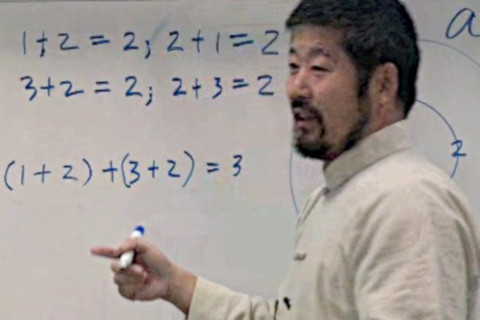 |
The four relationships describe a single interaction between a pair of adjacent rings, creating Type 2 Energies. However, a new, more profound relationship emerges when two such interactions occur simultaneously between two pairs of adjacent rings. Master Chen explains this through the concise formula: (1+2) + (3+2) = 3.
This formula signifies that two component Type 2 Energies combine to create a single, integrated force: Type 3 Energy. |
| Achieving this level of power demands the perfect, simultaneous coordination of all three rings (R1, R2, and R3). This complete engagement creates a synergy—a whole greater than the sum of its parts—to generate the system’s maximum potential force derived from integrated movement. This synthesis is represented by the formula 2 + 2 = 3 (4): the combination of two strong Type 2 partial energies yields the singular Three Harmonies (三合, Sān Hé) Type 3 Energy. The bracketed term ‘(4)’ signifies that this resulting Type 3 energy is itself composed of four distinct constituent energies, reflecting the complexity of its integrated state. |
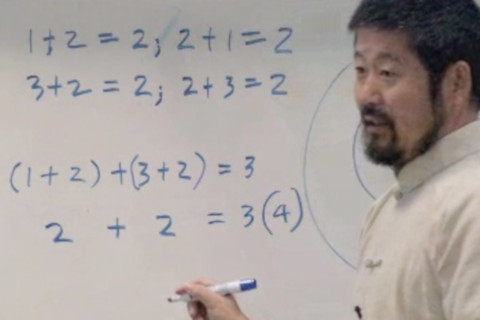 |
Another interpretation of this Relationship is to express the formula in terms of structural components:
“Waist + Elbow + Hand = Connects Inside and Outside”
Since the order and direction of each pair interaction can vary, there are four possible combinations of Type 2 Energies, which in turn create four different Type 3 Energies.
| Sequence | Formula | Description |
|---|---|---|
| Relationship 5 | (1 + 2) + (3 + 2) = 3 | Relationship 1 + Relationship 2 = Type 3 Energy |
| Relationship 6 | (3 + 2) + (1 + 2) = 3 | Relationship 2 + Relationship 1 = Type 3 Energy |
| Relationship 7 | (2 + 1) + (2 + 3) = 3 | Relationship 3 + Relationship 4 = Type 3 Energy |
| Relationship 8 | (2 + 3) + (2 + 1) = 3 | Relationship 4 + Relationship 3 = Type 3 Energy |
| Relationship 9 | 1 x 2 x 3 = 9 | Maximum Potential |
The final and ultimate relationship occurs when there is a perfect integration of all possible actions and energies, unlocking the system’s maximum potential. When the three rings are perfectly coordinated, their energies don’t just add up; they multiply:
Ring 1 × Ring 2 × Ring 3 ≈ Maximum Potential
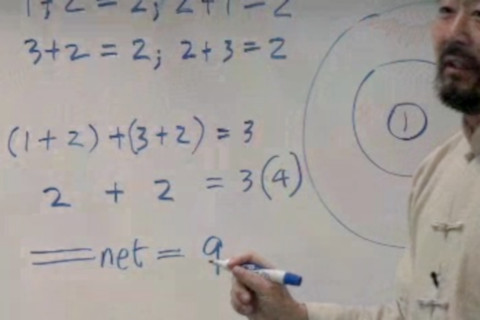 |
The highest potential combination achieved is represented by the value of Nine (九, Jiǔ). This number Nine symbolizes the total number of layers, directions, and possibilities that can be combined, demonstrating a power output that is theoretically nine times greater than the physical input due to perfect structural integration. |
The Forbidden Relationship
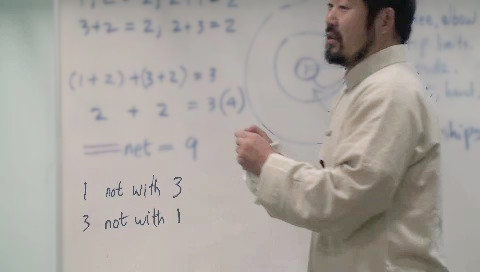 |
To ensure structural stability and the generation of effective force, there is one fundamental pairing that is structurally impossible and must be strictly avoided:
which is translated as Ring 1 (The Fixed Core) can never work (↮ ‘is not connected’ ) directly with Ring 3 (The Movable Extremities). |
As Master Chen remind his students.”I’ve explained all the combinations [functional relationships of the Three Rings] but there’s only one [pair combination that is the] exception. One can never work with Three. You can reverse this and say that Three can never work with One . So in this [pair] combination [of the Three Rings] here, there are so many things you can do but there are only two things of the same type you cannot do.”
This is known as the Forbidden Relationship because a direct link between the static core and the fingertips is physically impossible and structurally unsound. It is physically impossible because without the intervening Ring 2 joint (like the elbow), there is no necessary anatomical hinge point to transfer the linear force from the core into a directed, leveraged motion at the extremity. To successfully generate force, the power originating in the Fixed Core (Ring 1) must always be transferred through the lever arm provided by Ring 2 (The Intermediary Joints, like the elbow or forearm). Attempting a direct transfer bypasses these essential joints, resulting in a weak, disconnected, and compromised structure—like trying to push a heavy object effectively using only your static torso and fingertips. This single exception simplifies the entire system and confirms that Ring 2 is indispensable, serving as the mandatory bridge and ensuring that every effective technique relies on its coordination to connect the Core and the Extremity.