|
The practice session focuses on applying the Theory of Three Rings through hands-on experimentation. Master Chen emphasized that the Practical Method requires “mutual” practice, which necessitates partners to verbalize their actions and provide constant feedback and guidance between participants. In general, normal, untrained actions fail because they rely on muscular strength, which allows the opponent’s structural “looseness” to dissipate the force, highlighting the necessity of precision, accuracy, and correct aim. |
| Master Chen stressed that a correct Taiji technique must be directed toward a stable point on the opponent’s body (like the Dantian or the line connecting to the rear foot), not just the limb. Success requires the initiator to maintain perfect alignment—a straight, continuous virtual line connecting their rear foot, body, elbow, hand, and the target—while resisting the urge to move or “derail” (a natural reflex) when the opponent’s strength is felt. The goal is not brute strength but achieving a “stuck” state, or “lock,” which is created by leveraging the body’s internal bone structure and maintaining the integrity of all Three Rings relationships, ensuring power is generated by the unified structure and remains on the straight line, a critical distinction from conventional, muscle-based actions. | |
| (This is Part 5 of a five part article based on the Three Rings of Tai Chi filmed in 2010, Edmonton, Canada.) |
|
|
Part 5
|
Part 5
Trying the Technique: Practice and Verbalization
According to Master Hong’s Learning System of Duo (多), after engaging with the Theory of Three Rings through watching, listening, and asking, the next crucial step is to Try — to practice through hands-on experimentation.
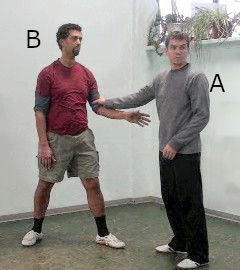 |
Master Chen began this phase by instructing his students, “Okay, try it.” He designated Student A (in grey) as the initiator and Student B (in red) as the opponent. Master Chen told Student A, “Just try different things here.” Student A initiated the practice by using his right hand to grab Student B’s left bicep.
To ensure focused learning, Master Chen mandated slow, verbalized action. He instructed them to “[Perform those actions] very slow so you can verbalize it. When you try it, verbalize it. Tell him what you want to do.” In this instance, Student A had to tell Student B that he was grabbing the bicep and pushing Student B’s arm back, stating, “I want to get [my right hand that is grabbing] stuck.” |
Master Chen then guided Student B to resist the initial push, reminding him to “So fight back.” He encouraged Student A to “Tell him. Fight back.” When Student B stopped the progress of the push, Master Chen sought confirmation from Student A, asking, “So it [the push] is stuck, Right?” Student A confirmed the resistance.
Initial Application and Failure
Master Chen then explained the Tai Chi technique derived from the Three Rings Theory. He instructed Student A, “Then lock it [the hand] and then push this [elbow] onto it [the hand].” This was an attempt to apply the R2 (elbow) to R3 (hand) relationship.
The technique failed because Student B’s shoulder moved in response to Student A’s action. Master Chen explained the error to Student A: “See what you did [with your technique] is [that] you did not know the overall body [of your opponent].” He pointed out Student B’s shoulder, noting, “This, his [shoulder is] too loose in here.” The failure occurred because when Student A executed the technique of connecting the elbow to the hand and moving his body into the elbow, “if he’s too loose [at the shoulder], everything is lost.”
Master Chen used a relatable physical analogy to convey this idea of disconnected action: “It’s like you’re working with him, but you’re not on the table. Everything keeps falling off.”
The Importance of Aim and Communication
Master Chen reset the training with the same grip. He told Student A to correct his initial aim, “So push towards here [your opponent’s Dantian].” Student B resisted the push, and Master Chen encouraged the students, saying, “That’s it.” He asked Student A, “Can you feel this [hand-elbow-body relationship] gradually linking [to the target – the opponent’s Dantian]?”
Crucially, Master Chen reminded both students about communication’s role in “setting the table”: “Talk about it [what you are trying to do and how the action feels.] [Mutual practice requires] you both work together otherwise it’s too difficult at the beginning level [to apply the theories correctly].”
Correcting Aim, Accuracy, and Precision
The exercise continued, focusing on correcting problems caused by aim, accuracy, and precision. Student A pushed his hold into Student B and met the initial resistance. Master Chen instructed, “[Stop. Hold this tension.] Don’t do anything yet. Just lock onto him here [into his body].”
Master Chen corrected Student A’s slightly off aim: “Don’t lock that way [off to the left of the body]. Lock towards his center.” He adjusted Student A’s arm so the hand, elbow, and the target were properly aligned.
Once this alignment was achieved, Master Chen outlined the steps for success:
|
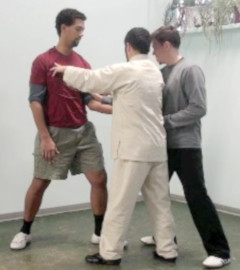 |
This final step was the successful application of the Three Rings relationship (R2 to R3).
The technique briefly worked but then failed again. Master Chen explained the failure: “That [technique] does not push [in a] straight [line].” He asked Student A, “Can you see you moved? Because it [your connection and push] is not straight [into the target].”
He referred back to a previous theoretical discussion concerning the theory of “The Suspended Head,” explaining, “Same as that stick I showed you. If you push onto the stick on the floor, there is no movement because it’s straight. Nothing leaked out.” Relating this back to the error, he noted that when Student A pushed, “something happened [to your body – you moved sideways]. It [movement] means you are not on [the line]. Do you understand?”
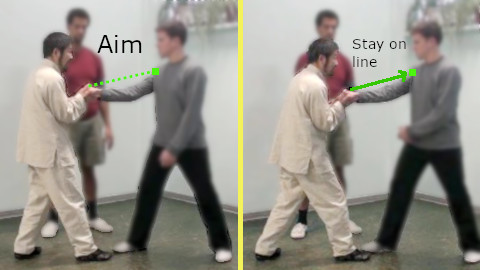 |
To emphasize the importance of staying “on the line,” Master Chen held Student A’s hand and demonstrated how to create this line. He aimed his grip toward Student A’s shoulder. By making a slight adjustment to the grip’s position, Master Chen created a direct line, allowing him to push into it with power. Student A confirmed the technique’s effectiveness. Master Chen concluded by instructing his student to “Look for this spot,” which is the initial target, and then connect everything toward it in a straight line. |
The Core-to-Elbow Connection and Body Alignment
Student A sought clarification, noting that his technique felt ineffective because most of the power seemed to reside in his front shoulder.
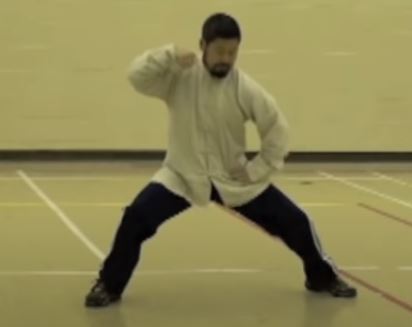
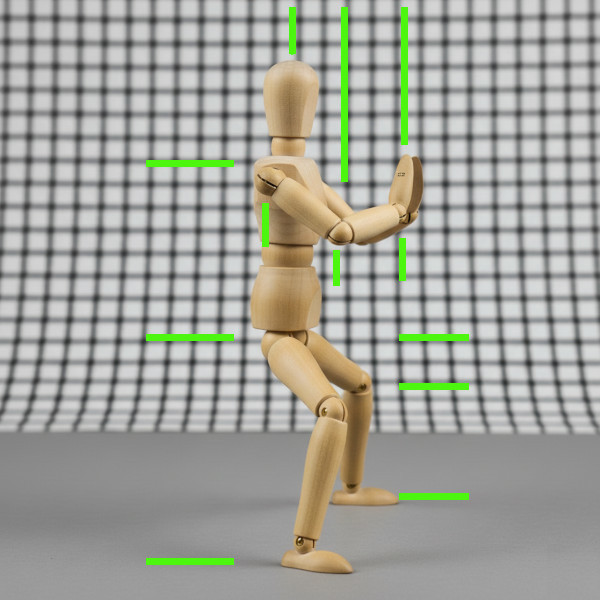
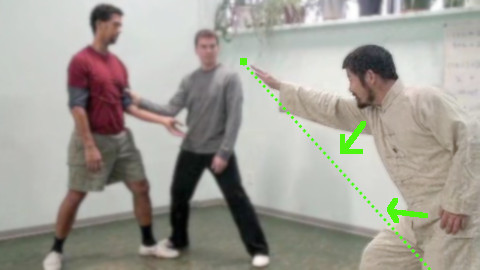
| Master Chen demonstrated the correction by exaggerating the external appearance of putting all his body parts onto a line that included the initial target, the hand, and the rear foot. He observed, “Overall, see, look. When you [complete the] link, it has to be like this [where all body parts falls into the established line].” In Master Chen’s structure, a virtual line was visible, linking the target, hand, and rear foot, with the elbow and shoulder dropping toward the line, and the kua (hip/groin) opening and moving toward the line. This alignment focuses the body’s power onto the line without any visible external movement. |
 |
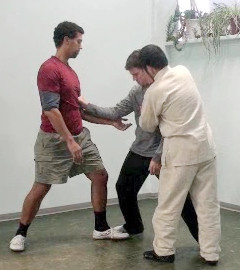 |
Master Chen then corrected Student A based on this explanation. After establishing the initial relationship of the elbow (R2) to the hand (R3), he told Student A to “Lock here [the Body R1] and open here [front shoulder]. That’s the first [action].” This action effectively established the relationship between R1 (core) to R2 (elbow). As soon as Student A executed this, Student B felt more power and moved his shoulder backward, dissipating Student A’s action.
Master Chen caught this error, telling Student A, “Your hand moved.” Losing control allowed Student B to escape the technique, demonstrating another error related to aim, accuracy, and precision. |
The initial target must be a point the opponent cannot easily move away from. In this example, Student A aimed toward the right shoulder, a target Student B could easily move off the line, negating the power. Master Chen corrected this by changing the target to the opponent’s body, which cannot be easily adjusted. The error in precision and accuracy occurred when Student A, feeling initial success, lost focus and followed Student B’s counter-movement.
The correction is to ignore the opponent’s action. The success of a technique should not depend on the opponent’s reaction but on the student’s own understanding and flawless execution of Tai Chi principles.
Finding the Opponent’s Power Source
Student A, still struggling, asked, “But I feel all his resistance here [at my grip on his bicep]. Like I’m pushing [him but he is not reacting].”
| Master Chen pointed out the cause of the resistance: “He’s resisting here [at the bicep and shoulder and then move his elbow back and rotating towards the left to dissipate your push]. You have to [generate power that] move towards his rear foot. So that is [where he is] the strongest.” With this, Master Chen hinted that the opponent’s body structure and energy can also be understood in terms of alignment. To control the opponent, one must be aware of their opponent’s body alignment and the source of their power. The opponent felt strong at the shoulder because it was connected to their rear foot. The Tai Chi strategy is to find this structural connection and control that line. |
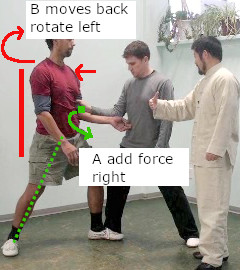 |
Student A tried again and noted Student B’s reaction as using his body structure. Student A found he couldn’t maintain his own line and asked, “Can I move my body [in order to maintain my alignment and keep my connection to his rear foot]?”
Master Chen explained, “[Yes.] At the beginning, do that because now [you don’t have the experience or techniques to fully control your opponent].” He added that for the technique to be effective, “You have to control him. So [when] he turned that way [towards left]. You have to control him this way [by using your grip to guide him towards the right].”
Structure vs. Strength
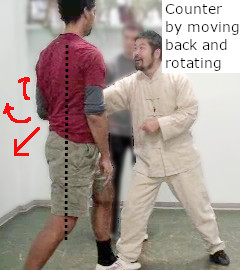 |
Master Chen began the demonstration by grabbing Student B’s left bicep with his right hand, establishing the starting position for their mutual practice. He first reproduced the common, muscle-based student reaction.
“I’ll show you what it feels like,” he said, pushing forward with his right hand. Student B naturally dissolved this forward movement by pulling his left elbow back and rotating his torso. Master Chen confirmed this typical reaction: “You did this [move your elbow back].” |
Establishing the Line: A Subtle Technique
Master Chen then demonstrated the correct Tai Chi technique, revealing a subtle detail that prevents the student’s normal counter-reaction.
|
“But when I push [you did not pull your elbow back or rotate your body], [as a result,] can you see how long [is the line that connects my grab and your rear foot]?” he asked.
He then pointed to his right thumb. “Can you see I use [my right thumb] here [when I was grabbing you]?” This thumb-force acts as an additional vector, subtly leading the student’s withdrawal towards their rear foot instead of allowing the rotation and withdrawal towards the left side. |
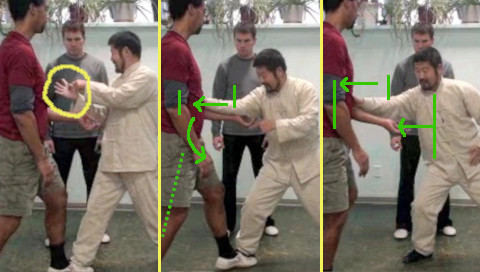 |
Master Chen continued, explaining the procedure: “[Because I prevented his counter towards the left,] I push onto the rear foot. And then because of that [I am able to push onto the rear foot, the push eventually get] stuck.” Getting “stuck” means the force is fully routed and neutralized by the student’s structure.
“Only when I am stuck then I can do this,” he explained, referring to applying the Three Rings Theory to increase power. “I drive my elbow (R2) into the hand (R3). I make use of the R2 (elbow) to R1 (core) relationships.”
“And then I can do this [open my rear kua and connect to my rear leg]. Can you see [through all those actions, I have maintain the line and that] everything goes through the hand? That’s the procedure. It’s fairly difficult because you can’t change direction [Everything must stay on line and on target]. Do you understand?”
Reviewing the Lock
Master Chen reviewed the scenario with Student A, using the same grip. As he pushed forward, he emphasized the initial contact point: “The power is here [on the bicep and the front left shoulder]. That’s why it [your opponent by moving the elbow back and pivoting left, so the grip, it] went that way [behind the body].”
He then explained the Tai Chi strategy, which uses the opponent’s body as a structure: “So I use this as a structure.” Without visible change, he increased grip pressure and focused his intention towards Student A’s rear leg. “The power is here [on the elbow but aim] towards here [the rear leg]. Can you feel that [it is different from the initial push]?”
Once stability is achieved, the structure is utilized: “[Once I feel that the] Power is here [on my grip and I cannot move my hand anymore]. [Once I achieved this stability,] Then [I follow the procedure established by the Three Rings Theory. I can push R2 to R3, separate R2 from R1] I can open [my body and my kua].”
He concluded, “Can you see gradually [my whole body is on a line]? [As a result,] You can’t get away, right? That is the ability to lock.” Master Chen sighed, noting the difficulty of the concept.
The Misunderstanding of “Pushing”
Student A voiced a common confusion: “I understand that. But it was just like I was pushing right directly into his foot, which was totally stable.” Master Chen replied, “That’s good.”
The student countered, “It’s good for him. Not for me.”
Master Chen quickly corrected him: “No. No. No. If it’s good for him, it’s good for you. I just explained that.”
Still confused, Student A asked, “Yeah. I see that. But I don’t see how I would push him over.” Master Chen’s response, “Pardon me? Remember it’s a chicken? Yeah. Game of chicken,” highlighted that the student was still focused on brute strength. The opponent moved because the proper relationships outlined by the Three Rings Theory were established—if the question is “How to Push,” the answer lies outside Tai Chi technique.
Establishing the Rings
To clarify, Master Chen had Student A and Student B continue the practice. When Student A pushed, Master Chen immediately noticed the deviation: “Yeah. You see you’ve moved already.” Student B countered easily.
Master Chen corrected Student A’s target: “Don’t move that way.” Instead of aiming at the elbow, Master Chen adjusted the grip to aim towards Student B’s right side. “Okay. Push this way. Yeah. Use here [the grip of your thumb and fingers]. Push this way [towards the right side through the dantian, towards the rear leg].”
After Student A felt strong resistance, Master Chen reminded him, “If he is strong, then it is good for you.” Master Chen then guided Student A through the precise structural adjustments required by the Three Rings Theory, instructing both students to hold the position and maintain tension.
|
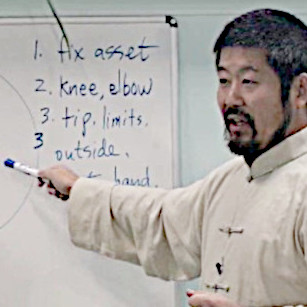 |
With each action, he reminded Student A: “Now don’t pop,” meaning do not move the body part out of line.
Overcoming the Reflex: Staying on the Line
Master Chen emphasized the core principle: “It doesn’t matter how strong he [your opponent] is. It [This Tai Chi technique] will work. As long as you don’t move [deviate from the target or move away from the line]. The problem is whenever you feel he’s strong, you want to move.”
This urge to move is a natural protective mechanism: autogenic inhibition (the Golgi Tendon Reflex). This is an evolutionary adaptation where the body rapidly reduces muscle tension when sensing excessive force to prevent injury.
“Because your opponent is strong, your body is also strong. The push has to derail,” Master Chen stated. This derailment is the body’s subconscious reaction to excessive load by shifting the point of contact.
He demonstrated this derailment: “Can you see energy goes up?” and then away from the contact point.
Master Chen contrasted this with the Tai Chi goal: “So I have to get stuck. If it [the contact point] is stuck and I push, it [the energy] has to go down. Then I continue to [lead the energy to] go down [by changing my structure]. [I] Continue [to change my structure] until it [energy] went to the bottom [the ground].”
This is achieved through triangulation: “[This means the opponent’s applied force (or energy) must be balanced by the internal energy absorbed by your structure, which must approach but not exceed the maximum energy capacity of the ground/foundation.]”
The Structural Advantage
There is a distinct physical explanation for the effectiveness of Tai Chi movements.
In normal interactions, engagement relies heavily on muscles and strength. This reliance causes the point of contact to constantly change—either because the muscles are overwhelmed and forced to relax (autogenic inhibition), or because one side is actively seeking better leverage.
In contrast, the effectiveness of Tai Chi is dependent on the internal structure—the alignment of bones and the connection of ligaments—rather than brute muscular force. It’s important to recognize that the human skeleton is incredibly strong and highly optimized to transmit and withstand significant compressive and tensile forces when properly aligned. Since structural integrity requires anchors for stability to resist movement, the initial goal is to establish the first anchor at the point of contact. The second, and most common, anchor is the feet secured to the ground. Precision, accuracy, and aim all relate to optimizing this structure. Your opponent is not fighting your muscles but your bones.
Within this structural context, the Three Rings of Tai Chi are not merely stylistic forms but are key principles used to optimize and reinforce this internal, anchored bone structure.
Maintaining the Connection
A student asked about the required body adjustments: “But what you showed me [the action I need to perform on my body. For example,] split here, split here, split here. Then I could get it [the desired reaction from my opponent]. But [with all those body actions] then it [the energy] is not from here [the original action at the elbow] anymore?”
Master Chen quickly refuted this: “No, it [the energy] gradually [increase with each adjustment of the body] so that it’s never lost.” He demonstrated, “Can you see? It [body alignment] is still one piece.” Pointing to the elbow, he affirmed, “It [energy] is still from here [elbow].”
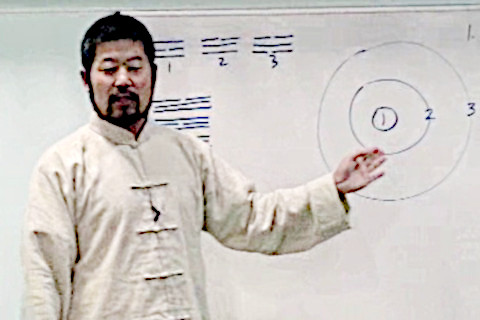 |
He reminded his student that the conventional perspective is flawed: “Because your body, when you move, it’s all lost.” The student’s question was rooted in understanding movement where force is produced from a single point of origin with your muscles; Master Chen answered from the perspective of body structure, where power is generated by the entire structure, ensuring every part contributes to the power at the contact point.
Master Chen concluded the seminar with a final thought: “Everybody knows how to move. Nobody wants to lock ….” |
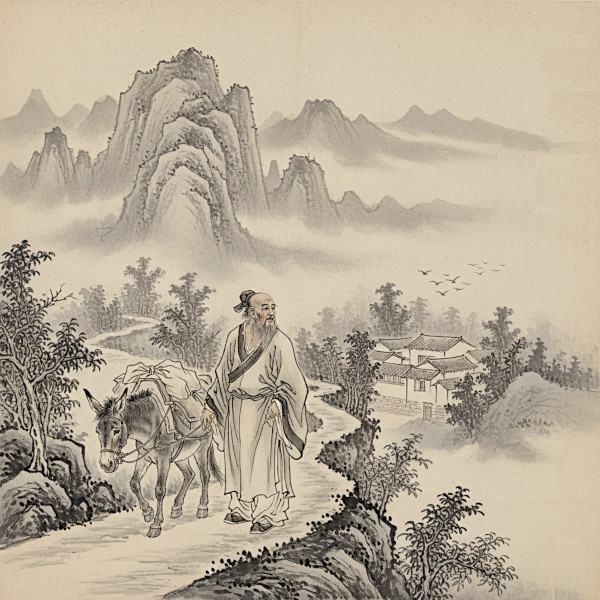
千里始一步 归心在初庭
|
|
First Nothingness to Yin-Yang to Trigrams
The profound wonder and mystery of the universe are that complexity can be governed by simplicity. Alternatively, one might observe that immense structure emerges from simple rules. The root of this idea was stated simply and succinctly thousands of years ago in Chapter 42 of the Tao Te Ching (道德經):
| 道生一, | Dào shēng yī, | The Tao gives birth to the One. |
| 一生二, | yī shēng èr, | The One gives birth to the Two. |
| 二生三, | èr shēng sān, | The Two gives birth to the Three. |
| 三生万物。 | sān shēng wànwù. | The Three gives birth to the ten thousand things. |
| 万物负阴而抱阳, | Wànwù fù yīn ér bào yáng, | All things are rooted in Yin and faced by Yang, |
| 冲气以为和。 | chōng qì yǐ wéi hé. | And through the blending of their vital energy, they achieve harmony. |
Stripped of historical discourse, philosophical debates, and cosmological interpretation, these passages describe a mathematical system built on two fundamental concepts: a binary system (Yin-Yang, 阴阳) and a ternary system (Yin-Yang Harmonious Qi, 阴阳 和气). From this perspective, the Book of Changes (易經, Yì Jīng) represents a practical operation manual for these two systems. The binary unit is the yáo (爻)—a horizontal line where Yin is broken (⚋) and Yang is solid (⚊). The ternary and higher systems are built by stacking these lines. Specifically, three yáo are stacked to form the Bā Guà (八卦, Eight Trigrams) . Since each line has two possible states, this construction logically yields 2^3=8 trigrams: Qian (☰), Dui (☱), Li (☲), Zhen (☳), Xun (☴), Kan (☵), Gen (☶), and Kun (☷). The fundamental unit of the Yì Jīng application is the hexagram, a figure composed of six stacked yáo, which represents 2^6 = 64 possible states. Thus, the Yì Jīng is a complete, logical system for mapping and classifying all natural states using simple binary code.
Taijiquan is the physical manifestation of this idea; the Three Rings of Tai Chi (太極三環) is its representative application. This theory demands practical usage to demonstrate its profound insight—moving from abstraction (抽象 chōuxiàng) to tangible usefulness (实用 shíyòng) is the heritage of Master Hong’s Practical Method. The path to Taiji understanding is clear, but the destination is not the final step; it is the constant return to that first, foundational home.
Master Hong’s Contribution
In Master Hong’s seminal work, Chen Style Taijiquan Practical Method (《陈式太极拳实用拳法》), the concept of the Three Rings of Tai Chi (太極三環) is central, even if the specific term was not explicitly used. Master Hong employs the idea of circles (圈, quan) to provide a uniquely practical, biomechanical, and martially-oriented explanation of Taijiquan principles.
The Rings as Biomechanical Components
Master Hong explains the rings not merely as shapes, but as functional bodily rotations that create the coiling energy (纏絲勁, chan si jin) unique to Chen Style Taijiquan. He meticulously links these concepts to precise physical actions and their combat applications, summarizing the 3D model into three components:
|
 |
Furthermore, he uses the terminology of the “Three Circles” (三圈: Inner, Middle, Outer) to describe the range, scale, and tactical application of these movements.
Redefining the Six Harmonies
True to his practical style, Master Hong adds crucial insight by elaborating on the importance of the Six Harmonies (六合, Liù Hé) in practice. He addresses the traditional division of the Liù Hé into:
|
 |
Crucially, Master Hong’s view on the Six Harmonies becomes the structural basis for defining the favorable and restricted relationships that would eventually be formalized into the Three Rings Theory.
The Three External Harmonies are the outward, observable expression of that power. The Three Internal Harmonies not as abstract mental states, but as specific, functional relationships between intent, energy, and physical power, grounding the concept directly in bodily action.
| Master Hong teaches that these Internal and External Harmonies interact as a single, seamless system, often described through a powerful metaphor: |
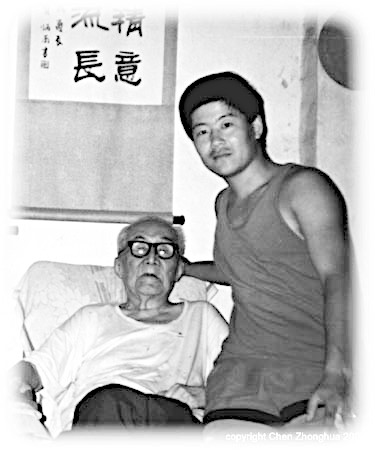 |
|
|
||
When properly integrated, the body functions as a unified power-transmission unit, ensuring that internal intent is perfectly translated into external, physical force.
Master Chen’s Synthesis
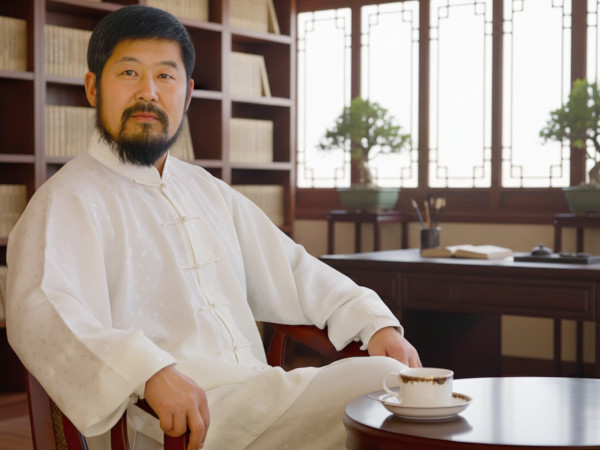 |
Master Chen Zhonghua, a prominent disciple of Master Hong Junsheng, has become a leading global authority on the Practical Method (实用拳法). While he faithfully transmits Master Hong’s core concepts, his explanation of the Three Rings represents a significant evolution. He has taken Master Hong’s practical, mechanical foundation and built upon it a more detailed, geometric, and physics-based architectural model for the body. |
Master Chen’s unique contribution is framing the Three Rings (太極三環) not just as types of movement, but as three fundamental, non-negotiable, and interlocking physical structures that must be maintained at all times to create an unstoppable force.
Refining Structural Geometry
Master Chen built on his teacher’s “Three Circles” (三圈: Inner, Middle, Outer) by re-framing the concept from purely a measure of distance to a principle of structural geometry and mechanical advantage. He intricately links the circles to the Three Rings and the precise mechanics of joints, creating a unified, physical model for their application.
The Inseparable Law of Harmony
Crucially, Master Chen integrated the Internal and External Harmonies into one inseparable, physical law that governs the body’s integrity:
|
Building on Master Hong’s Practicality
Master Hong provided the “what” and “why” of the Three Rings. Remaining faithful to this foundation and building on his teacher’s practicality, Master Chen has masterfully elaborated the “exactly how.” He has created a comprehensive and rigorous biomechanical model that allows a student to diagnose and correct their structure with precision, ensuring that the theoretical principles of his teacher manifest as undeniable physical reality in practice.