|
The foundational principle of Tai Chi’s Structural Integrity is the Principle of Three Rings which requires maintaining a full-body kinetic bridge. This structural framework is brought into practical application through the higher skill of Accuracy (Aiming), epitomized by the concept, “My foot is in my hand,” where the point of contact (R3) is seamlessly integrated with the feet to form a direct spatial vector, anchoring the practitioner to the Earth. |
| The core training method to achieve this is the counter-intuitive principle of “Get Stuck,” where the practitioner intentionally uses precise Aim and Alignment to transform the initial contact point into a fixed, immovable anchor against the opponent’s force. This “stuck” state allows the practitioner to deliberately ignore the natural fear and reflex to yield, instead establishing favorable ring relationships to leverage the body’s internal bone structure. The ultimate objective is not to win with brute strength, but to lock the opponent into the mutual connection, redirecting their force against the immovable mass of the Earth. This superior strategy that transforms the ‘Game of Chicken‘ dynamic of normal fighting into a contest of strategy where mastery lies in the precise, unwavering application of sound theory. | |
| (This is Part 4 of a five part article based on the Three Rings of Tai Chi filmed in 2010, Edmonton, Canada.) |
|
|
Part 4
|
Part 4
Accuracy and Aiming: The Higher Skill
Master Chen began the next section by explaining what effective application is based on: “[Effective] practice is based on another technique, another theory called accuracy. And accuracy is [also] called aiming (对准). If your aiming is off, the power is not there.” He stressed that even if a student correctly understands the Three Rings Theory, “although in your mind you want to do this [establish the correct relationships embedded by the Three Rings Theory], whether you succeed, it has to do with aiming.”
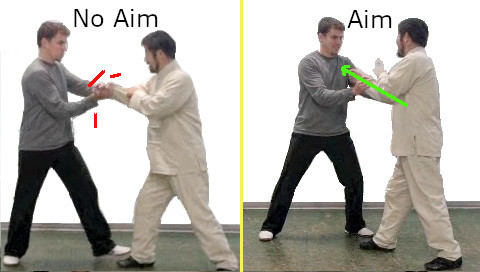 |
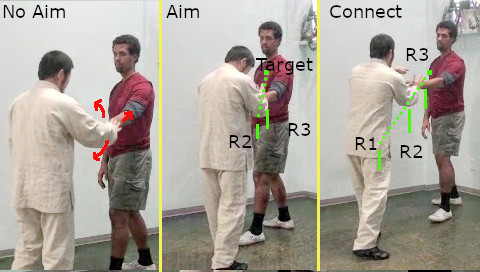
Master Chen demonstrated this idea with a student. “So if you grab me, you see. [Hold me] any way you want to.” The student grabbed Master Chen’s leading arm with both hands. Master Chen explained why the initial resistance felt weak: “Can you see [initially I am not] aiming? There isn’t a line [or a target to establish a line].” In this demonstration, Master Chen’s leading hand did not point to a target and just resisted the grab normally. |
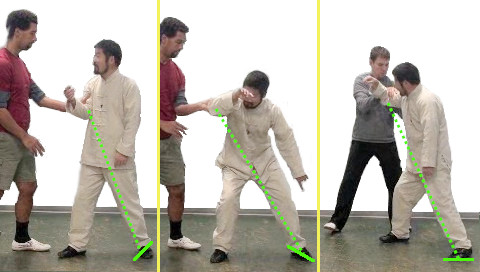
Master Chen then shifted his focus, demonstrating a classic Tai Chi concept. He would establish a target on the student’s body, aim at it with his hand, and simultaneously use his foot and elbow to create a virtual line of force. He explained this ancient principle by asking, ‘Can you feel my foot is in my hand?’ This technique, often called ‘my foot is in my hand,’ defines a spatial vector anchored by two main reference points: the hand, which dictates the direction of aim, and the position of the feet, which serves as the point of origin. The goal of Tai Chi training is to automatically reinforce and maintain this integral line in response to an opponent’s movements.
Master Chen demonstrated the flexibility of this technique by changing the anchor point without altering the external appearance of his body structure. He changed the anchor point from the foot to the elbow, explaining: “So now, my elbow is in my hand. Can you feel that?”
He then switched the relationship again to show the precision required for accuracy: Master Chen demonstrates that the Ring relationships can change even though there is no visual change in the external structure. In the first example, after the student’s grab, Master Chen aim his hand towards the student then establish a relationship between the elbow (R2) to the hand (R3). Asking his student for his feedback noting.”[After establishing R2 to R3.] It [elbow R2] is in my hand [R3].” He encourage his student. “So now, [continue to] push. Feel that? Now, I change [the relationship]. Can you feel my hand [R3] is in my elbow [R2]? Oh, yeah. When you push, it [the hand] came here [into the elbow].” He noted that these specific, relationship-based movements are harder to achieve: “And these are a little bit more accurate because it’s precision-based, they are more intricate to get. It’s a higher level skill. In terms of theory, It’s no higher or lower. It’s just some things are more difficult to manipulate.”
| Master Chen concluded by demonstrating the principle of accuracy across different directions and actions: “So if you touch me any way you want to, you see, everywhere you touch, okay, here, I make sure that you are touching my foot. So here, can you feel it’s my foot? And if you change direction, can you see it is [still] my foot? It’s always on my foot. Can you feel the foot? Yeah. So you change direction, you see. It’s still on my foot. Can you see? So when you change, I change with you, but it’s still here, always on my foot.” |
 |
The Concept of “My Foot is in My Hand”
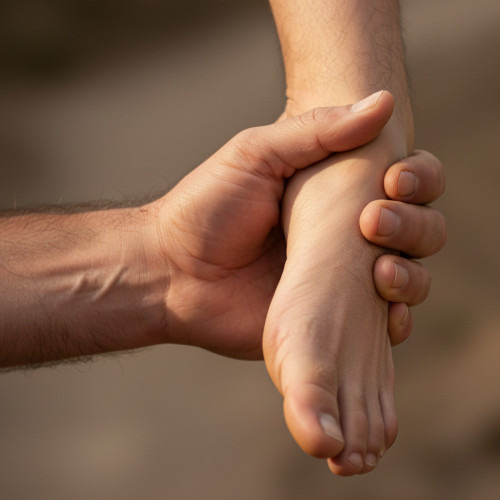 |
The ancient concept of “My foot is in my hand” (我的脚在我的手里, Wǒ de jiǎo zài wǒ de shǒu lǐ), a well-known and vivid concept in Chinese internal martial arts, especially in Tai Chi. This idea is all about whole-body connectivity and power generation. Master Hong, in his seminal work 《陈式太极拳实用拳法》 (Chen Style Taijiquan Practical Method), provides the foundational mechanical description: |
| “When one part moves, nothing remains unmoved; when one part is still, nothing remains unmoving. The waist is the commander, the hand is the vanguard, and the foot is the root.”
(“一动无有不动;一静无有不静。而腰为主宰,手为先锋,脚为根.”) |
 |
This quote establishes the non-negotiable mechanical relationship where the action of the hand is an expression of the power rooted in the feet, unified and directed by the waist. This is what creates the sensory illusion and practical reality for your opponent that “the foot is in the hand.”
Grounding and The Power of Earth
Master Chen explains that the core concept in their practice is linking any point of contact [such as the hand] directly to the foot, thereby grounding the energy and connecting it to the floor. He emphasizes that the floor is a fixed asset of Earth, and establishing a secure connection essentially gives the practitioner the boundless power of the Earth itself, making the effective size of the practitioner equal to the planet’s scale.
Master Chen provides a practical explanation of this pivotal idea: “So ultimately, we want to go from any entry point [such as the hand] directly to a foot. Why? [The reason is that the] foot is on the floor.”
Master Chen then asks rhetorically, “What’s the floor?” to emphasize the critical importance of this idea. He continues, explaining: “The floor is part of the fixed asset of Earth. Whenever you have a [secure connection to the] floor, it’s considered a part of Earth because it’s nailed down onto the ground. And when it [the initial entry point] has a direct link to the ground, its effective size is exactly the same as Earth.”
Redirection and The “Unwinnable Fight”
 |
“If you truly possess the ability to redirect an opponent’s force into the ground, you wield power without limitation. This principle stems from the massive scale difference between the human body and the Earth upon which we pivot. This is precisely why, through repeated practice guided by the correct theory, Tai Chi can generate power that appears supernatural.”
“The fundamental objective of these techniques is to skillfully deceive the opponent, manipulating their own momentum and force to engage directly against the immovable stability of the Earth itself. |
|
This confrontation is unwinnable: the magnitude of your personal physical strength or the specific technique you employ is irrelevant because the opponent is not fighting you. ”
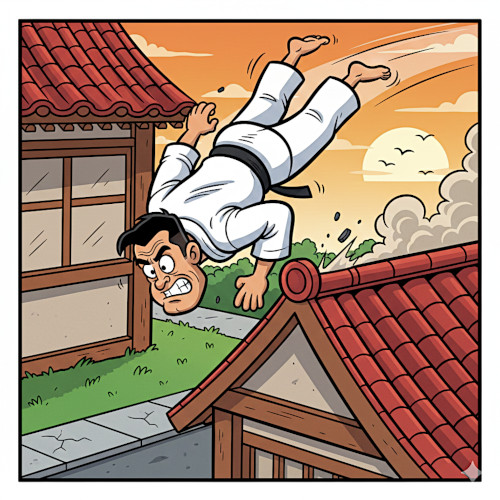
“Consider the extreme case: any forceful impact with the Earth, such as a fall from a great height or striking the surface with maximum force, results in catastrophic structural failure and death. [The human body alone cannot withstand the kinetic force of confrontation with the Earth’s mass without the aid of machinery or specialized tools.] The theory is fundamentally simple.” |
 |
Get Stuck
The Aim and Ring Relationships Drill
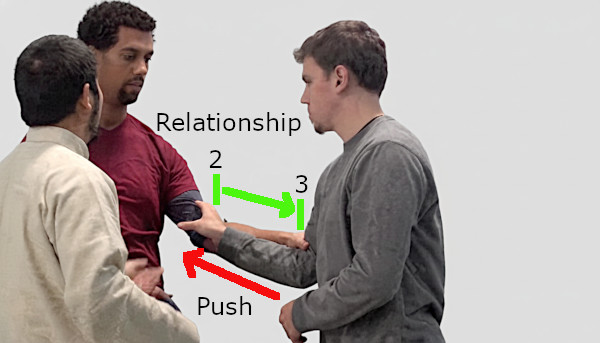
Master Chen directs his students in a specific drill focusing on establishing aim and exploring the various Ring relationships.
Setup
 |
|
The Application and Connection
Master Chen initiates the drill by instructing Student B to apply force: “Now push.” Student B pushes into Student A’s bicep as instructed. Master Chen tells Student B to continue pushing until Student A can clearly feel the pressure. Once Student A registers the push, Master Chen instructs Student B to “Stop.” pushing but to maintain the pressure.
Master Chen then instructs Student A on the internal connection required: “So when you feel he [Student B] is strong, use it [your elbow] as a fixed spot, then aim here [towards your hand. This establishes the R2 to R3 relationship. Student A with the correct aim has put the elbow] onto it [the hand].”
Feedback and Conclusion
After Student A successfully establishes the internal connection (aiming the elbow into the hand), Master Chen solicits feedback from the opponent, Student B, to verify the effect of the technique:
“Feel. Yeah. You feel that? Can you feel his elbow is here [on his hand]?”
This is a simple yet pivotal exercise designed to practice the idea of aim and the Ring relationships. Because the forearms are placed parallel and touching, the aim is easily established, which then allows the physical consequence of the Ring relationships to be fully explored.
Master Chen concludes with a cautionary note on the difficulty of the technique: “So you have to move until your hand is stuck. This is a technique that’s very difficult to do. Most people like the flexibility.” Master Chen is implying that most people prefer to yield or use muscular flexibility rather than establishing the fixed, immovable structure achieved by the correct aiming.
The Illusion of Flexibility vs. The Power of “Stuck”
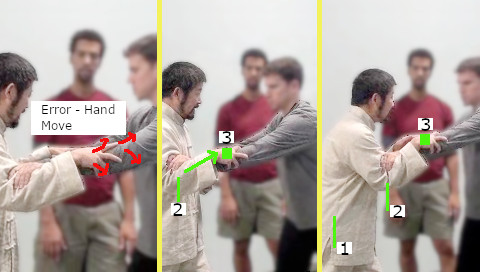 |
Master Chen delved deeper into the concept of flexibility with a demonstration. He had his student grab his biceps with both hands, while he, in return, grabbed the student’s forearm. He noted the natural human tendency during contact: “When you touch me [and grab my arm], I like to be able to move [my hands].” Master Chen demonstrated this by rotating and repositioning his hand around the student’s forearm, displaying the tendency to readjust the grip to seek a positional advantage. |
He then immediately indicated that those normal movements are not effective. Master Chen explained that the correct Tai Chi technique is counterintuitive:”But it [the Tai Chi technique] is actually [to use the hand as a stationary anchor].”
Master Chen demonstrated that the key to the effective movement is that the hand does not move. He clarified, “See like I’m stuck [My hand does not move].” The utility of this “stuck” position is that it allows the body’s internal structure to connect: “If I’m stuck, another part [such as the elbow] can come to it [the hand].” He summarized the principle: “If I’m not stuck, it’s like if you don’t nail it [the contact point] down, you can’t use it yet. Because if it [the contact point] is still a moving part, it’s not usable.”
Aiming to Get Stuck
 |
Master Chen provided a further demonstration using a lighter touch. In one case, he slapped a student’s forearm, noting, “If I just touch you like this [slap your forearm], can you see it’s useless, right?” He then compared this to the correct Tai Chi technique: “But I use this touch [on his forearm], aim it [the contact point] here [into his dantian] so that I get stuck.” |
This technique makes use of the opponent’s natural defensive response. By aiming the open hand towards the opponent’s center, the opponent naturally blocks the progress of the hand. By maintaining the aim, this block creates the essential “stuck” position.
Master Chen explained the resulting connection: “Can you see I got stuck [this lead hand cannot move towards the Dantian because of the opponent’s block]? Even in this position [when I am just touching the opponent’s forearm with the blade of my hand] without anything [such as a grab or a special technique], I still get stuck. Once I’m stuck, I can join here [the elbow to the hand].”
The Ring Relationship and The Game of Chicken
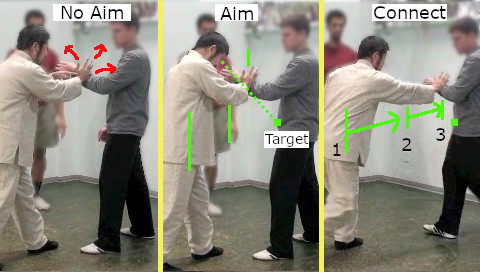 |
Performing the same demonstration with another student, Master Chen touched the blade of his hand onto the student’s forearm. He asked at the initial stage, “Can you feel? You feel this [hand] here [on your forearm]. Can you feel we’re totally loose, right?” After the student confirmed the loose contact, Master Chen proceeded to execute the correct Tai Chi action: “But if I [use my hand to] aim at your strong points. [You naturally tense up and prevent my hand from proceeding further. As a result,] can you see I got stuck?” |
The student confirmed that once the hand is stuck, the internal connection forms: “This energy [from the elbow] can come here [into my hand. Illustrating the Ring relationship of R2 to R3].” The student moved back due to the sudden force. Master Chen summarized the principle: “[When the contact point does not move and the aim does not deviate,] I can get you.”
Master Chen summarized why this skill is so difficult to acquire: “And this little bit of thing that I just showed you will take years to get. Why? Because your mind will not [like to] get stuck. You don’t want to get stuck. You want to be able to do this [Move the contact point to gain an advantage]. You want to be able to get away because you’re scared of your opponent fighting you because [when] you’re stuck. His energy comes in. [The normal reaction is to escape from this energy.]”
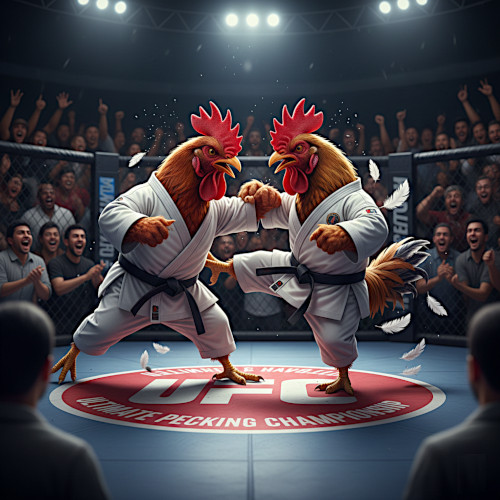
The lesson always returns to the concept of mutual connection and risk: “In the end, that’s why I said again and again, in the end, everything comes down to, in terms of the real fighting, a Game of Chicken. Why? Because that’s the law of physics. It means if I got you, what does it mean? It means you got me.”
The Principle of Mutual Connection
The core idea is that connection is always a two-way street, similar to basic physics or electricity.
You can’t say, “I turn it on, the light is on, but no electricity came.” The light is on because electricity came, and the same logic applies when two people connect physically. “So if I got you, it means I’m connected to you,” Master Chen explains. “If I’m connected to you, you are connected to me because you cannot say I connect myself to you, but you didn’t connect to me. How would that work?” He uses a concrete example: “You can’t say I touched the wall, therefore the wall didn’t touch me. There is no logic like that. If you touched it solid, the wall touched you solidly.”
In the end, this physical equation is always fair and equal; the force, or the connection, is the same on both sides.
The Game of Chicken and its Advantage
|
Master Chen continues: The physical connection itself is always equal, which means the true advantage must be forged in the mind or through superior strategy. This dynamic is often compared to a ‘Game of Chicken‘. While the connection is always fair, the secret lies in your own clarity: “if you’re the one doing it, you know what to do.” The goal, naturally, is that your opponent does not possess that clarity, and as a result, “He will make the wrong move.”
Master Chen clarifies this further: when it comes down to it, the reason for winning isn’t mysterious. In that crucial moment of connection, you both stand on even ground. Your opponent believes his approach gives him the edge and misreads yours. |
 |
But here’s the ultimate truth: victory belongs to the one whose conviction is backed by deep, correct theory. What he perceives as an advantage, and how you feel in the heat of the moment — none of that matters if your underlying principle is sound.
Ultimately, this is why the application “becomes very easy because you just wait for your opponent to fight you.” You are simply using the principle of mutual connection against them. The key takeaway is simple: “If he got you, you got him.”